Introduction
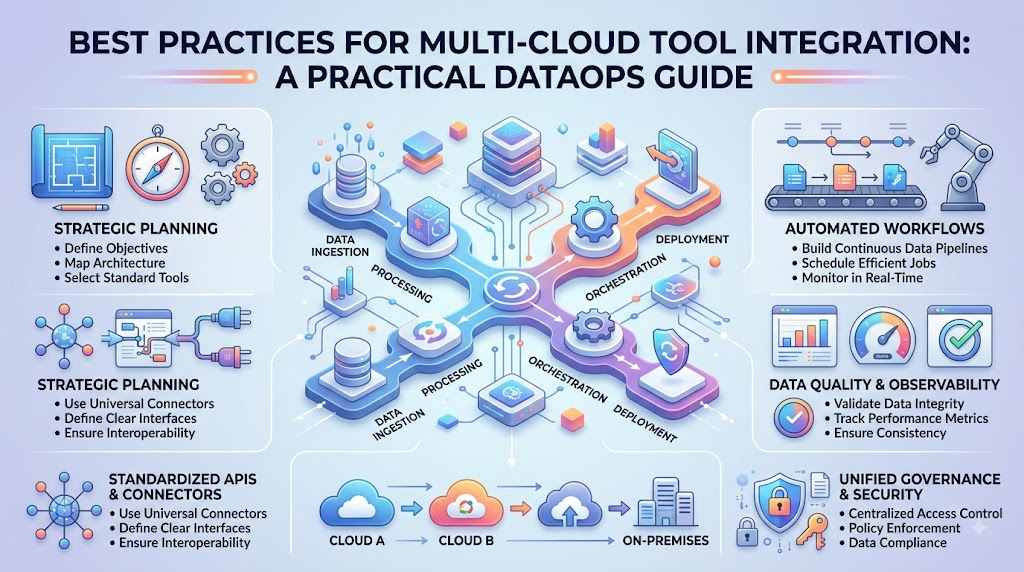
Modern organizations rarely rely on a single cloud provider. As enterprise data architectures evolve, teams frequently operate across combinations of Amazon Web Services (AWS), Microsoft Azure, Google Cloud Platform (GCP), and specialized software-as-a-service platforms. Managing this distributed environment requires structured multi-cloud tool integration governed by DataOps principles. By implementing automation, continuous validation, centralized observability, unified governance, and collaborative workflows, teams can turn fragmented cloud services into a reliable, enterprise-wide data delivery engine. For an in-depth foundation on operationalizing data delivery across modern environments, explore the core concepts at TheDataOps.org.
What Is Multi-Cloud Tool Integration?
Multi-cloud tool integration is the practice of connecting distinct data technologies, ingestion engines, transformation layers, and governance systems across two or more cloud providers so that data workflows operate as a cohesive system.
Multi-Cloud Environment
 └─► Multiple Cloud Providers
      └─► Multiple Data Services
           └─► Integrated Data Workflows
In a typical enterprise ecosystem, integration spans several distinct operational layers:
- Data Ingestion & Streaming: Moving batch datasets and real-time events across different cloud landing zones.
- Processing & Transformation (ETL/ELT): Running compute jobs that transform raw objects into structured data assets regardless of where storage sits.
- Storage Systems: Connecting object stores, distributed databases, cloud data warehouses, and modern lakehouses.
- Orchestration & Workflow Automation: Scheduling and triggering cross-cloud pipeline stages based on data readiness.
- Data Quality & Observability: Validating schema health, verifying freshness, and tracking pipeline execution status across environments.
- Data Governance & Catalogs: Enforcing unified access control policies, maintaining business glossaries, and tracking lineage across multiple providers.
- Analytics & Business Intelligence (BI): Providing downstream dashboards and analytical tools with consistent, validated cross-cloud data.
There is a clear difference between simply using multiple clouds and actually integrating tools across them:
- Using Multiple Clouds (Fragmented): Separate teams run independent projects on different cloud platforms without shared standards, leading to duplicated pipelines, isolated data silos, and blind spots in governance.
- Integrating Tools Across Clouds (Unified): Cross-cloud infrastructure operates under standardized data contracts, centralized pipeline orchestration, end-to-end lineage tracking, and automated validation.
Why Multi-Cloud Integration Is Important for DataOps
DataOps focuses on reducing cycle times and improving data delivery quality through automated, collaborative data management. When an organization adopts a multi-cloud footprint, DataOps practices become essential for maintaining operational stability.
┌───────────────────────────────────────────────────────────┐
│               DataOps Multi-Cloud Benefits                │
├─────────────────────────────┬─────────────────────────────┤
│ • Cross-cloud data flow     │ • End-to-end data quality   │
│ • Automated delivery        │ • Centralized observability │
│ • Unified governance        │ • Scalable analytics        │
└─────────────────────────────┴─────────────────────────────┘
Effective multi-cloud tool integration supports DataOps across several key operational areas:
- Reliable Data Movement: Automates handoffs between cloud-specific pipelines, reducing manual interventions and broken dependencies.
- Consistent Workflow Execution: Standardizes deployment, testing, and execution patterns so engineers work with identical practices across all environments.
- Faster Analytics Delivery: Eliminates disconnected data silos, allowing analytics engineers to combine datasets without building ad-hoc, brittle bridges.
- Automated Data Quality Checks: Executes automated validation checks at cloud boundaries before downstream models consume inaccurate records.
- Cross-Environment Observability: Provides engineering teams with an end-to-end view of data pipeline latency, runtime errors, and upstream anomalies.
- Standardized Governance and Security: Ensures that security policies, access controls, and compliance rules apply uniformly across all cloud boundaries.
Common Challenges in Multi-Cloud Tool Integration
Integrating tools across cloud boundaries introduces architectural, operational, and financial challenges:
                  ┌──────────────────────────────┐
                  │    Integration Challenges    │
                  └──────────────┬───────────────┘
         ┌───────────────────────┼───────────────────────┐
         ▼                       ▼                       ▼
┌─────────────────┐     ┌─────────────────┐     ┌─────────────────┐
│ Incompatible    │     │ Inconsistent    │     │ Network Latency │
│ Cloud Services  │     │ Schemas & APIs  │     │ & Egress Costs  │
└─────────────────┘     └─────────────────┘     └─────────────────┘
         │                       │                       │
         ▼                       ▼                       ▼
┌─────────────────┐     ┌─────────────────┐     ┌─────────────────┐
│ Fragmented IAM  │     │ Disconnected    │     │ Distributed     │
│ & Security      │     │ Monitoring      │     │ Data Silos      │
└─────────────────┘     └─────────────────┘     └─────────────────┘
1. Incompatible Native Cloud Services
Each cloud provider designs its native ingestion, storage, and processing tools around proprietary paradigms. For instance, Azure Data Factory, AWS Glue, and Google Cloud Dataflow use different job submission models, APIs, and execution mechanics, making unified control difficult without an abstraction layer.
2. Distributed Data Silos
When datasets reside in separate object storage repositories—such as AWS S3, Azure Blob/ADLS, and Google Cloud Storage—discovering, cataloging, and combining those assets requires explicit cross-cloud strategies. Uncoordinated storage leads to duplicated data and conflicting versions of business truth.
3. Inconsistent APIs and Authentication Mechanisms
Authentication and authorization models vary widely. Managing AWS IAM roles, Azure Active Directory/Entra ID managed identities, and Google Cloud Service Accounts simultaneously creates complex, error-prone authentication configurations for cross-cloud pipeline tools.
4. Schema and Format Variations
Different cloud data platforms often handle nested types, timestamps, spatial data, and null representations differently. Without strict schema enforcement and standardized serializations (such as Parquet or Avro), transformations can fail when moving between environments.
5. Inconsistent Security Policies
Securing data across clouds requires managing distinct encryption schemes, key management systems (KMS), network access points, and security groups. Enforcing uniform data classification and role-based access control (RBAC) across these different systems is a major challenge for security teams.
6. Disconnected Monitoring and Alerting
Using AWS CloudWatch, Azure Monitor, and Google Cloud Monitoring separately leaves teams without an end-to-end view of cross-cloud data workflows. A failure in an upstream Azure pipeline can silently disrupt a downstream AWS model without triggering a unified alert.
7. Network Latency and Egress Costs
Transferring data across cloud provider networks introduces latency and egress bandwidth fees. Without careful pipeline design, high-frequency synchronization can cause unexpected costs and slow down processing.
8. Architectural Vendor Lock-In
Over-reliance on proprietary cloud services can tie pipeline logic to a single provider’s proprietary APIs, making it difficult to migrate or integrate workflows across other clouds in the future.
12 Best Practices for Multi-Cloud Tool Integration
To build a reliable, secure, and scalable multi-cloud data architecture, DataOps teams should follow these 12 core practices:
               12 Multi-Cloud Best Practices
 ┌─────────────────────────────┬─────────────────────────────┐
 │ 1. Define Clear Strategy    │ 7. Continuous Monitoring    │
 │ 2. Cloud-Agnostic Design    │ 8. Unified Observability    │
 │ 3. Standardize Schemas      │ 9. Automated Testing        │
 │ 4. Standard APIs/Connectors │ 10. Version-Control (Git)   │
 │ 5. Centralize Governance    │ 11. Design for Failure      │
 │ 6. Automate Orchestration   │ 12. Track Costs & FinOps    │
 └─────────────────────────────┴─────────────────────────────┘
1. Define a Clear Integration Strategy
Before deploying tools, document data movement patterns across your cloud platforms. Identify which datasets need to move, their source and destination systems, update frequencies (real-time vs. batch), and the specific business needs driving each integration. Avoid moving data across clouds unless there is a clear analytical or operational requirement.
2. Prefer Cloud-Agnostic Design Where Practical
Use open standards, containerized execution engines, open-source file formats (such as Apache Parquet, ORC, and Iceberg), and open API specifications for core data transformations. Cloud-agnostic designs make pipelines portable across compute platforms. However, balance this with pragmatic use of native cloud services when they offer clear performance, operational, or cost advantages.
3. Standardize Data Formats and Schemas
Enforce unified schema definitions, naming conventions, and data type mappings across all cloud environments using Data Contracts. Ensure that timestamp formats, timezone handling, null representations, and nested JSON parsing rules are identical across AWS, Azure, and Google Cloud processing layers.
4. Use Standard APIs and Reusable Connectors
Integrate cross-cloud platforms using secure REST, GraphQL, or gRPC interfaces alongside authenticated, vendor-maintained connectors. Avoid building custom, hard-coded API integrations whenever managed, standardized connectors can reliably handle data transport, retries, and pagination.
5. Centralize Governance and Metadata Management
Deploy a cloud-neutral data catalog and governance framework that connects to all cloud storage locations and warehouses. Maintain a single source of truth for metadata, data lineage, classification tags, and access policies.
6. Automate Data Pipeline Orchestration
Use cross-cloud workflow orchestrators to trigger, track, and manage multi-cloud jobs from a centralized control plane. Automated orchestration removes manual steps, enforces execution dependencies, and maintains reliable end-to-end runs across diverse cloud tools.
7. Implement Continuous Pipeline Monitoring
Track pipeline execution states, task completion rates, queue sizes, and worker pool health across all cloud environments in real time. Configure automated alerts that notify engineering teams before pipeline slowdowns breach Service Level Objectives (SLOs).
8. Build Strong Data Observability
Differentiate between pipeline infrastructure health (such as CPU, memory, and job failures) and data-quality health (including schema drift, value distribution anomalies, freshness, and row counts). Implement observability tools that track data behavior throughout cross-cloud transit.
9. Automate Testing and Data Validation
Incorporate automated tests into your CI/CD deployment workflows and runtime pipelines. Automatically validate schemas, test for missing fields, check for duplicate rows, and verify business logic before passing data across cloud boundaries.
10. Manage Everything Through Version Control
Store all pipeline code, transformation SQL, schema definitions, environment configurations, and Infrastructure-as-Code (IaC) scripts in a centralized Git repository. Enforce standard code reviews, automated CI/CD testing, and versioned releases across all cloud deployments.
11. Design for Failure, Retries, and Recovery
Network disruptions and service rate limits are inevitable across multi-cloud networks. Build pipelines with idempotent operations, automated retry logic using exponential backoff, dead-letter queues (DLQs), and stateful checkpoints to ensure quick recovery without data loss.
12. Track Cross-Cloud Costs and Performance Metrics
Set up dedicated dashboards to track compute usage, storage costs, and cross-cloud data egress fees. Optimize your architecture by keeping heavy compute workloads near their primary data storage locations to minimize expensive network transfers.
Multi-Cloud DataOps Architecture
A well-architected multi-cloud system routes data smoothly from collection points to downstream analytics using a unified integration layer.
┌─────────────────────────────────────────────────────────────┐
│                     1. Data Sources                         │
│   (On-Premise Databases, Multi-Cloud SaaS, IoT Streaming)   │
└──────────────────────────────┬──────────────────────────────┘
                               │
                               ▼
┌─────────────────────────────────────────────────────────────┐
│                  2. Integration Layer                       │
│    (Cross-Cloud Orchestrator, Unified Ingestion, APIs)     │
└──────────────────────────────┬──────────────────────────────┘
                               │
                               ▼
┌─────────────────────────────────────────────────────────────┐
│                   3. Processing Layer                       │
│     (Distributed Compute: Cloud A & Cloud B Engines)        │
└──────────────────────────────┬──────────────────────────────┘
                               │
                               ▼
┌─────────────────────────────────────────────────────────────┐
│                    4. Storage Layer                         │
│  (Multi-Cloud Object Stores, Cloud Warehouses & Lakehouses) │
└──────────────────────────────┬──────────────────────────────┘
                               │
                               ▼
┌─────────────────────────────────────────────────────────────┐
│          5. Data Quality & Observability Layer              │
│       (Schema Validation, Drift Checks, Lineage)            │
└──────────────────────────────┬──────────────────────────────┘
                               │
                               ▼
┌─────────────────────────────────────────────────────────────┐
│               6. Central Governance Layer                   │
│         (Unified Catalog, Identity, RBAC, Auditing)         │
└──────────────────────────────┬──────────────────────────────┘
                               │
                               ▼
┌─────────────────────────────────────────────────────────────┐
│                    7. Analytics & BI                        │
│         (Downstream Dashboards, ML Models, Reports)         │
└─────────────────────────────────────────────────────────────┘
- 1. Data Sources: Captures transactional data, log streams, and third-party APIs across operational environments.
- 2. Integration Layer: Manages ingestion routines, API handshakes, and event messaging across platforms.
- 3. Processing Layer: Executes data transformation and enrichment jobs close to where the data lives.
- 4. Storage Layer: Stores raw, staging, and curated data using open table formats across cloud object stores and data warehouses.
- 5. Data Quality & Observability Layer: Continuously verifies dataset health, schema adherence, and end-to-end data lineage.
- 6. Central Governance Layer: Enforces identity controls, access permissions, security classifications, and data discovery rules.
- 7. Analytics & BI: Delivers validated, low-latency data to dashboards, analytics models, and business teams.
Cloud-Agnostic vs. Cloud-Native Tools
Balancing cloud-agnostic frameworks with cloud-native services is one of the most important architectural decisions in multi-cloud engineering.
| Evaluation Factor | Cloud-Agnostic Tools | Cloud-Native Tools |
| Portability | High; runs on any cloud, Kubernetes, or on-prem environment. | Low; tightly bound to the specific cloud provider’s ecosystem. |
| Integration | Designed for multi-cloud, hybrid, and cross-platform workflows. | Highly optimized for services within the same cloud ecosystem. |
| Cloud-Specific Features | May not use specialized, proprietary hardware or cloud features. | Fully integrated with provider-specific APIs and specialized services. |
| Vendor Dependency | Low; workloads can be moved to other environments if needed. | High; migration requires rewriting pipeline configurations. |
| Management Overhead | Moderate to High; often requires self-hosting or managing SaaS control planes. | Minimal; fully managed and serverless configurations are readily available. |
| Performance | Consistent across environments; depends on deployment tuning. | Highly optimized for data flows within the native cloud network. |
| Best Use Cases | Core orchestration, transformation, quality checks, and governance. | Specialized serverless ingestion, localized compute, and quick prototypes. |
Neither approach is universally superior. High-performing DataOps teams frequently use a hybrid strategy: they deploy cloud-native tools for localized ingestion and storage, while using cloud-agnostic tools for global orchestration, transformation logic, observability, and governance.
Types of Tools Used in Multi-Cloud DataOps
┌────────────────────────────────────────────────────────────┐
│                    DataOps Tool Stack                      │
├────────────────────────────┬───────────────────────────────┤
│ • Ingestion (ETL/ELT)      │ • Orchestration & Workflow    │
│ • Streaming & Messaging    │ • Warehouses & Lakehouses     │
│ • Quality & Observability  │ • Governance & Catalogs       │
│ • CI/CD & Deployment       │ • Infrastructure-as-Code      │
└────────────────────────────┴───────────────────────────────┘
- ETL and ELT Tools: Extract data from heterogeneous systems, apply transformations, and load datasets into target repositories. In multi-cloud setups, modern ELT tools simplify moving data across different storage formats without custom scripts.
- Data Ingestion Tools: Collect batch files, database changes (via Change Data Capture), and API feeds. They abstract connection protocols across different cloud providers.
- Data Orchestration Tools: Serve as the centralized workflow engine. They schedule and coordinate interdependent pipeline tasks running across different cloud platforms.
- API Integration Platforms: Provide managed gateways, access policies, and data formatting layers to expose and consume data across cloud environments safely.
- Streaming and Messaging Platforms: Ingest high-velocity event streams and distribute messages across distributed microservices and cross-cloud ingestion layers.
- Cloud Data Warehouses: Provide scalable, SQL-based analytical engines. Modern implementations decouple compute from storage, allowing teams to query datasets stored across clouds.
- Data Lakes and Lakehouses: Store massive volumes of structured, semi-structured, and unstructured data using open table standards (such as Apache Iceberg or Delta Lake), making storage accessible to diverse compute engines.
- Data Quality Tools: Run automated validation suites at each pipeline stage, checking for null values, unexpected schemas, and invalid ranges across all cloud systems.
- Data Observability Tools: Provide real-time visibility into pipeline execution, data freshness, volume anomalies, and lineage tracking across all connected environments.
- Data Catalog and Governance Tools: Maintain a centralized inventory of data assets, manage business definitions, track data origin, and enforce access permissions across providers.
- CI/CD Tools: Automate the testing, validation, and deployment of data pipeline code, SQL transformations, and configuration files across development, staging, and production environments.
- Infrastructure-as-Code (IaC) Tools: Automate the provisioning of storage, compute, and security resources across multiple cloud providers using version-controlled code.
Data Quality Across Multiple Clouds
Maintaining high data quality becomes significantly harder when pipelines span multiple clouds. Disparate networks and differing transformation engines can introduce data corruption, missing records, and schema mismatches.
Data Quality Framework:
┌──────────────┐   ┌──────────────┐   ┌──────────────┐   ┌──────────────┐
│ Completeness │──►│   Accuracy   │──►│ Consistency  │──►│  Freshness   │
└──────────────┘   └──────────────┘   └──────────────┘   └──────────────┘
DataOps teams focus on six core dimensions to maintain data quality across environments:
- Completeness: Verifying that no records, partitions, or payload fields are lost during cross-cloud transit.
- Accuracy: Ensuring data values correctly represent real-world events after moving through transformation steps.
- Consistency: Making sure metrics, definitions, and values match across datasets on all cloud platforms.
- Freshness: Monitoring pipeline runtimes to ensure downstream analytics receive data within defined SLA windows.
- Validity: Confirming that all data adheres to expected formats, value ranges, and business constraints.
- Uniqueness: Detecting and removing duplicate records created by ingestion retries or distributed fan-outs.
To maintain these standards, teams integrate automated data-quality checks directly into their pipelines. If a dataset fails a quality check at a cloud boundary, the pipeline halts or routes the data to a dead-letter queue, preventing bad data from polluting downstream analytics models.
Data Governance and Security in Multi-Cloud Environments
Operating across multiple clouds expands your attack surface and complicates regulatory compliance. A secure multi-cloud DataOps architecture requires a unified, consistent governance framework.
┌───────────────────────────────────────────────────────────┐
│            Unified Cross-Cloud Governance                 │
├─────────────────────────────┬─────────────────────────────┤
│ • Centralized IAM & RBAC    │ • Unified audit logging     │
│ • End-to-end encryption     │ • Policy-based retention    │
│ • Automated classification  │ • Cross-cloud compliance    │
└─────────────────────────────┴─────────────────────────────┘
- Centralized Identity & RBAC: Connect cloud-specific identity systems to a centralized Identity Provider (IdP) using federated Single Sign-On (SSO) and Role-Based Access Control.
- End-to-End Encryption: Encrypt all data at rest using standard algorithms (such as AES-256) and secure all cross-cloud transit with TLS 1.3.
- Automated Data Classification: Automatically scan, tag, and protect sensitive data (such as PII and financial records) across all cloud storage locations.
- Cross-Cloud Lineage Tracking: Maintain an unbroken visual map showing how data flows, transforms, and lands across every cloud provider.
- Unified Audit Logging: Aggregate API access logs, pipeline execution records, and user query histories into a centralized, tamper-proof security repository.
- Retention and Compliance Policies: Automate data lifecycle management to satisfy regulatory standards (such as GDPR, CCPA, and HIPAA) across all storage tiers.
Multi-Cloud Monitoring and Observability
Traditional infrastructure monitoring tracks server metrics like CPU, disk I/O, and memory usage. DataOps observability goes deeper by tracking the health and accuracy of the data itself across all environments.
                      Unified Observability Plane
 ┌──────────────────────────────────────────────────────────────────┐
 │ Pipeline Health: Latency • Failures • Queue Sizes • Worker State │
 ├──────────────────────────────────────────────────────────────────┤
 │ Data Health:     Freshness • Volume • Schema Drift • Distribution│
 └──────────────────────────────────────────────────────────────────┘
A complete multi-cloud observability framework combines:
- Logs: Centralized logs detailing pipeline task executions, connector errors, and worker events.
- Metrics: Real-time dashboards showing pipeline run durations, row processing counts, and throughput speeds.
- Traces: Distributed tracking of data payloads as they move through APIs, message queues, and cross-cloud transformation jobs.
- Lineage Maps: Dependency graphs showing which upstream dataset updates impact downstream dashboards.
- Alerting Systems: Anomaly detection that flags unexpected schema changes, volume drops, or pipeline delays.
Centralizing these telemetry streams gives data engineering teams a single control plane to triage, diagnose, and resolve cross-cloud issues before they impact business operations.
Automation in Multi-Cloud DataOps
Automation reduces manual overhead and minimizes human error across complex multi-cloud data pipelines.
Automation Engine:
  ├─► Pipeline Scheduling & Event Triggering
  ├─► Cross-Cloud Data Synchronization
  ├─► Automated Pre-flight & Post-flight Testing
  ├─► CI/CD Pipeline Deployment & Rollbacks
  └─► Auto-scaling Compute & Fault Recovery
- Automated Scheduling & Event Triggers: Initiates data processing tasks as soon as upstream files land or database write events occur.
- Cross-Cloud Synchronization: Moves validated, enriched datasets across cloud boundaries on automated schedules to support downstream analytics.
- Automated Testing: Runs pre-flight checks on code syntax, schema integrity, and data transformations before deployments go live.
- CI/CD Deployment & Rollbacks: Automates pipeline updates using tested deployment scripts, with fast rollback capabilities if production errors appear.
- Dynamic Resource Scaling: Scales cloud compute resources up or down based on actual data workload volumes to optimize costs.
- Automated Fault Recovery: Automatically retries transient network failures, routes unparseable data to dead-letter queues, and alerts engineers to persistent errors.
Hypothetical Multi-Cloud Integration Example
The following fictional scenario shows how a company can apply DataOps best practices to resolve multi-cloud data challenges.
Hypothetical Architecture Flow:
┌────────────────────────┐         ┌────────────────────────┐
│  Cloud A (AWS)         │         │  Cloud B (Azure)       │
│  • IoT & Web Ingestion │         │  • Corporate Warehouse │
│  • Raw Validation      │         │  • Synced Modeling     │
└───────────┬────────────┘         └───────────▲────────────┘
            │                                  │
            └────────── Cross-Cloud ───────────┘
                       Orchestration
The Challenge
A hypothetical retail organization, RetailFlow, ingests high-volume customer clickstream and IoT warehouse data into Cloud A (AWS). Meanwhile, its core enterprise resource planning (ERP) systems and executive BI dashboards run on Cloud B (Azure).
Initially, the team relied on manual scripts to extract, compress, and upload raw CSV files between clouds. This unmanaged setup created major operational problems:
- Pipeline scripts frequently failed due to intermittent network timeouts.
- Unannounced schema changes in Cloud A broke downstream dashboards in Cloud B.
- The team had no centralized visibility into data freshness or pipeline failures.
- Cross-cloud egress fees climbed steadily due to uncompressed, redundant data transfers.
Applying DataOps Best Practices
RetailFlow redesigned its cross-cloud data workflows using DataOps integration practices:
Step 1: Standardized Schemas & Open Formats (Parquet + Data Contracts)
        │
Step 2: Centralized Orchestration (Cross-Cloud Scheduler)
        │
Step 3: Automated In-Stream Data Quality Validation
        │
Step 4: Centralized Metadata, Observability & Lineage
        │
Step 5: Optimized Compression & Incremental Transfers
- Standardized on Open Formats: The team adopted Apache Parquet and defined strict Data Contracts for all clickstream and IoT events.
- Centralized Orchestration: They deployed a cloud-agnostic workflow orchestrator to schedule and trigger jobs across both AWS and Azure.
- Automated Quality Checks: Automated data validation steps were added to the ingestion pipelines in Cloud A. If invalid records or schema drift are detected, bad records are routed to an S3 dead-letter queue while clean data continues downstream.
- Unified Observability: The team centralized their pipeline metrics and logs into a single dashboard, establishing clear SLO alerts for data freshness.
- Optimized Data Movement: By converting raw events to compressed, columnar Parquet files and syncing only incremental changes, RetailFlow reduced cross-cloud data transfer volumes and lowered network egress costs.
How to Choose the Right Multi-Cloud Integration Tools
Selecting the right tools requires balancing your team’s existing skill sets, architecture requirements, and operational budget.
Tool Evaluation Criteria:
  [ ] Cloud Compatibility & Ecosystem Support
  [ ] Connector Availability & API Capabilities
  [ ] Scalability (Batch Volume vs. Real-Time Streaming)
  [ ] Built-In Data Quality, Validation & Observability
  [ ] Governance, Security & Access Control Features
  [ ] Total Cost of Ownership & Egress Optimization
  [ ] Team Skill Sets & Long-Term Maintainability
- Cloud Provider Support: Does the tool run reliably across AWS, Azure, Google Cloud, and on-premises environments?
- Connector Ecosystem: Does it offer mature, vendor-supported connectors for your specific databases, object stores, and applications?
- Scalability & Latency: Can the platform support both high-throughput batch processing and low-latency event streaming as your data scales?
- Data Quality & Observability: Does the tool include native schema checking, automated validation, and clear operational dashboards?
- Security & Compliance: Does it integrate smoothly with federated identity providers, support end-to-end encryption, and generate detailed audit logs?
- Cost & Licensing: What is the total cost of ownership, including licensing, compute usage, infrastructure overhead, and network transfer fees?
- Portability & Open Standards: Does the tool use open standards to prevent deep vendor lock-in?
- Team Skills & Maintainability: Can your data and engineering teams easily build, deploy, test, and troubleshoot workflows using the tool?
10 Common Mistakes to Avoid
┌───────────────────────────────────────────────────────────┐
│               Top Multi-Cloud Pitfalls                    │
├─────────────────────────────┬─────────────────────────────┤
│ 1. Architecture-free tools  │ 6. Overlooking egress fees  │
│ 2. Custom point-to-point    │ 7. Fragmented monitoring    │
│ 3. Treating quality late    │ 8. Premature automation     │
│ 4. Unenforced schemas       │ 9. Sidelining governance    │
│ 5. Missing documentation    │ 10. Deep vendor lock-in     │
└─────────────────────────────┴─────────────────────────────┘
- Adopting Tools Without a Unified Architecture Plan
- The Mistake: Buying integration tools to solve isolated problems without an overarching architecture.
- Recommendation: Define your enterprise-wide data strategy, integration patterns, and governance rules before investing in new tools.
- Building Brittle Point-to-Point Scripts
- The Mistake: Writing custom Python or shell scripts to move data between cloud endpoints.
- Recommendation: Use standardized connectors and enterprise workflow orchestrators that include built-in retry logic and state management.
- Treating Data Quality as an Afterthought
- The Mistake: Moving unvalidated data across clouds and fixing errors only after dashboards break.
- Recommendation: Add automated schema checks and data validation rules at every cloud ingestion point.
- Allowing Uncontrolled Schema Drift
- The Mistake: Letting source applications change payload formats without notifying downstream consumers.
- Recommendation: Use versioned schema registries and enforce formal Data Contracts between producers and consumers.
- Neglecting Pipeline and Architecture Documentation
- The Mistake: Leaving integration logic, data mappings, and recovery steps undocumented.
- Recommendation: Document architectures clearly and manage pipeline definitions as code within version-controlled repositories.
- Ignoring Network Egress and Transfer Costs
- The Mistake: Running full cross-cloud dataset syncs continuously without tracking egress charges.
- Recommendation: Compress datasets, sync only incremental changes, and process data locally within each cloud whenever possible.
- Relying on Disconnected Cloud-Native Monitoring
- The Mistake: Checking AWS CloudWatch, Azure Monitor, and GCP logs in separate silos.
- Recommendation: Centralize all telemetry into a cross-cloud observability platform with unified alerting.
- Over-Automating Unstable Pipelines
- The Mistake: Building complex auto-recovery and orchestration around fragile, unverified pipelines.
- Recommendation: Stabilize data flows, schemas, and manual validation steps before building automated recovery workflows.
- Sidelining Governance and Access Policies
- The Mistake: Loosening IAM permissions across cloud boundaries to make cross-cloud connections work quickly.
- Recommendation: Enforce least-privilege access, federated identities, and automated data tagging across all cloud environments.
- Tying Core Logic to Proprietary Cloud Services
- The Mistake: Embedding proprietary APIs directly into core data transformation steps.
- Recommendation: Keep data transformation logic in portable SQL, open table formats, and standard containerized jobs.
Measuring Multi-Cloud DataOps Success
Tracking both technical metrics and business outcomes helps teams measure the reliability, performance, and value of their multi-cloud integrations.
| Metric Name | What It Measures | DataOps Target Goal |
| Pipeline Success Rate | The percentage of scheduled cross-cloud pipeline runs that complete without manual fixes. | $\ge 99.5\%$ |
| Data Freshness (SLA) | The time it takes for new data to move from generation to downstream analytics availability. | Within defined business SLAs |
| Data Quality Score | The percentage of data records that pass all validation, completeness, and schema rules. | $\ge 99.9\%$ |
| Pipeline Latency | The total end-to-end runtime of cross-cloud data processing jobs. | Stable and predictable |
| Failure Rate (MTBF) | The frequency of pipeline breakdowns, data delivery failures, or system errors. | Downward trend over time |
| Mean Time to Recovery (MTTR) | How quickly the data team can diagnose, repair, and resume a failed pipeline. | $< 30\text{ minutes}$ |
| Data Transfer & Egress Cost | Total monthly network spend on moving data between cloud environments. | Predictable; within budget |
| Integration Availability | Uptime and accessibility of cross-cloud connectors, APIs, and sync engines. | $\ge 99.9\%$ |
| Deployment Frequency | How often new pipeline features, schemas, and updates are safely deployed to production. | Frequent, low-risk releases |
Step-by-Step Multi-Cloud Integration Roadmap
  [Step 1: Map Sources] ──► [Step 2: Identify Dependencies] ──► [Step 3: Define Requirements]
                                                                          │
  [Step 6: Build Pilot]  ◄── [Step 5: Select Tools]         ◄── [Step 4: Standardize Formats]
         │
         ▼
  [Step 7: Automated Tests] ──► [Step 8: Implement Observability] ──► [Step 9: Add Governance]
                                                                             │
                                   [Step 10: Scale & Improve] ◄──────────────┘
- Step 1: Map Existing Data Sources: Catalog all transactional databases, SaaS platforms, streaming feeds, and cloud storage buckets across your organization.
- Step 2: Identify Cloud Dependencies: Document which teams, applications, and analytics dashboards depend on specific cloud environments.
- Step 3: Define Integration Requirements: Clarify data delivery latencies, update frequencies, compliance rules, and performance expectations for each data flow.
- Step 4: Standardize Data and Metadata Formats: Establish shared naming conventions, consistent schema definitions, and open file formats (such as Parquet) across all platforms.
- Step 5: Select Compatible Integration Tools: Choose orchestration, ELT, quality, and governance tools that support your multi-cloud architecture.
- Step 6: Build a Small Pilot Pipeline: Build and test a single end-to-end integration pipeline between two clouds to validate your architectural patterns.
- Step 7: Add Automated Testing and Validation: Add automated schema checking, unit tests, and data validation rules to the pilot pipeline.
- Step 8: Implement Monitoring and Observability: Connect the pilot pipeline to centralized dashboards to monitor runtime health, data freshness, and error logs.
- Step 9: Add Governance and Security Controls: Configure federated identity access, end-to-end encryption, metadata tagging, and audit logging.
- Step 10: Scale and Continuously Improve: Gradually migrate additional data pipelines to the new framework, using operational metrics to optimize performance and costs.
Role of TheDataOps.org
As enterprise data architectures become more distributed, continuous learning is essential for data practitioners and technology leaders.
┌────────────────────────────────────────────────────────────┐
│                      TheDataOps.org                        │
├────────────────────────────┬───────────────────────────────┤
│ • Multi-cloud strategies   │ • Data quality & testing      │
│ • Cross-cloud pipelines    │ • Centralized observability   │
│ • Tool integration guides  │ • Modern governance & CI/CD   │
└────────────────────────────┴───────────────────────────────┘
TheDataOps.org serves as an open educational resource for engineers, architects, and managers navigating multi-cloud tool integration. The platform provides vendor-neutral guides and frameworks across core DataOps disciplines:
- Multi-Cloud Data Management: Architectural blueprints for building scalable, resilient data platforms across diverse clouds.
- Pipeline Automation & CI/CD: Practical strategies for automating data delivery, managing transformations as code, and simplifying deployments.
- Data Quality & Observability: Frameworks for catching schema drift, validating data at cloud boundaries, and monitoring distributed pipeline health.
- Unified Data Governance: Approaches for managing data catalogs, maintaining end-to-end lineage, and enforcing security across platforms.
Whether you are designing your first cross-cloud pipeline or refining an enterprise-wide DataOps strategy, continuous learning helps teams build data systems that are resilient, scalable, and maintainable.
Future Trends in Multi-Cloud DataOps
Multi-cloud data engineering continues to evolve alongside advances in automation, distributed systems, and open data architectures:
                      Emerging Trends
 ┌─────────────────────────────────────────────────────────┐
 │ • AI-Assisted Pipeline Generation and Healing           │
 │ • Intelligent Cross-Cloud Orchestration                 │
 │ • Open Lakehouse Standards (Iceberg, Delta Lake)        │
 │ • Automated Data Mesh & Domain-Driven Products          │
 │ • Automated FinOps & Intelligent Egress Routing         │
 └─────────────────────────────────────────────────────────┘
- AI-Assisted Data Integration: Intelligent systems that automatically map source schemas to target models, flag data anomalies, and recommend pipeline optimizations.
- Intelligent Orchestration: Workflow engines that dynamically route processing jobs to the most cost-effective or lowest-latency cloud provider based on real-time spot pricing and network conditions.
- Open Lakehouse Architectures: Widespread adoption of open table formats (like Apache Iceberg) that allow diverse query engines across different clouds to read the same underlying data directly.
- Data Mesh and Decentralized Data Products: Organizational models where domain teams own and publish standardized, governed data products across clouds using shared DataOps infrastructure.
- Automated Data FinOps: Intelligent cost-management engines that monitor cross-cloud query patterns, compress data inflight, and minimize egress costs automatically.
When evaluating these emerging technologies, focus on foundational engineering values: long-term reliability, system interoperability, data security, maintainability, and measurable business impact.
Frequently Asked Questions
What is multi-cloud tool integration?
Multi-cloud tool integration is the practice of connecting data platforms, orchestration engines, storage systems, and analytics tools across multiple cloud providers so data workflows operate as a single, coordinated system.
Why is multi-cloud integration important for DataOps?
It eliminates data silos, standardizes pipeline development, enables end-to-end observability, and automates data quality checks across disparate cloud platforms, ensuring reliable and rapid data delivery.
What are the main challenges of multi-cloud data integration?
Key challenges include managing incompatible cloud-native services, handling schema drift, securing federated identities, debugging disconnected monitoring systems, and controlling network latency and cross-cloud egress costs.
What are cloud-agnostic DataOps tools?
Cloud-agnostic DataOps tools are platforms designed to run consistently across any cloud, on-premises system, or containerized environment without depending on proprietary, provider-specific APIs.
How can organizations maintain data quality across multiple clouds?
Teams maintain data quality by implementing automated pre-flight schema validation, testing for missing or duplicate records at cloud boundaries, tracking data contracts, and using continuous data observability tools.
How does DataOps improve multi-cloud workflows?
DataOps introduces version control, automated testing, continuous integration and deployment (CI/CD), centralized monitoring, and collaborative governance to complex, multi-cloud data operations.
What tools are used for multi-cloud data integration?
Multi-cloud architectures typically use a mix of cross-cloud orchestrators, modern ELT/ETL platforms, streaming engines, open table formats, distributed compute layers, centralized data catalogs, and observability tools.
How can organizations monitor multi-cloud data pipelines?
Organizations monitor pipelines by aggregating logs, metrics, execution traces, and data quality alerts from all cloud environments into a centralized observability platform with unified dashboarding and alerting.
How can businesses reduce multi-cloud integration costs?
Teams reduce costs by processing data locally within each cloud, compressing datasets, transferring only incremental changes, using open table formats, and monitoring network egress charges with dedicated FinOps tools.
What are the best practices for multi-cloud DataOps?
Core best practices include defining a clear integration strategy, standardizing on open formats, using cross-cloud orchestration, automating quality validation, centralizing governance, and tracking pipeline metrics continuously.
Conclusion
Successful multi-cloud tool integration is not just about establishing network connectivity between different cloud providers. It requires a deliberate, disciplined architectural strategy focused on long-term maintainability, reliability, and security. By applying core DataOps principles—standardizing on open data formats, automating cross-cloud orchestration, validating data at every boundary, centralizing governance, and maintaining end-to-end observability—organizations can turn complex, multi-cloud environments into a scalable, high-performing data delivery engine.
