Introduction
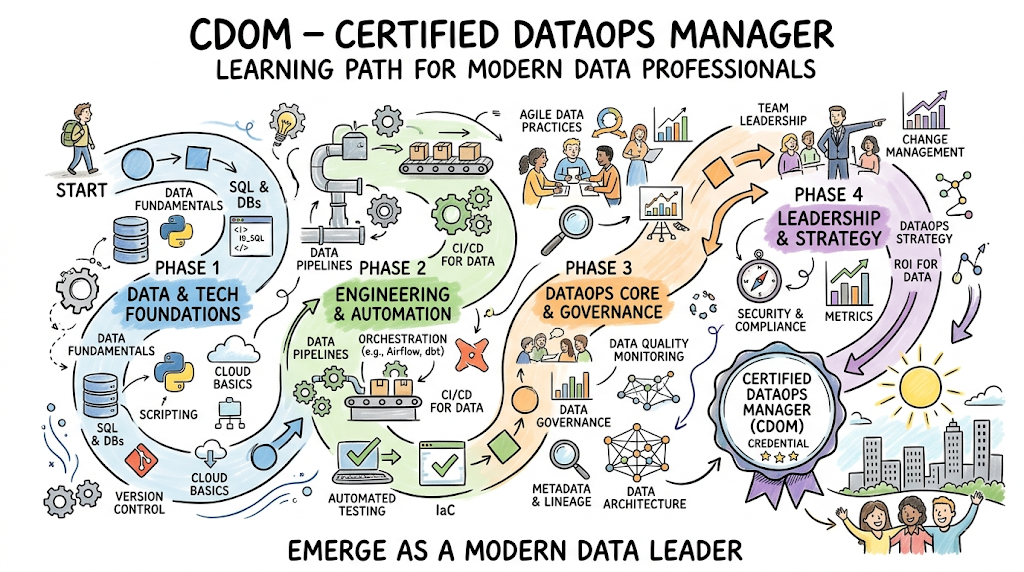
The CDOM – Certified DataOps Manager is a professional designation designed to bridge the gap between data engineering and operational excellence. This guide is written for data professionals, engineering leads, and platform architects who need to streamline the delivery of high-quality data in complex environments. By following this professional certification program, candidates learn to apply lean and agile methodologies to the data lifecycle. At Dataopsschool, the focus is on building resilient data pipelines that provide value to the business while maintaining high standards of governance. This guide helps professionals navigate the evolving landscape of data management to make informed decisions about their career growth and technical specialization.
What is the CDOM – Certified DataOps Manager?
The CDOM – Certified DataOps Manager represents a shift from traditional, siloed data management toward a collaborative, automated approach to data delivery. It exists because modern enterprises struggle with “data debt” and brittle pipelines that fail under the weight of increasing data volume and variety. This certification focuses on the practical application of CI/CD principles to data, ensuring that data is treated with the same rigor as software code.
Unlike theoretical courses, this program emphasizes production-focused learning, covering automated testing, orchestration, and monitoring of data workflows. It aligns with modern engineering practices by integrating version control, environment management, and automated deployment into the data factory. For the enterprise, it provides a framework for reducing the cycle time of data analytics while improving the accuracy and reliability of the insights generated.
Who Should Pursue CDOM – Certified DataOps Manager?
This certification is highly beneficial for data engineers and cloud architects who are responsible for building and maintaining data platforms. Site Reliability Engineers (SREs) and DevOps professionals looking to pivot into the data domain will find the curriculum aligns perfectly with their existing knowledge of automation and infrastructure. Engineering managers and technical leaders also benefit significantly, as the program provides the strategic oversight needed to manage cross-functional data teams.
The relevance of this program is global, catering to the needs of massive tech hubs in India as well as established enterprise markets in North America and Europe. Beginners with a strong foundation in SQL or Python can use this to enter the high-demand field of data operations. For experienced professionals, it serves as a formal validation of their ability to manage complex data ecosystems at scale.
Why CDOM – Certified DataOps Manager is Valuable in the Future
The demand for DataOps professionals is surging as organizations realize that simply having data is not enough; the data must be accessible, clean, and timely. CDOM – Certified DataOps Manager provides a sustainable career path that remains relevant even as specific tools and cloud providers change. It teaches the underlying philosophy of automation and quality that applies to any technology stack, ensuring long-term career longevity.
Enterprise adoption of DataOps is no longer optional for companies aiming to be data-driven, making this certification a high-ROI investment. It helps professionals stay ahead of the curve by mastering the orchestration of heterogeneous data environments. Ultimately, it validates an individual’s ability to reduce operational overhead and increase the speed of innovation within a data-centric organization.
CDOM – Certified DataOps Manager Certification Overview
The program is delivered via the official training portal and is hosted on the primary website mentioned in the introduction. The assessment approach is strictly practical, requiring candidates to demonstrate proficiency in automating data lifecycles through hands-on labs and scenario-based exams. The certification is structured into distinct levels to accommodate everyone from entry-level practitioners to senior strategic managers. It covers the entire DataOps spectrum, including statistical process control, automated testing, and environment sandboxing. This structure ensures that a certified individual possesses both the technical skills to build pipelines and the management skills to lead a DataOps transformation.
CDOM – Certified DataOps Manager Certification Tracks & Levels
The certification is divided into Foundation, Professional, and Advanced levels to reflect a natural career progression. The Foundation level introduces the core concepts of the DataOps manifesto, agile development for data, and basic pipeline automation. The Professional level dives deep into specialization tracks, allowing candidates to focus on areas like Data Security (DataSecOps), Cloud Data Platforms, or Data Reliability Engineering.
As professionals move to the Advanced and Expert levels, the focus shifts toward governance, cost optimization, and enterprise-wide scaling. These levels are designed to align with roles such as Lead Data Engineer or DataOps Director. By following these tracks, individuals can build a comprehensive skill set that covers both the technical execution and the business value of data operations.
Complete CDOM – Certified DataOps Manager Certification Table
| Track | Level | Who it’s for | Prerequisites | Skills Covered | Recommended Order |
| Core DataOps | Foundation | Aspiring Data Engineers | Basic SQL / Python | DataOps Manifesto, CI/CD, Git | 1 |
| Engineering | Professional | Data Engineers, SREs | Foundation Level | Orchestration, Testing, Containers | 2 |
| Governance | Professional | Data Stewards, Security | Data Privacy Knowledge | Data Masking, Compliance, Access | 2 |
| Management | Advanced | Engineering Managers | Professional Level | Team Leadership, KPI Tracking | 3 |
| Architecture | Expert | Platform Architects | Advanced Level | Multi-cloud Strategy, Scale | 4 |
Detailed Guide for Each CDOM – Certified DataOps Manager Certification
CDOM – Certified DataOps Manager – Foundation Level
What it is
This certification validates the candidate’s understanding of the fundamental principles of DataOps. It confirms that the individual knows how to apply agile methodologies to data projects and understands the basic components of an automated data pipeline.
Who should take it
Entry-level data engineers, business analysts, and traditional database administrators who want to modernize their workflow. It is also suitable for project managers who need to speak the language of DataOps teams.
Skills you’ll gain
- Understanding the DataOps Manifesto and its 18 principles.
- Version control for data and schema changes.
- Basic CI/CD concepts applied to data pipelines.
- Collaborative development workflows using Git.
Real-world projects you should be able to do
- Set up a basic automated deployment for a SQL script.
- Create a simple sandbox environment for data experimentation.
- Document a data pipeline using automated metadata tools.
Preparation plan
Explain 7–14 days, 30 days, and 60 days preparation strategies. For the first two weeks, focus on the manifesto and basic Git. In 30 days, complete lab environments for simple pipelines. Use 60 days for mock exams and full pipeline automation.
Common mistakes
- Treating DataOps as just “DevOps for Data” without understanding the unique challenges of data state.
- Ignoring the cultural aspects of the DataOps transition.
Best next certification after this
- Same-track option: CDOM Professional Engineer
- Cross-track option: CDOM Governance Professional
- Leadership option: CDOM Advanced Management
CDOM – Certified DataOps Manager – Professional Level
What it is
The Professional level validates advanced technical implementation skills. It proves that the candidate can build, maintain, and scale complex data pipelines using industry-standard orchestration and monitoring tools.
Who should take it
Senior Data Engineers, Site Reliability Engineers, and Cloud Architects who are responsible for production data environments.
Skills you’ll gain
- Advanced orchestration using automation tools.
- Automated data quality testing and observability.
- Containerization of data workloads.
- Implementing Statistical Process Control for data monitoring.
Real-world projects you should be able to do
- Build a self-healing data pipeline that alerts on quality drops.
- Implement a blue-green deployment strategy for a data warehouse.
- Create an automated data profiling dashboard for stakeholders.
Preparation plan
Explain 7–14 days, 30 days, and 60 days preparation strategies. Start with orchestration tool syntax for 14 days. Spend 30 days building end-to-end pipelines. Use 60 days to refine monitoring and incident response strategies.
Common mistakes
- Over-complicating the toolset instead of focusing on process efficiency.
- Neglecting automated tests for data quality in favor of speed.
Best next certification after this
- Same-track option: CDOM Expert Architect
- Cross-track option: FinOps Practitioner
- Leadership option: CDOM Managerial Level
Choose Your Learning Path
DevOps Path
The DevOps path focuses on the convergence of software engineering and data operations. Engineers in this track learn how to apply infrastructure-as-code to data platforms. They master the art of environment provisioning and ensuring that the data infrastructure is as flexible and scalable as the applications it supports. This path is ideal for those who want to build the underlying infrastructure that moves data across the enterprise efficiently.
DevSecOps Path
The DevSecOps path integrates security directly into the data lifecycle. This involves automating data masking, managing fine-grained access controls, and ensuring compliance with global regulations. Professionals on this path learn how to build secure data perimeters and automate the auditing process. This ensures that the speed of data delivery does not come at the cost of sensitive information security or organizational compliance.
SRE Path
The SRE path for DataOps focuses on reliability, availability, and performance of data systems. Candidates learn how to define Service Level Indicators specifically for data freshness and accuracy. They specialize in error budgets for data pipelines and automated incident response systems. This path is critical for ensuring that the data platform remains stable even under heavy load or during unexpected system failures.
AIOps Path
The AIOps path teaches professionals how to use artificial intelligence to manage IT operations and data flows. This involves using machine learning models to predict pipeline failures, detect anomalies in real-time, and automate root-cause analysis. It is designed for engineers looking to use intelligent automation to manage massive, complex data ecosystems that are too large for manual oversight or traditional rules-based monitoring.
MLOps Path
The MLOps path is dedicated to the lifecycle of machine learning models within the data factory. It covers the automation of model training, deployment, and performance monitoring. Professionals learn how to manage model versioning, data lineage, and the feedback loops required to keep models accurate over time. This path bridges the gap between data science and production engineering, ensuring consistent business value.
DataOps Path
The core DataOps path is the most direct route for data professionals focusing on holistic management. It focuses on the management of data from source to consumption, emphasizing automation and quality. This includes mastering data engineering, data quality metrics, and team collaboration frameworks. It is the ideal path for those who want to lead data teams and implement the DataOps philosophy across an entire enterprise.
FinOps Path
The FinOps path focuses on the financial management and cost optimization of data and cloud resources. Professionals learn how to monitor cloud spend, optimize data storage costs, and attribute costs to specific projects. This path is essential for organizations operating at a large scale where data processing costs can significantly impact the overall budget. It ensures that data initiatives remain financially sustainable and transparent.
Role → Recommended CDOM – Certified DataOps Manager Certifications
| Role | Recommended Certifications |
| DevOps Engineer | CDOM Foundation, Professional Engineer |
| SRE | CDOM Foundation, SRE Track Specialist |
| Platform Engineer | CDOM Foundation, Professional Architect |
| Cloud Engineer | CDOM Foundation, Professional Level |
| Security Engineer | CDOM Foundation, DevSecOps Specialist |
| Data Engineer | CDOM Foundation, Professional Engineer |
| FinOps Practitioner | CDOM Foundation, FinOps Specialist |
| Engineering Manager | CDOM Foundation, Advanced Management |
Next Certifications to Take After CDOM – Certified DataOps Manager
Same Track Progression
Once you have mastered the Foundation and Professional levels, the logical step is to pursue Expert-level certifications. These focus on high-level architecture and the ability to design multi-cloud data strategies. Deep specialization in a specific niche like Data Sovereignty can further distinguish your profile. Staying within the track allows you to become the primary technical authority for DataOps within your organization.
Cross-Track Expansion
Broadening your skills by taking certifications in related fields like MLOps or FinOps can make you a more versatile professional. Understanding how data operations impact machine learning or the bottom line of the company allows you to take on cross-functional roles. This expansion is particularly useful for consultants or architects who work across different departments and need a holistic view of the technology landscape.
Leadership & Management Track
For those looking to move away from hands-on keyboard work, the management track offers a path to executive leadership. These certifications focus on building a DataOps culture, managing budgets, and aligning technical goals with business outcomes. Transitioning to leadership involves mastering the “soft” side of technology, including talent acquisition, team retention, and strategic planning within the data domain.
Training & Certification Support Providers for CDOM – Certified DataOps Manager
DevOpsSchool is a premier institution providing extensive resources for those seeking to master DataOps and related disciplines. They offer a blend of instructor-led training and self-paced modules designed to cater to working professionals globally. Their curriculum is updated frequently to reflect the latest changes in the industry, ensuring that students are learning the most relevant skills. With a focus on practical labs and real-world scenarios, they help candidates build a portfolio of work that demonstrates their expertise to potential employers. Their support system is robust, offering mentorship that guides engineers from foundational concepts to advanced architectural strategies efficiently and effectively.
Cotocus provides specialized training programs that focus on the technical implementation of DataOps frameworks. They are known for their hands-on approach, where students work on live projects to solve complex data engineering problems. Their instructors are industry veterans who bring a wealth of experience into the classroom, providing insights that go beyond the standard definitions. This focus on “learning by doing” makes them a favorite for engineers who want to gain deep technical proficiency in a short amount of time. They bridge the gap between theoretical knowledge and production-grade execution, ensuring that every student is ready for the challenges of a modern enterprise environment.
Scmgalaxy is a community-driven platform that offers a vast array of tutorials, blogs, and training programs related to DevOps and DataOps. They emphasize the importance of configuration management and version control in the data lifecycle. By providing a wealth of free and paid resources, they support professionals at every stage of their career journey. Their focus on the wide variety of tools used in modern engineering helps candidates understand how different technologies fit together in a cohesive pipeline. They foster a collaborative learning environment where students can share knowledge and solve problems together, making the learning process more engaging and comprehensive.
BestDevOps offers targeted training that helps professionals prepare for high-level certifications in the data and operations space. They provide comprehensive study guides, practice exams, and mentorship programs that are designed to increase the success rate of candidates. Their approach is focused on identifying the core competencies required by the market and ensuring that their students are fully prepared to meet those demands. This results-oriented strategy has made them a trusted name in technical education for those looking to advance their careers quickly. They provide the necessary tools and guidance to ensure that candidates can pass their exams with confidence and competence.
Devsecopsschool focuses exclusively on the intersection of development, security, and operations. In the context of DataOps, they provide the training necessary to build secure and compliant data pipelines. Their programs cover advanced topics like automated threat modeling and continuous security auditing for data environments. This specialization is crucial for professionals working in highly regulated industries like finance or healthcare where data security is a top priority. They empower engineers to bake security into the data lifecycle from the very beginning, ensuring that protection is an integral part of the process rather than an afterthought or a bottleneck.
Sreschool provides in-depth training on site reliability engineering principles applied to modern data and cloud platforms. They teach the methodologies required to maintain high availability and performance in complex, distributed systems. Students learn how to manage incident response, perform blameless post-mortems, and build automated systems that reduce manual toil. Their curriculum is essential for anyone looking to ensure the long-term stability and reliability of enterprise-scale data operations. By focusing on reliability as a core feature, they help engineers build systems that can withstand the pressures of high-volume data processing while maintaining consistent performance levels for all users.
Aiopsschool is dedicated to the study and application of artificial intelligence in IT operations. They provide training on how to use machine learning to automate the monitoring and management of large-scale infrastructure. For DataOps professionals, this means learning how to build “intelligent” pipelines that can self-correct and optimize based on historical performance data. Their cutting-edge curriculum prepares students for the future of automated enterprise management where AI plays a central role. They focus on practical applications of AI that reduce the burden on human operators and improve the overall efficiency and accuracy of the data management process.
Dataopsschool is the primary provider for the CDOM certification and offers a specialized curriculum tailored to the data professional. They focus on the entire data lifecycle, from ingestion to consumption, emphasizing the need for automation and quality at every step. Their programs are designed to break down the silos between data producers and consumers, fostering a culture of collaboration. This direct focus on DataOps makes them the most relevant choice for those seeking this specific certification. They provide the deep domain expertise required to master the DataOps philosophy and implement it successfully within any organization, regardless of its size or complexity.
Finopsschool addresses the growing need for financial accountability in the cloud and data world. They provide training on how to manage and optimize cloud spending, ensuring that data operations remain cost-effective and transparent. Their curriculum covers cost allocation, forecasting, and the use of automated tools to identify and eliminate wasteful spending. This knowledge is vital for senior managers and architects who are responsible for large budgets and want to demonstrate clear ROI on their data initiatives. They help professionals align their technical decisions with the financial goals of the business, ensuring that every data project provides tangible value.
Frequently Asked Questions (General)
- How difficult is the CDOM certification exam?The difficulty is moderate to high, as it requires a mix of theoretical knowledge and practical skills. Candidates must demonstrate they can apply concepts to real-world scenarios rather than just memorizing definitions.
- How long does it take to get certified?On average, it takes between 30 and 90 days depending on your prior experience and the amount of time you can dedicate to study. Professionals with a strong data background may complete it faster.
- Are there any prerequisites for the Foundation level?There are no formal prerequisites, but a basic understanding of SQL and the software development lifecycle is highly recommended to grasp the concepts effectively.
- What is the ROI of getting this certification?Professionals often see a significant increase in salary and job opportunities, as DataOps is one of the fastest-growing fields in the technology sector due to enterprise demand for data accuracy.
- Does this certification expire?Most professional certifications in this field require renewal every few years to ensure your skills stay current with the latest industry standards and tool evolutions.
- Can I take the exam online?Yes, the program is designed to be accessible globally through a secure online proctoring system, allowing you to take the exam from your home or office.
- Is there a community for certified professionals?Yes, becoming certified usually gives you access to an exclusive network of DataOps professionals for networking, mentorship, and ongoing knowledge sharing.
- Does the certification cover specific tools like Airflow?While it teaches the concepts used in such tools, the focus is on the underlying principles so you can apply them to any technology stack or cloud provider.
- How is this different from a standard Data Engineering course?Standard courses focus on building pipelines; this certification focuses on managing, automating, and ensuring the quality and reliability of those pipelines at scale.
- Are there group discounts for corporate training?Most training providers offer customized packages for teams and organizations looking to upskill their employees together as part of a digital transformation initiative.
- What kind of support is available during the training?Students typically have access to hands-on labs, mentorship, community forums, and dedicated instructors to help them navigate the curriculum and prepare for the exam.
- Is this certification recognized globally?Yes, the principles taught are universal and are recognized by major enterprises and tech companies around the world as the standard for modern data operations.
FAQs on CDOM – Certified DataOps Manager
- What specific management skills will I learn in this program?You will learn how to lead cross-functional teams, manage the “people” aspect of technical change, and align data delivery with the broader strategic business goals of the organization.
- Does this program include data governance and compliance?Yes, it covers the essential basics of data privacy, compliance, and how to automate governance within the pipeline to ensure data remains secure and accessible to authorized users only.
- How does DataOps specifically relate to Agile and Scrum?DataOps takes the core principles of Agile development—such as iterative delivery and constant feedback—and applies them to the unique challenges of the data lifecycle and data engineering.
- Can a non-technical manager take this certification course?While a technical background is helpful, the management tracks are specifically designed to provide technical leaders with the strategic oversight they need without requiring deep, hands-on coding skills daily.
- Is automated testing a major part of the certification curriculum?Absolutely. Automated testing for data quality and pipeline integrity is a cornerstone of the DataOps philosophy and is covered extensively in both the engineering and management tracks.
- How do I choose between the different specialization tracks?You should choose the track that aligns most closely with your current professional role or your immediate career goals, though you can always cross-train in other tracks later.
- What is the typical role of a DataOps Manager in an organization?They act as the primary bridge between the data scientists who need reliable data and the engineering teams that provide the infrastructure and pipelines to deliver that data.
- Is there a heavy focus on cloud-native technologies?Yes, the program emphasizes cloud-native architectures as they provide the necessary flexibility, scalability, and automation capabilities required for modern, high-performance DataOps environments.
Final Thoughts: Is CDOM – Certified DataOps Manager Worth It?
From a mentor’s perspective, the value of the CDOM – Certified DataOps Manager lies not just in the credential, but in the mindset shift it facilitates. In an era where data volume is exploding, the old manual ways of managing databases and pipelines are no longer sustainable. This certification provides you with a structured framework to tackle these challenges head-on.
If you are looking to future-proof your career, mastering the operational side of data is a logical and lucrative step. It moves you from being a “builder” to a “facilitator” of business value. While the training requires a commitment of time and effort, the ability to lead a high-performing data team is a skill that will remain in high demand. Use this guide to choose the path that best fits your goals and start your journey toward becoming a certified leader in the field.
