Introduction
Stepping into the role of a Solutions Architect is one of the most rewarding shifts you can make in your career, marking the transition from purely building systems to designing them with a clear understanding of how they solve business problems. Having watched the technology landscape evolve from physical servers to the massive cloud environments we use today, I can tell you that the Azure Solutions Architect Expert certification is the gold standard for anyone looking to lead in this space. This guide is built to help you navigate the certification process, explore specialized paths like DevOps or SRE, and find the right training to ensure you don’t just pass the exam, but truly master the art of cloud architecture.
What is the Azure Solutions Architect Expert?
This professional-level certification is designed for those who want to prove they can design end-to-end solutions on the Microsoft Azure platform. It covers everything from identity management and security to data platforms and disaster recovery. Earning this badge shows the industry that you can translate complex business requirements into reliable, scalable, and secure cloud designs.
- Official Certification URL: Azure Solutions Architect Course
- Provider: DevOpsSchool
Certification Breakdown: Azure Solutions Architect Expert
What it is
The Azure Solutions Architect Expert credential is the highest level of certification for cloud designers in the Microsoft ecosystem. It requires a deep understanding of IT operations, including networking, virtualization, and business continuity. This certification isn’t just about technical knowledge; it’s about your ability to advise stakeholders and lead digital transformation projects.
Who should take it
This path is ideal for senior IT professionals who already have a strong foundation in operating systems and cloud infrastructure. If you are currently a Senior Developer, a Cloud Engineer, or a Team Lead, this certification provides the structural knowledge needed to move into leadership. Managers also find this valuable to better understand the technical landscape their teams are navigating daily.
Skills you’ll gain
- Infrastructure Design: Learn to architect compute, network, and storage solutions that are cost-effective and highly available.
- Security & Governance: Master the art of protecting data and identities using Azure Policy, RBAC, and advanced security frameworks.
- Business Continuity: Design robust disaster recovery and backup strategies to ensure zero data loss during unforeseen outages.
- Data Integration: Understand how to choose and implement the right data platforms, from SQL databases to big data lakes.
Real-world projects you should be able to do
- Global DR Planning: Architect a multi-region disaster recovery plan that ensures a banking application stays online during a regional failure.
- Zero-Trust Security: Implement a modern security model that verifies every access request across a corporate network, regardless of where it originates.
- Cloud Migration: Lead a large-scale migration of on-premise legacy servers to Azure using automated tools with minimal downtime for the business.
- Cost Optimization: Audit an existing cloud environment to find waste and redesign the architecture to save the company thousands of dollars monthly.
Preparation Plan
- 14 Days (Accelerated): This plan is for experts who use Azure every single day. Focus heavily on the “Design” aspects and architectural case studies, spending 4-5 hours daily on high-level strategy and governance modules.
- 30 Days (Intermediate): This is the best pace for Cloud Engineers. Spend 2 hours daily reviewing identity, storage, and networking, ensuring you complete at least one full practice exam every weekend to build stamina.
- 60 Days (Comprehensive): Recommended for Software Engineers or Managers new to infrastructure. This allows time for deep hands-on labs, reading the full Azure Well-Architected Framework, and truly understanding the “why” behind every service.
Common Mistakes
- Technical Tunnel Vision: Many candidates focus only on the buttons and tools while forgetting that architecture is about meeting specific business goals and budgets.
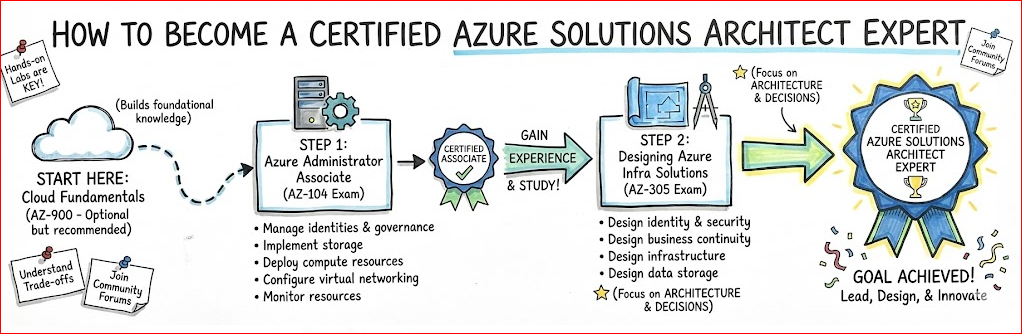
- Skipping the Basics: Attempting the Expert level without first mastering the Administrator Associate (AZ-104) material often leads to gaps in fundamental infrastructure knowledge.
- Ignoring Governance: People often fail because they don’t study Azure Policy or Blueprints enough, thinking these “administrative” tasks aren’t part of a designer’s core job.
Best Next Certification
Once you have mastered the design phase, the Azure DevOps Engineer Expert is the most natural next step for your career. This allows you to bridge the gap between “designing” a solution and “automating” its delivery, making you a complete end-to-end technical leader.
Certification Tracks Table
| Track | Level | Who it’s for | Prerequisites | Skills Covered | Recommended Order | Link |
| Cloud Architecture | Expert | Senior Engineers, IT Leads | AZ-104 (Admin) | Infrastructure, Security, Data, Business Continuity | Fundamental -> Admin -> Architect | Click Here |
| DevOps | Expert | DevOps/SRE Engineers | AZ-104 or AZ-204 | CI/CD, Instrumentation, Site Reliability | Admin/Dev -> DevOps Expert | Click Here |
| Security | Associate | Security Engineers | Basic Cloud Knowledge | Identity, Threat Protection, Cloud Security | Fundamental -> Security Associate | Click Here |
| Data Engineer | Associate | Data Professionals | Data Fundamentals | Data Storage, Processing, Security | Data Fund. -> Data Engineer | Click Here |
Choose Your Path: 6 Learning Journeys
- The DevOps Path: This journey focuses on turning your architectural designs into repeatable code. You will learn to use tools like Terraform and GitHub Actions to deploy infrastructure automatically, ensuring that your high-level designs are implemented perfectly every single time without manual errors.
- The DevSecOps Path: In this path, security is not an afterthought but a core part of the design process. You will learn to integrate automated security checks into your Azure pipelines, ensuring that every piece of code and infrastructure is scanned for vulnerabilities before it ever goes live.
- The SRE Path: This track is all about the reliability and health of the systems you design. You will focus on monitoring, incident response, and using Azure Chaos Studio to test your architecture’s limits, ensuring it can survive the most stressful real-world traffic spikes.
- The AIOps/MLOps Path: This journey is for those looking to design the future of intelligent systems. You will learn how to architect high-performance environments that support machine learning models, ensuring that data flows smoothly from ingestion to training and finally into production applications.
- The DataOps Path: Focus on the lifecycle and quality of data within your Azure environment. This path teaches you to design efficient data pipelines using Azure Synapse and Data Factory, making sure that business analysts have access to clean, reliable data whenever they need it.
- The FinOps Path: As an architect, you must also be a financial steward for your company. This path focuses on cost management, reserved instances, and tagging strategies to ensure that the cloud environment stays within budget while still delivering high performance to the users.
Role → Recommended Certifications
- DevOps Engineer: You should aim for a combination of AZ-104 for administration and AZ-400 for DevOps expertise. This ensures you can both manage the cloud and automate the delivery of software effectively.
- SRE (Site Reliability Engineer): Focus on AZ-104 and AZ-305 to understand design, then add specialized monitoring training. This helps you build systems that are inherently stable and easy to troubleshoot when things go wrong.
- Platform Engineer: This role requires AZ-104, AZ-305, and a deep dive into Kubernetes (AKS) specialization. You will be building the internal developer platforms that allow other teams to deploy their applications quickly and safely.
- Cloud Engineer: Start with AZ-900 to get the basics down, then move quickly into AZ-104. This provides the hands-on skills needed to manage the day-to-day operations of an enterprise cloud environment.
- Security Engineer: The AZ-500 is your primary focus here, as it covers deep security technologies. You will be responsible for setting up firewalls, managing encryption keys, and ensuring the entire Azure tenant is hardened against attacks.
- Data Engineer: Pursue the DP-203 certification to master data storage and processing. This role is critical for organizations that rely on big data and analytics to make their daily business decisions.
- FinOps Practitioner: Combine AZ-305 with AZ-104 and specialized cloud economics training. You will be the bridge between the finance department and the engineering team, ensuring every dollar spent on the cloud is justified.
- Engineering Manager: Focus on AZ-900 and AZ-305 to maintain a high-level view of what is possible. You don’t need to do the daily coding, but you must understand the architectural trade-offs your team is making.
Top Institutions for Training & Certification
- DevOpsSchool: This is a leading choice for professionals who want a mix of theory and heavy practical training. Their trainers are industry veterans who focus on teaching you how to solve real-world problems rather than just helping you pass an exam.
- Cotocus: Known for providing highly personalized training tracks that cater to the specific needs of working professionals. They offer a deep dive into enterprise-level migrations, making them ideal for those working in large corporate environments.
- Scmgalaxy: A massive community platform that offers a wealth of free and paid resources, including blogs and detailed tutorials. It is an excellent place to stay updated on the latest shifts in the Azure and DevOps landscapes globally.
- BestDevOps: They specialize in high-intensity bootcamps that are designed to help you transition into an Architect role in a short amount of time. Their hands-on approach ensures that you leave the course with a portfolio of work you can show employers.
- devsecopsschool.com: This institution is the best place to learn how to weave security into every layer of your Azure architecture. They focus on the tools and mindsets needed to make security a shared responsibility across the entire engineering team.
- sreschool.com: If you want to master the art of reliability, this is the place to go. They teach you how to apply Site Reliability Engineering principles specifically to the Azure cloud to ensure your designs are always available.
- aiopsschool.com: They focus on the cutting edge of operations, teaching you how to use AI and machine learning to manage complex cloud environments. This is ideal for architects who want to build self-healing systems that require minimal human intervention.
- dataopsschool.com: This school provides the specialized knowledge required to manage massive data architectures. You will learn how to ensure data quality and speed throughout the entire pipeline within an Azure-based ecosystem.
- finopsschool.com: A critical resource for senior leaders who need to master cloud financial management. They provide the frameworks needed to track spending, optimize resources, and ensure the cloud remains a cost-effective asset for the business.
FAQs: Azure Solutions Architect Expert
1. How difficult is the Azure Solutions Architect Expert exam?
This exam is widely considered one of the most difficult in the cloud industry because it tests your ability to make high-level decisions. You won’t just be asked what a service does; you will be given a complex business problem and asked to design the most efficient solution.
2. How much time do I need to prepare for this certification?
Most working professionals find that 30 to 60 days of consistent study is the sweet spot for success. This gives you enough time to go through the official documentation, complete hands-on labs, and take several practice exams to get comfortable with the format.
3. What are the formal prerequisites for the Expert badge?
You must first pass the AZ-104 (Azure Administrator Associate) exam to earn the Expert certification. Microsoft requires this because an architect must understand how to manage the resources they are designing to ensure they are practical and maintainable.
4. In what sequence should I take the Azure exams?
The most successful path is to start with AZ-900 if you are new, then move to AZ-104 for administration, and finally AZ-305 for design. This building-block approach ensures you have no gaps in your knowledge as you move into the more complex architectural topics.
5. Is this certification still worth it in the current job market?
Yes, it is highly valued because companies are moving away from simple cloud migrations and toward complex, optimized cloud-native designs. Being a certified Expert puts you at the top of the list for high-paying roles in both India and international markets.
6. Does the Azure Solutions Architect Expert certification expire?
Microsoft certifications are valid for one year, but you can renew them for free through a simple online assessment. This ensures that you stay up to date with the constant changes and new services that Microsoft adds to Azure every month.
7. Can a Software Engineer transition to an Architect role using this?
Absolutely, this certification provides the “missing link” for many developers by teaching them about networking, security, and infrastructure. It gives you the broad perspective needed to lead entire projects rather than just writing individual features or modules.
8. Is it possible to pass without any hands-on experience?
It is extremely difficult because the exam uses case studies that reflect real-world messiness. Without spending time in the Azure portal and actually building things, you will likely struggle with the practical questions that require you to troubleshoot or optimize a design.
Next Certifications to Take
- Same Track (Azure DevOps Expert): This is the best way to prove you can not only design a system but also build the automation that keeps it running smoothly.
- Cross-Track (Azure Security Engineer): Specializing in security makes you an invaluable asset to any company, as cloud security is currently a top priority for every major business.
- Leadership (Enterprise Architecture): Once you have the technical badges, look toward TOGAF or leadership courses. These help you move into the C-suite where you influence the overall technology strategy of the entire company.
Testimonials
“The journey to becoming an Azure Solutions Architect Expert was challenging but completely transformed how I approach my work. I now have the confidence to lead architectural discussions with our executives and explain the long-term value of our cloud choices.” — Amit V., Senior Solutions Architect
“What I appreciated most about the certification was the focus on the Well-Architected Framework. It gave our team a common language and a set of standards that immediately improved our system’s reliability and significantly reduced our monthly cloud bill.” — Elena G., Engineering Manager
Conclusion
Becoming an Azure Solutions Architect Expert is about more than just passing an exam; it is about shifting your mindset to see the “Big Picture.” In my years of mentoring engineers, I have found that those who succeed are the ones who never stop learning and who understand that every technical choice is a business choice. Take the first step today, choose the path that aligns with your goals, and remember that the best architectures are built on a foundation of continuous improvement and curiosity.