Have you ever heard of MLOps or DevOps? If you’re in the technology industry, chances are you’ve come across these terms at some point in your career. But what do they really mean? And are they interchangeable?
In this article, we’ll dive deep into the world of MLOps and DevOps, exploring their differences and similarities. From their origins to their methodologies, we’ll cover everything you need to know about these two crucial concepts in tech. So, let’s get started!
Getting to Know DevOps
To understand MLOps, we first need to understand its predecessor, DevOps. DevOps is a combination of “development” and “operations,” and it’s a set of practices that aim to bridge the gap between software development and operations teams.
The idea behind DevOps is to create a collaborative and agile environment, where developers and operations professionals work closely together to deliver high-quality software products. DevOps emphasizes automation, continuous integration and delivery, and infrastructure as code.
The Emergence of MLOps
MLOps, on the other hand, is a relatively new concept that’s gaining traction in the tech industry. MLOps stands for “machine learning operations,” and it’s a set of practices that aim to streamline the process of deploying and managing machine learning models in production.
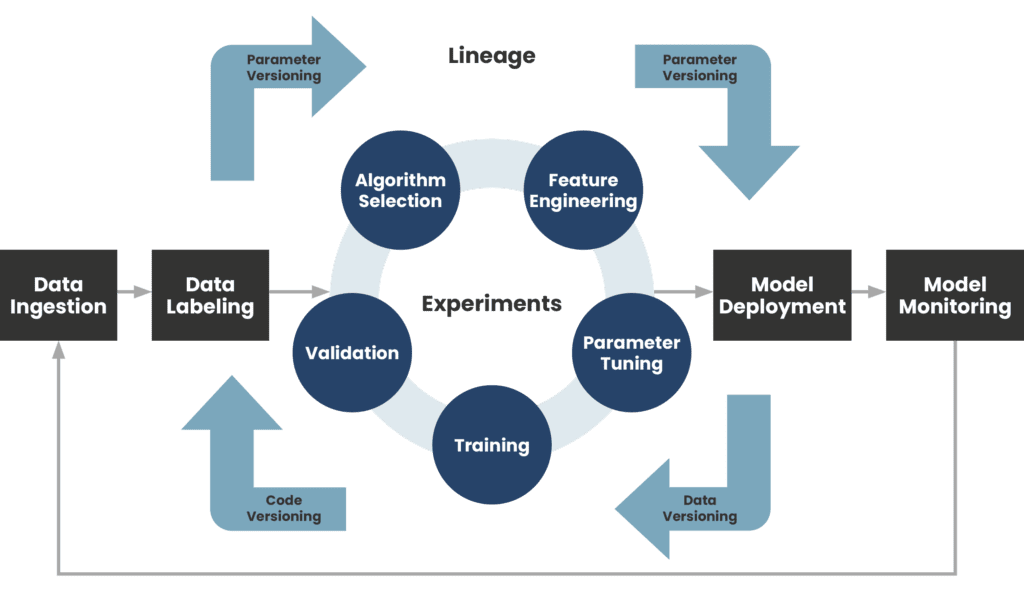
The need for MLOps emerged as machine learning became more prevalent in software development. Machine learning models require a different set of considerations than traditional software, and they can be more complex to manage in production environments. MLOps aims to address these challenges by providing a framework for managing the entire lifecycle of machine learning models.
Key Differences Between MLOps and DevOps
While MLOps and DevOps share some similarities, there are some key differences between the two concepts. Here are some of the most notable differences:
Data vs Code
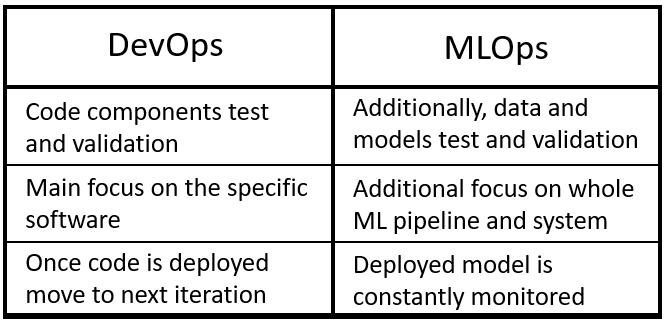
One of the biggest differences between MLOps and DevOps is the type of artifacts they manage. DevOps is primarily focused on managing code, while MLOps is focused on managing data and models.
Experimentation vs Stability
Another key difference is the approach to experimentation and stability. DevOps emphasizes stability and reliability, while MLOps emphasizes experimentation and iteration.
Model Training vs Deployment
MLOps focuses heavily on the process of model training, while DevOps focuses on the deployment and management of software products. While both concepts involve the entire software development lifecycle, they place different levels of emphasis on different stages of the process.
Infrastructure vs Environment
Finally, MLOps places a greater emphasis on the environment in which models are deployed, while DevOps places a greater emphasis on the underlying infrastructure. This is because the environment in which a machine learning model is deployed can have a significant impact on its performance and accuracy.
Wrapping Up
So, what’s the difference between MLOps and DevOps? While there are some similarities between the two concepts, there are also some key differences that set them apart. MLOps is focused on managing the entire lifecycle of machine learning models, while DevOps is focused on bridging the gap between software development and operations.
Both concepts are crucial in modern software development, and they’re both evolving rapidly as the industry continues to change and grow. By understanding the differences between MLOps and DevOps, you can better navigate the complex world of software development and ensure that your projects are successful and efficient.
