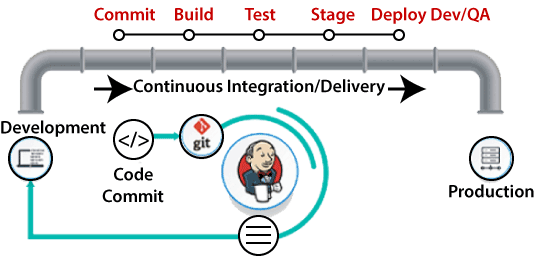
DevOps defines an agile relationship between operations and the development team. It is a process where the development and operations team work together from beginning to end of the project to finish the work and to fast the delivery process, reduce time and cost, and enhance the software quality. The DevOps approach adopts continuous innovation, agility, and scalability to build, test, and upgrade software products. It promotes the culture and practice of experimentation, feedback, and constant learning to reinvent products, services, and processes. Although, to execute DevOps, a deep understanding of different phases of the DevOps lifecycle is very important. If they won’t, the entire development process will get complex and time-consuming.
What are the DevOps Lifecycle Phases?
The DevOps lifecycle includes some phases as given below:

Continuous Development – This phase incorporates the planning and coding of the software. Before coming into the development phase we have to get through the planning process then the developers put coding to build the application.
There is no need for any tools for planning but some tools are there to maintain the code. The code can be written by any language but it is maintained by only using version control tools.
Maintaining the code is known as Source Code Management. The most popular tools like Git, SVN, CVS, Maven, Gradle, Jira, etc can be used for building and packaging codes into an executable file which will be transferred to the next phase.
Companies that have successfully implemented Continuous Development throughout their organization often find dramatic strategic benefits. The combination of continuous integration and continuous delivery made a development process known as continuous software development.
Continuous Integration – This is the second phase which involves different steps includes planning of test execution which will be carried out in the testing phase as well as understanding the project requirements provided by the client to incorporate the necessary feature in the software.
In this phase developers continuously merge their code changes into the central repository after which automated builds and tests are run.
The major function of continuous integration is to find the bugs, improve software quality, reduce the time to check and release the new update.
Developers often obligate to a shared repository using a version control system like Git, through continuous integration.
Former to each commit, developers might choose to run local unit tests on their code like an extra verification layer before integration. A continuous integration automatically builds and runs unit tests on the new code changes to immediately point out any errors.
Continuous Testing – This is the phase where built software is constantly tested for bugs, defects, and flaws. The aim of continuous testing is to evaluate the quality of the software as a phase of a continuous delivery process, by testing early and frequently.
Automation testing tools such as Selenium, TestNG, JUnit, etc are used for continuous testing.
These tools permit QAs to test multiple code-bases completely in parallel in order to increase the efficiency of the testing process to make sure there are no flaws in the functionality.
The consequences of the test are shared with the developers to make changes in the product. Quality assurance is the process of pursuing or maintaining a desired level of quality in a product. QA focuses to deliver consistent results through using a standardized set of procedures and includes all activities which ensure software meets certain requirements before getting released.
QA doesn’t do the actual testing of products but focuses on the procedures that ensure the best outcomes, as it is process-oriented. QA helps a company in developing software that meets customer expectations which encourages customer loyalty.
In this phase, Docker Containers can be utilized to simulate the test environment. Selenium does the robotization testing, whereas TestNG creates the result. This whole testing phase can be robotized with the help of a Continuous Integration tool called Jenkins.
Continuous Deployment – Continuous Deployment involves deploying the code in such a way that it doesn’t affect the performance of the product or website.
In this stage, it is important to ensure the code is deployed correctly on all the servers. It is all about ensuring the product is deployed with all accuracy, with no errors.
Before going forward, let’s try to understand Configuration management and Containerization tools. This set of tools help in achieving Continuous Deployment. Configuration Management is the act of setting up and maintaining consistency in an application’s functional requirements and performance.
In simple words, it is the act of releasing deployments to servers, scheduling updates on all servers, and most significantly keeping the configurations consistent over all the servers. Since the new code is deployed in a continuous way, configuration management tools play a key role in performing tasks quickly and repeatedly. Some popular tools used here are Puppet, Chef, and Ansible, etc.
Containerization tools also play a key role in the deployment stage. Docker and Vagrant are the popular tools that come in use for this purpose here.
These tools help produce consistency over Development, Test, Staging, and Production environments. By using these tools, there is no scope of errors, failure in the production environment as they package and repeat the same dependencies used in the development/ testing/ staging environment. It makes your application easy to run on different systems.
Continuous Monitoring – This is a very important stage of the DevOps life cycle where you constantly monitor the performance of your application.
In Continuous Monitoring, important data about the product’s utilization is recorded. This information is taken care of to recognize the proper functionality of the application.
Generally, the monitoring is incorporated inside the operational capabilities of the application. The system errors like low memory, server not reachable, etc, are sorted out in this phase. The main cause of issue monitoring in this phase.
It maintains the security and availability of the services as if a network issue occurs, they are resolved in this phase. It helps automatically fix the problem as soon as they are found.
It involves the participation of the Operations team who will monitor the activity for bugs or any improper behavior of the system. Popular tools like Splunk, Nagios, NewRelic, and Sensu, etc get used for this.
These tools help you to closely monitor the application’s performance and the servers and also help you to check the health of the system proactively. It can also improve productivity and increase the reliability of the system which reduces IT support costs.
Any major issues found are reported to the development team so that they fix them. This leads to a faster solution to the problems.
At last, I would like to share with you guys, about one of the best platforms to learn everything about DevOps is from DevOpsSchool. It is the most popular and one the best institute to learn about DevOps. If you guys considering making your carrier in DevOps then you must visit this one. Their way of teaching is generous and easy to understand.
