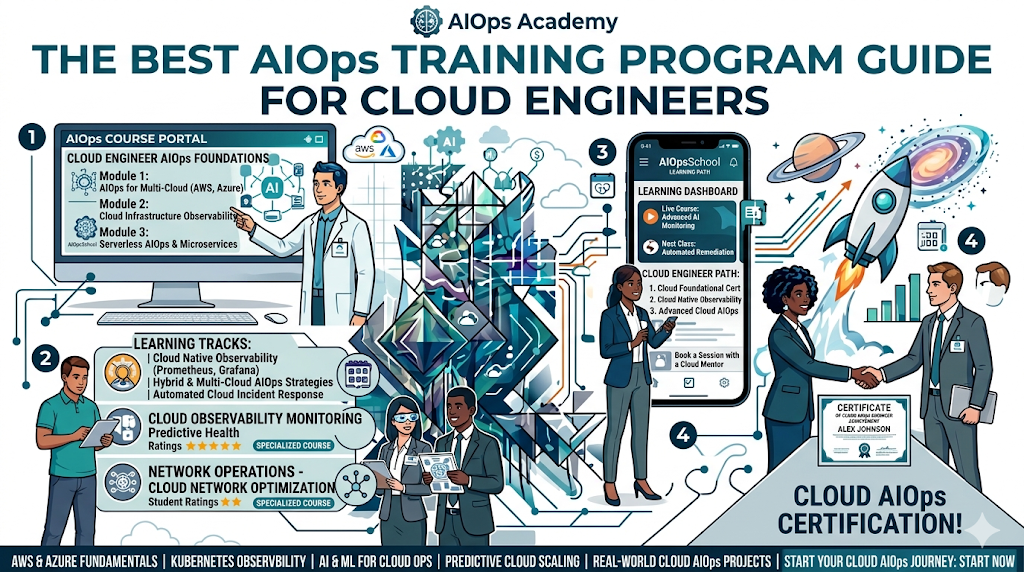
As modern IT environments transition from centralized datacenters to highly distributed, multi-cloud, and microservices-based setups, the sheer volume of data generated by enterprise software has exploded. Infrastructure components, containers, serverless functions, and application frameworks continuously churn out infinite streams of telemetry. For engineering teams, managing this operational noise has become a primary bottleneck, frequently turning minor service disruptions into severe, high-stakes system outages. For technology professionals looking to stay relevant in an automated world, understanding how to apply artificial intelligence to infrastructure management is no longer optional. This article provides a comprehensive overview of how AIOpsSchool serves as a premier AIOps learning platform—offering structured AIOps training, foundational knowledge, and hands-on guidance to help engineers transition into highly sought-after AI-driven operational roles.
What Is AIOps?
At its core, AIOps stands for Artificial Intelligence for IT Operations. Coined originally by Gartner, the term describes the strategic combination of big data, machine learning, and advanced analytics to automate, optimize, and scale IT operational workflows.
The Evolution of IT Operations
The discipline of managing infrastructure has evolved through distinct technological eras:
[Manual Administration] ──> [Siloed Monitoring] ──> [APM & Observability] ──> [AIOps]
  Physical servers,           Introduction of             Metrics, logs, and        Algorithmic data
  reactive scripting          vibrant dashboards          traces aggregated         analysis, automation
- Manual Administration: Engineers manually configured physical infrastructure and investigated issues using local system logs.
- Siloed Monitoring: The introduction of specialized tools to track specific layers (e.g., database performance, network uptime) independently.
- APM & Observability: The consolidation of metrics, logs, and traces into centralized platforms to provide deep visibility into modern software.
- AIOps: The current state, which introduces algorithmic intelligence on top of observability data to act as an automated brain for system engineering.
Enterprises are adopting AIOps platforms because human operators can no longer process data at cloud scale. By utilizing machine learning algorithms, AIOps sifts through massive datasets to establish dynamic behavioral baselines, filter out non-critical alerts, map complex system dependencies, and execute automated remediation paths to ensure continuous application uptime.
What Is AIOpsSchool?
AIOpsSchool is a dedicated online learning platform designed to bridge the growing skills gap between traditional IT operations and intelligent, AI-driven automation. The ecosystem provides comprehensive, vendor-neutral educational frameworks that take engineers from the foundational mechanics of telemetry data up to deploying production-ready machine learning models inside enterprise environments.
Through structured courses, conceptual tutorials, and detailed certification preparation materials, the platform ensures that students do not just memorize theory, but learn practical implementation strategies. By focusing on real-world enterprise scenarios, the curriculum prepares professionals to pass rigorous industry assessments—such as the AIOps Foundation Certification—while building the technical confidence required to lead AIOps initiatives inside large-scale engineering organizations.
Why AIOps Is Important in Modern IT Operations
Modern infrastructure is fast, fluid, and highly complex. The widespread adoption of technologies like Kubernetes, service meshes, and dynamic cloud scaling means that systems are constantly changing state. In a microservices environment, a single user transaction might touch dozens of isolated services across multiple geographic cloud regions.
When a latency spike occurs, finding the root cause manually is like looking for a needle in a haystack that is actively changing shape. Traditional monitoring systems fail here because they operate on rigid, pre-defined rules (e.g., “Alert if CPU usage is greater than 85%”). However, high CPU might be normal during a scheduled batch job, while a 5% increase in database error rates could signify a catastrophic failure.
AIOps solves these challenges by transitioning organizations from reactive firefighting to predictive operations. By continuously analyzing live telemetry data, an AIOps platform detects subtle behavioral deviations that indicate an impending failure, groups related alerts together into a single contextual incident, and provides engineers with actionable intelligence to resolve issues instantly.
Who Should Learn AIOps?
- DevOps Engineers: Learn to embed intelligence directly into continuous deployment loops, ensuring infrastructure automatically adapts to software performance shifts.
- SRE Engineers: Use algorithmic alerting to minimize alert fatigue, maintain strict error budgets, and scale reliability without matching hiring to infrastructure growth.
- Cloud & Platform Engineers: Understand how to manage massive multi-cloud topologies by automating capacity planning and discovering hidden dependency structures.
- IT Operations & Monitoring Teams: Move beyond manual dashboard watching and learn to configure AI platforms that handle the frontline sorting of system events.
- Automation Engineers: Extend standard scripting practices into intelligent self-healing workflows triggered by algorithmic anomaly detection systems.
- Technology Leaders & Architects: Gain the strategic expertise needed to evaluate enterprise AIOps tools and design resilient operational frameworks.
- Students & Beginners: Establish a future-proof career foundation by entering the IT industry with skills centered around the next generation of operations management.
Key Features of AIOps Training Programs
A well-rounded educational journey in AI-driven operations requires more than just high-level overviews. The training frameworks emphasized by AIOpsSchool focus on core technical pillars:
- Structured Learning Paths: Courses are designed linearly, ensuring beginners master data fundamentals before moving on to complex machine learning implementations.
- Observability Practices: Deep dives into how to collect, enrich, and structure the core pillars of observability—metrics, logs, and traces—to provide high-quality data to downstream AI systems.
- Advanced Anomaly Detection: Learning how statistical models discover real-time system deviations without relying on hardcoded, fragile thresholds.
- Automated Root Cause Analysis: Understanding dependency mapping and topological graphs to track how an error in one component propagates through an entire enterprise application.
- Incident Management Workflows: Integrating AI insights directly into standard collaborative tools (such as ticketing systems and chatops channels) to optimize team triage workflows.
- Certification Preparation: Thorough mapping of course content to industry certification standards, ensuring students can validate their technical skills in the job market.
AIOps Certification: Why It Matters
As companies invest heavily in artificial intelligence for infrastructure, they require validated proof that engineering candidates possess true operational expertise. Earning an AIOps Foundation Certification provides clear professional benefits:
- Skill Validation: Demonstrates a concrete understanding of machine learning principles, data engineering, and modern observability frameworks.
- Career Advancement: Positions you for senior architectural roles by showing you understand how to lower MTTR and optimize operational overhead.
- Professional Credibility: Establishes you as a forward-thinking engineer capable of modernizing legacy operational processes.
- Enterprise Demand: Matches your credentials directly with Fortune 500 companies actively looking for specialists to implement their corporate AIOps roadmaps.
AIOps Course Curriculum Components
An industry-ready AIOps Course covers several essential modules:
- Introduction to Intelligent Operations: Core definitions, historical context, and the fundamental shift from traditional monitoring to observability and AIOps.
- Telemetry Data Architecture: Strategies for gathering and normalizing unstructured log streams, system metrics, and distributed tracing metadata across hybrid architectures.
- Machine Learning for IT Operations: Practical application of clustering, regression, classification, and natural language processing (NLP) models to infrastructure datasets.
- Algorithmic Event Correlation: Techniques to deduplicate redundant alerts, group related notifications by time and topology, and eliminate operational noise.
- Predictive Analytics & Capacity Management: Utilizing historical data trends to forecast system bottlenecks, disk exhaustion events, and unexpected traffic spikes.
- Intelligent Incident & Automation Workflows: Triggering automated, self-healing runbooks based on confident machine learning insights to resolve incidents without human intervention.
AIOps Tools and Technologies
To implement an effective operational strategy, engineers must understand where different technologies fit within the enterprise ecosystem.
| Tool Category | Purpose | Benefits | Typical Use Cases |
| Observability Platforms | Continuous ingestion of system metrics, logs, distributed traces, and end-user telemetry. | Provides high-fidelity operational data needed to feed AI models. | Real-time application performance monitoring, distributed request tracking. |
| Log Analytics Tools | Centralizing and parsing unstructured text data generated by applications and systems. | Converts raw textual logs into structured data matrices for pattern analysis. | Searching for rare error signatures, tracking audit trails across clusters. |
| Event Management Platforms | Ingesting, deduplicating, and correlating alerts coming from multiple disparate monitoring systems. | Drastically reduces alert noise, grouping thousands of alerts into single incidents. | Cross-domain incident triage, suppressing non-actionable infrastructure noise. |
| Automation Solutions | Orchestrating infrastructure configuration changes and running programmatic remediation scripts. | Eliminates manual intervention for repetitive, known operational errors. | Auto-scaling cluster nodes, restarting crashed microservices safely. |
| AI/ML Components | Processing telemetry pipelines to calculate dynamic baselines and discover hidden anomalies. | Uncovers complex, multi-variable issues that standard alert rules miss completely. | Behavioral baselines tracking, predicting memory leaks before systems crash. |
AIOps Use Cases in Real Enterprises
Noise Reduction & Event Correlation
In large enterprise networks, a single core switch failure can trigger thousands of downstream alerts from virtual machines, databases, and client applications. An AIOps platform recognizes the underlying network topology, identifies that all affected nodes share a dependency on that single switch, and suppresses the secondary alert noise. It surfaces a single, highly actionable incident ticket indicating the exact switch that requires replacement.
Automated Root Cause Analysis
When an e-commerce checkout page slows down, the root cause could be an inefficient database query, network congestion, or bad code deployment. By analyzing distributed tracing graphs alongside system metrics, AIOps traces the transaction path through the entire microservices mesh. It automatically pinpoints the exact service and database query responsible for the latency spike, saving hours of manual debugging.
Predictive Capacity Planning
Instead of waiting for a storage volume to hit 90% capacity and firing a panicked alert, machine learning models analyze long-term ingestion patterns. The system projects future growth trends and notifies the cloud operations team weeks in advance that a cluster will exhaust its storage resources, allowing for orderly, automated disk expansion.
AIOps for SRE Teams
Site Reliability Engineering (SRE) focuses on using software engineering practices to solve operational and infrastructure problems. SRE teams balance system speed against system reliability using strict metrics called Service Level Indicators (SLIs) and Service Level Objectives (SLOs).
AIOps acts as an accelerator for SRE teams by automating the data analysis required to protect these service objectives. Instead of spending cycles manually adjusting alerting thresholds as software changes, SREs leverage machine learning to maintain dynamic baselines.
Furthermore, when an incident breaches an error budget, AIOps speeds up the post-mortem phase by instantly providing clear event timelines and dependency graphs. This allows SREs to focus less on manual troubleshooting and more on engineering long-term system reliability and architectural resilience.
AIOps vs DevOps
While closely linked, AIOps and DevOps serve different primary goals within the software development and delivery lifecycle.
| Area | DevOps | AIOps |
| Primary Focus | Breaking down silos between software development and IT operations teams. | Applying AI and machine learning to automate data analysis and operational response. |
| Core Goal | Increasing deployment frequency, speed, and continuous integration/delivery pipelines. | Improving service uptime, reducing noise, and automating complex problem isolation. |
| Business Impact | Enables faster time-to-market for software features and application updates. | Lowers MTTR, reduces operational overhead, and ensures system stability at scale. |
AIOps vs MLOps
It is common to confuse AIOps with MLOps, but they represent entirely different operational directions.
| Area | AIOps | MLOps |
| Primary Goal | Using machine learning to optimize and protect IT infrastructure and operational workflows. | Applying DevOps principles to streamline the development, deployment, and management of ML models. |
| Data Ingested | Systems telemetry data: logs, metrics, event streams, configuration records, and traces. | Model training datasets, model code versions, hyperparameter logs, and prediction logs. |
| Primary User | SREs, Cloud Engineers, System Administrators, IT Operations Teams. | Data Scientists, Machine Learning Engineers, MLOps Engineers. |
How Anomaly Detection Works in AIOps
Traditional monitoring relies on static, binary thresholds (e.g., alert if disk utilization is greater than 90%). However, modern IT systems are dynamic, experiencing natural peaks and valleys depending on time of day, weekly business cycles, or seasonal events.
[Telemetry Stream Ingestion]
       │
       ▼
[Algorithmic Analysis (Time-Series / Clustering)]
       │
       ▼
[Dynamic Baseline Creation (Expected Behavioral Bounds)]
       │
       ▼
[Real-Time Outlier Identification (Flags anomalies, prevents false alarms)]
- Continuous Telemetry Ingestion: The AIOps platform ingests a constant stream of time-series metrics from across the entire infrastructure.
- Behavioral Profiling: Machine learning models study historical performance patterns across days and weeks to understand what “normal” looks like for various time intervals.
- Dynamic Baseline Generation: The system constructs an expected band of behavior that automatically adjusts based on time, context, and external variables.
- Intelligent Outlier Identification: When data points fall outside this dynamic boundary, the system flags it as a true anomaly. This flags critical system degradation early while preventing false alerts during expected traffic surges.
Root Cause Analysis in AIOps
When complex software architectures break down, the visible symptoms are rarely the actual cause of the failure. For example, an application running out of available memory might look like an infrastructure problem, but the real cause could be a slow memory leak introduced in a recent microservice deployment.
[System Alert Fired] ──> [AIOps Topography Engine Maps Dependencies] ──> [Root Cause Identified]
   App memory limit         Traces transaction flow back to a           Bad database query
   is exceeded.             specific un-optimized query.                isolated in seconds.
In traditional environments, finding this out requires assembling a “war room” where network, database, and software engineers manually dig through their respective logs to piece together a timeline.
An AIOps platform accelerates this process by leveraging real-time topology mapping and event correlation. The system maps the relationships between infrastructure layers and applications. When an incident occurs, the platform traces the transaction flow backward across these dependencies, correlating the exact timing of changes, error spikes, and log entries to pinpoint the true root cause in seconds.
Observability and AIOps
To understand AIOps, it is vital to understand its relationship with observability. Observability is the practice of measuring the internal states of a system by analyzing its external outputs—specifically metrics, logs, and distributed traces (often referred to as the three pillars of telemetry).
AIOps acts as the analytics brain that sits directly on top of this observability data layer. Without comprehensive observability telemetry, an AIOps platform has no data to learn from. Conversely, without AIOps, the mountains of telemetry data generated by modern observability systems become too dense for human operators to interpret quickly. Together, they form a complete operational loop: observability provides the raw sight, and AIOps provides the intelligent insight.
Real-World Learning Scenarios
- The DevOps Engineer: A DevOps specialist notices that continuous software deployments frequently cause minor infrastructure performance drops that are difficult to isolate. By completing an AIOps course, they learn how to integrate algorithmic event correlation directly into their deployment workflows, enabling automatic detection and rollback of unstable releases.
- The SRE Professional: An SRE team is overwhelmed by hundreds of minor, daily alert notifications from their Kubernetes clusters. Through hands-on training, they learn to implement dynamic anomaly detection, reducing alert noise by up to 80% and allowing the team to focus on proactive engineering tasks.
- The IT Operations Leader: An IT director wants to upgrade their legacy operations center to a modern, automated system. By learning the core principles of intelligent automation and vendor-neutral architectures, they gain the exact technical perspective needed to select and deploy the right enterprise AIOps platform.
Career Opportunities After Learning AIOps
Specializing in AI-driven operations opens doors to high-impact roles across the modern technology landscape:
- AIOps Engineer / Architect: Specializes in designing, deploying, and maintaining the advanced big data engines and machine learning platforms that power corporate IT operations.
- Site Reliability Engineer (SRE): Leverages intelligent monitoring tools to keep highly distributed, cloud-scale enterprise services continuously available.
- Cloud Operations & Platform Engineer: Designs automated, resilient multi-cloud infrastructures that use algorithmic analysis for autoscaling and capacity forecasting.
- Intelligent Automation Engineer: Builds self-healing backend workflows that automatically remediate infrastructure errors based on real-time AI insight signals.
Common Mistakes Beginners Make When Learning AIOps
- Focusing Exclusively on Tools: Many beginners try to learn specific software UIs before understanding the core machine learning algorithms, statistical baselines, and data concepts that drive the entire industry.
- Skipping Observability Fundamentals: Trying to build advanced anomaly detection without first mastering how metrics, logs, and distributed traces are structured and gathered.
- Neglecting Real Operational Workflows: Forgetting that AI tools must integrate seamlessly with human processes, chat platforms, and ticketing systems to provide real corporate value.
- Expecting Immediate 100% Automation: Assuming an AIOps platform can instantly handle all infrastructure decisions autonomously on day one, rather than building trust through iterative baseline validation.
Tips for Successfully Learning AIOps
To master AI-driven IT operations effectively, follow a logical, structured path:
- Build Core Operations Knowledge: Ensure you understand the basics of system administration, cloud networking, and how distributed applications communicate.
- Master Observability Telemetry: Learn how to collect, format, and centralize metrics, system logs, and distributed application traces across environments.
- Study Machine Learning Basics: Get comfortable with the foundational concepts behind time-series analysis, clustering algorithms, and natural language pattern matching.
- Emphasize Vendor-Neutral Concepts: Focus on learning universal architectural principles and data workflows before committing to a specific commercial AIOps platform.
- Utilize Structured Learning Platforms: Leverage specialized frameworks like AIOpsSchool to access orderly tutorials, clear study paths, and targeted certification preparation tools.
AIOps Training Features Comparison
| Feature | Purpose | Learning Benefit | Career Value |
| Structured Learning Path | Moves logically from core telemetry concepts up to complex production ML models. | Prevents cognitive overload, ensuring a solid foundational understanding. | Demonstrates structured, methodical technical mastery to potential employers. |
| Conceptual Tutorials | Deeply explains the underlying math, data patterns, and behavioral algorithms used. | Allows you to understand why systems behave the way they do, not just how to run them. | Builds vendor-neutral expertise, making you highly adaptable across changing toolsets. |
| Use Case Analysis | Studies real-world enterprise system outages and infrastructure bottlenecks. | Bridges the gap between abstract academic theory and practical application. | Equips you with the architectural problem-solving skills needed for senior roles. |
| Certification Preparation | Targets the exact core domains tested in formal professional evaluations. | Formally structures your study efforts toward standard industry benchmarks. | Provides a clear credential that validates your skills to hiring teams. |
Future of AIOps
The field of IT operations is moving rapidly toward fully autonomous operations. In this next phase, infrastructure will rely less on human tuning and more on self-healing, closed-loop automation systems. As machine learning models become more accurate, AIOps platforms will transition from discovering problems to preventing them entirely through real-time, proactive reconfigurations.
Furthermore, the rise of large language models (LLMs) and generative AI is changing how engineers interact with infrastructure. Future operational platforms will allow engineers to query complex microservices telemetry using everyday natural language, instantly generating interactive dependency maps, code fixes, and automated post-mortems. Professionals who master AIOps now will be positioned to design and manage these intelligent, autonomous enterprise systems.
Frequently Asked Questions (FAQs)
1.What is an AIOps tutorial?
An AIOps tutorial is an educational resource that breaks down specific concepts within AI-driven operations—such as how to configure data ingestion pipelines, set up event correlation rules, or interpret time-series anomaly detection outputs—into clear, step-by-step instructions.
2.Why should I choose AIOpsSchool for my learning path?
AIOpsSchool provides structured, beginner-friendly paths focused entirely on modern IT operations, observability, and AI automation. Its frameworks are designed to give professionals both the deep conceptual knowledge and the certification readiness needed to excel in the enterprise job market.
3.What topics are covered in a comprehensive AIOps course?
A complete course typically covers data engineering for operations, time-series anomaly detection, algorithmic event correlation, root cause analysis methods, automated runbook configuration, and strategies for managing modern enterprise observability platforms.
4.Is coding required to learn and work in AIOps?
While deep data science programming isn’t always mandatory to operate commercial tools, having a foundational grasp of scripting languages (like Python or Bash) and data query languages is highly beneficial for setting up automation and data pipelines.
5.How does event correlation help infrastructure teams?
Event correlation analyzes thousands of incoming alerts across different systems, deduplicates redundant messages, and groups related notifications by time and infrastructure layer. This reduces alert noise, helping teams focus on a single, clear incident instead of thousands of individual alarms.
6.Can beginners transition directly into AIOps?
Yes, provided they follow a structured path. Beginners should start by learning core IT infrastructure and monitoring fundamentals before advancing to the machine learning and automated remediation architectures taught on platforms like AIOpsSchool.
7.What is the AIOps Foundation Certification?
It is an industry-recognized credential that validates an engineer’s understanding of the foundational principles, terminologies, data architectures, and machine learning use cases required to implement intelligent automation within IT operations.
8.How does AIOps improve Mean Time to Repair (MTTR)?
AIOps lowers MTTR by automatically filtering alert noise, pointing out the exact root cause of an issue using dependency mapping, and triggering automated remediation runbooks to fix problems within seconds of detection.
9.What is the role of machine learning in IT operations?
Machine learning analyzes massive volumes of telemetry to identify complex data patterns, calculate dynamic behavioral baselines, and flag subtle infrastructure anomalies that would be impossible for human operators to spot manually.
10.What is the difference between observability and monitoring?
Monitoring tracks whether a system is working based on predefined rules and metrics (checking if a component is “up” or “down”). Observability provides deep visibility into the internal state of a system by analyzing all its outputs (metrics, logs, and traces), allowing you to understand why a complex, novel issue is occurring.
11.How do AIOps platforms handle unstructured log data?
AIOps platforms use Natural Language Processing (NLP) and clustering algorithms to ingest raw text logs, filter out normal repetitive messages, and highlight rare log signatures or error patterns that indicate system failures.
12.What are the main benefits of predictive operations?
Predictive operations allow engineering teams to move away from reactive firefighting. By forecasting resource trends and structural degradations early, teams can resolve bottlenecks before they turn into customer-facing service outages.
13.How does AIOps integrate with existing DevOps pipelines?
AIOps connects directly with deployment tools and version control systems. It monitors the health of infrastructure immediately following a code deployment, automatically flagging performance drops and enabling rapid, intelligent rollbacks if bugs are discovered.
14.What industries benefit most from deploying AIOps?
Any industry running high-scale, mission-critical digital infrastructure benefits from AIOps—including financial services, e-commerce platforms, cloud healthcare systems, telecommunications networks, and large-scale software-as-a-service (SaaS) providers.
15.How long does it take to prepare for an AIOps certification?
With a clear, structured learning platform like AIOpsSchool, professionals with a basic background in IT or monitoring can typically master the core concepts and prepare for foundational certification within 4 to 8 weeks of dedicated study.
Final Recommendation
As enterprises continue to scale their cloud-native systems, the demand for technology professionals who can navigate AI-driven infrastructure is accelerating. Traditional monitoring practices are rapidly giving way to automated, predictive, and self-healing systems. For DevOps engineers, SRE specialists, and cloud administrators, learning how to implement machine learning for IT operations is the most reliable way to stay competitive and lead modern engineering teams.
