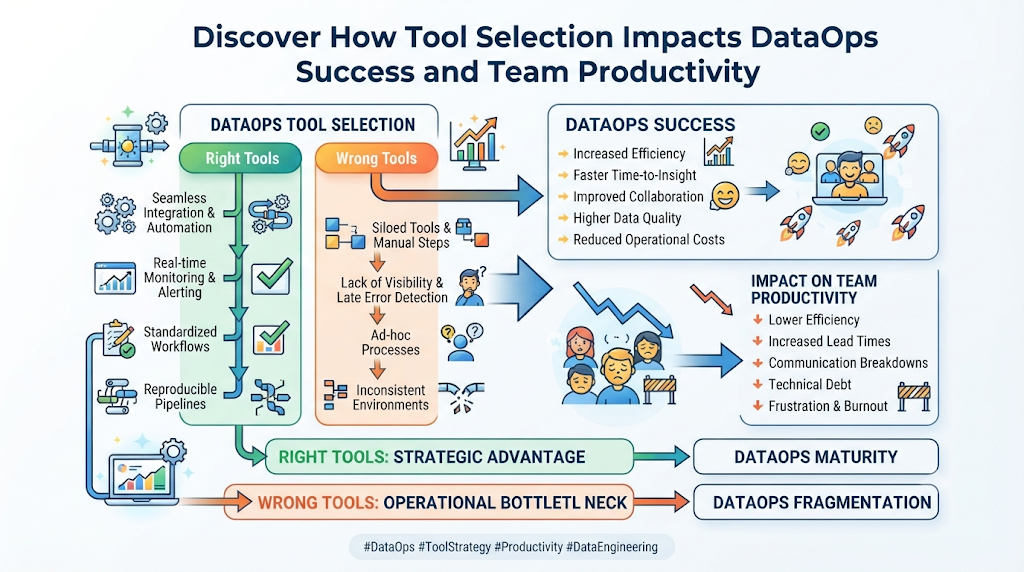
Modern businesses run on data. Every click, sale, and customer interaction generates information that companies use to make decisions. However, raw data is like crude oil; it needs to be refined before it becomes valuable. This refining process happens through complex data pipelines managed by technology professionals.To keep these pipelines running smoothly, organizations turn to DataOps. But implementing DataOps isn’t just about adopting a new philosophy. The technology choices an organization makes form the bedrock of their entire operation. Choosing the right software can accelerate growth, while picking the wrong software can stall projects and cost millions. For insightful resources on building modern data architectures, you can explore the official educational guides on TheDataOps.org. Selecting the right tools influences DataOps success by improving team collaboration, automating repetitive engineering tasks, enforcing strict data quality, and ensuring that business insights remain reliable day after day.
2. What Is DataOps?
Definition
DataOps, short for Data Operations, is a collaborative methodology designed to improve the quality, speed, and accuracy of data analytics. It brings together data engineers, data scientists, analysts, and IT operations teams to build automated, reliable workflows.
Core Principles and Goals
DataOps is built on a few simple ideas:
- Continuous Improvement: Constantly finding ways to make data pipelines faster and more accurate.
- Automation: Removing human intervention from repetitive tasks to reduce manual errors.
- Collaboration: Breaking down communication barriers between the people who collect data and the people who use it.
- Total Quality Management: Testing data at every stage of its journey to catch mistakes before they reach business users.
The main goal of DataOps is to deliver high-quality data to decision-makers as quickly as possible, ensuring the business can pivot instantly based on accurate insights.
Relationship with DevOps and Data Engineering
Think of DataOps as a cousin to DevOps (Development Operations), which revolutionized software development by introducing fast, automated software releases. DataOps borrows these concepts but applies them to data.
DevOps          = Software Code + Automated Infrastructure
Data Engineering = Building Pipelines + Managing Databases
DataOps          = DevOps Philosophy + Data Engineering Practices
While data engineering focuses on building the pipelines that transport information, DataOps focuses on how to run, monitor, and scale those pipelines efficiently using automation. Automation matters because data changes constantly. Without automated testing, a small change in an incoming data feed can silently break reports, leading to poor business choices.
3. Why Tool Selection Matters
Choosing the right technology stack is a critical decision that influences every layer of an organization. The impact of tool selection stretches across several core areas:
- Productivity and Collaboration: When software is intuitive and integrates well, engineers and analysts can work together seamlessly. Siloed systems lead to communication friction and wasted effort.
- Pipeline Reliability and Automation: High-quality tools automate routine processes like data movement and transformation. This reduces human error, making the entire ecosystem highly predictable.
- Scalability: As a company grows, its data volume multiplies. The right platforms scale dynamically, handling larger datasets without crashing or requiring a complete system rewrite.
- Data Quality and Governance: Selecting platforms with built-in validation checks ensures that bad data is flagged early. Proper governance capabilities keep data secure, helping businesses comply with global privacy regulations.
- Long-Term Maintainability: Avoid building brittle pipelines that break under minor adjustments. Standardized, popular technologies ensure that systems remain maintainable and that new team members can get up to speed quickly.
4. Categories of DataOps Tools
To build a robust infrastructure, you need different types of software working in harmony. Here are the primary categories explained in simple terms:
[Data Integration / ETL] ──> [Workflow Orchestration] ──> [Data Observability & Quality] ──> [Cloud Platforms & BI]
          ▲                                                           ▲
          └─────────────────── [CI/CD & Version Control] ─────────────┘
Data Integration, ETL, and ELT Tools
These tools act as the transportation network. They extract data from various sources (like websites, apps, or databases), transform it into a readable format, and load it into a centralized storage area.
Workflow Orchestration Tools
Orchestration tools act as the traffic conductors. They schedule and manage the sequence of data tasks, ensuring that Step B only begins after Step A finishes successfully.
Data Quality and Observability Tools
These systems serve as the immune system of your pipeline. Quality tools check if data meets specific rules, while observability tools monitor the health of the entire data ecosystem, alerting engineers if a pipeline slows down or stalls.
Metadata Management and Data Catalog Tools
These platforms serve as an interactive dictionary. They log where data comes from, who owns it, and how it is structured, making it easy for analysts to find the exact datasets they need.
CI/CD and Version Control Tools
Borrowed from software development, these tools track changes made to code and automate the deployment of new pipelines. This ensures that updates can be tested thoroughly before going live.
Cloud Data Platforms and Analytics Tools
Cloud data platforms are the digital warehouses where massive amounts of information are stored and processed. Analytics and business intelligence tools sit on top of these platforms, turning raw data into visual charts and dashboards for business leaders.
5. Factors to Consider When Selecting DataOps Tools
Before adopting any new piece of technology, teams must evaluate it against their specific business context:
- Clear Business Requirements: Understand what problems you are trying to solve before purchasing software. Never buy technology looking for a problem.
- Scalability and Performance: Ensure the technology can handle both your current data volumes and your projected growth over the next three to five years.
- Ease of Integration: The new software must connect easily with your existing databases, cloud platforms, and reporting applications without requiring complex, custom workarounds.
- Security and Compliance: Data protection is paramount. Tools must offer robust encryption, access control features, and compliance audit paths.
- Cost and Return on Investment (ROI): Look beyond the initial purchase price. Factor in cloud computing expenses, licensing fees, and the human capital required to run the platform.
- Community Support, Documentation, and Learning Curve: Highly adopted tools with clear documentation reduce training times and make it easier to find troubleshooting help online.
6. Benefits of Choosing the Right Tools
When an organization aligns its technology stack with its operational needs, the benefits are clear and immediate:
- Accelerated Development: Pre-built integrations and clear workflows allow data engineers to build new pipelines in hours rather than weeks.
- Frictionless Collaboration: Shared platforms allow engineers, analysts, and business stakeholders to work from a single source of truth, eliminating conflicting reports.
- Operational Cost Efficiency: Automated scaling and efficient resource management prevent runaway cloud computing bills.
- Resilient Reliability: Continuous monitoring and automated alerts catch system failures early, leading to highly stable reporting dashboards.
- High-Quality Business Insights: Clean, reliable data pipelines lead directly to accurate business reports, giving executives the confidence to make data-driven decisions.
7. Common Mistakes During Tool Selection
Even experienced teams can fall into common technology traps. Awareness of these mistakes can save organizations significant time and money:
- Chasing Hype and Popularity: Selecting a tool simply because it is trending on social media, without assessing whether it fits your specific infrastructure, often leads to failure.
- Ignoring Integration Context: Buying a tool that doesn’t natively speak to your current cloud provider or database creates technical friction and requires complex workarounds.
- Overlooking Future Scalability: Choosing a tool that works perfectly for small test datasets but slows to a crawl when exposed to enterprise-scale production workloads.
- Underestimating Long-Term Maintenance: Forgetting that open-source or highly complex systems require continuous updates, patching, and engineering hours to maintain.
- Neglecting Team Training: Deploying highly advanced software without training the end-users results in low adoption rates and abandoned technology investments.
- Tool Proliferation: Acquiring too many niche pieces of software that perform overlapping functions creates a bloated, confusing ecosystem that is difficult to secure.
8. Best Practices for Tool Selection
To avoid pitfalls, organizations should follow a structured approach when building their DataOps environment:
- Define Core Objectives First: Document your business goals, data volume expectations, and budget limitations before looking at vendor websites.
- Evaluate Ecosystem Compatibility: Prioritize tools that naturally integrate with your existing cloud environments and databases.
- Run a Minimal Pilot Project: Test the software with a real, small-scale business problem to observe how it handles production data before signing long-term contracts.
- Establish Performance Metrics: Measure implementation success based on tangible metrics like pipeline speed, error reduction, and team onboarding time.
- Commit to Team Training: Provide structured learning paths, workshops, and documentation to ensure everyone understands how to use the new platform.
- Schedule Regular Tech Audits: Review your software stack annually to remove redundant software, optimize licensing fees, and replace outdated tools.
- Standardize and Document: Establish clear design patterns across the organization and document all architectural decisions to make future updates straightforward.
9. Real-World Enterprise Examples
Banking
- Business Challenge: A retail bank struggled with delayed fraud detection because their transactional data took over 24 hours to process through legacy batch pipelines.
- Tool Selection Approach: The bank looked for highly secure, low-latency integration and real-world streaming tools that offered end-to-end data encryption.
- DataOps Implementation: They implemented real-time data automation pipelines paired with continuous data quality testing to flag anomalies instantly.
- Business Outcome: Fraudulent transactions are now caught in under three seconds, protecting customer accounts and saving millions in potential losses.
Healthcare
- Business Challenge: A regional hospital system had patient data scattered across multiple legacy applications, delaying critical care analytics and reporting.
- Tool Selection Approach: They prioritized strict regulatory compliance features, data cataloging capabilities, and secure hybrid-cloud integration.
- DataOps Implementation: The engineering team built a centralized data platform using secure metadata management tools to track patient records accurately while keeping them anonymous.
- Business Outcome: Patient processing efficiency improved by 35%, and data analysts generated compliance reports in minutes instead of weeks.
Retail
- Business Challenge: An international retailer faced frequent stock shortages because inventory data from physical stores and online platforms did not match.
- Tool Selection Approach: They sought cloud data platforms and workflow orchestration tools capable of handling massive spikes in holiday shopping traffic.
- DataOps Implementation: They automated their inventory pipelines to run every hour, using data observability software to check for errors across systems.
- Business Outcome: Out-of-stock incidents dropped by 40%, significantly boosting online sales and improving customer satisfaction.
Manufacturing
- Business Challenge: A manufacturing plant suffered expensive assembly line shutdowns because factory equipment broke down without warning.
- Tool Selection Approach: The team evaluated tools specializing in high-volume IoT sensor integration and predictive data models.
- DataOps Implementation: They deployed automated data pipelines that fed continuous machine vibration data directly into predictive analytics systems.
- Business Outcome: Equipment downtime fell by 25%, allowing the plant to schedule maintenance during planned breaks rather than emergency stops.
Telecommunications
- Business Challenge: A telecom provider faced high customer churn rates because they could not process network performance data quickly enough to resolve service drops.
- Tool Selection Approach: They focused on high-throughput data integration tools and scalable workflow orchestration to process terabytes of data daily.
- DataOps Implementation: Engineers created automated pipelines that combined network drops with customer account history, delivering immediate alerts to the support team.
- Business Outcome: Customer churn dropped by 15% within six months due to proactive customer service interventions.
E-commerce
- Business Challenge: An online marketplace struggled with inaccurate product recommendations caused by slow, siloed customer behavior data.
- Tool Selection Approach: The company sought cloud-native integration and flexible business intelligence systems that updated in real time.
- DataOps Implementation: They automated their user-activity pipelines, leveraging version control and CI/CD to safely update recommendation models multiple times a day.
- Business Outcome: Average order value increased by 20% due to highly accurate, contextual product recommendations.
10. Future Trends in DataOps
As data environments grow more complex, the tools used to manage them continue to evolve rapidly:
- AI-Powered Platforms and Intelligent Automation: Future tools will use machine learning to fix broken pipelines automatically, adjusting to source system changes without human intervention.
- Unified Observability: Instead of using separate monitoring systems, teams will adopt single-pane platforms that track pipeline health, data quality, and cloud spending simultaneously.
- Cloud-Native Data Fabric and Data Mesh: Organizations are shifting toward decentralized data architectures. Future software will seamlessly connect disparate data sources across multiple cloud providers, treating data as an accessible product.
- Low-Code Automation and Predictive Monitoring: The rise of intuitive, visual interfaces will allow analysts to build secure data pipelines safely. Meanwhile, predictive alerts will warn engineers about impending pipeline slowdowns before they occur.
11. Comparison Tables
Table 1: Choosing the Right DataOps Tools vs. Choosing Inappropriate Tools
| Evaluation Factor | Well-Chosen Tools | Poorly Chosen Tools | Business Impact |
| Integration | Connects easily via native APIs. | Requires complex custom code. | Fast deployments vs. project delays. |
| Scalability | Adjusts automatically to data load. | Slows down or crashes under load. | Smooth growth vs. unexpected crashes. |
| User Onboarding | Clear documentation and support. | High learning curve, sparse docs. | High productivity vs. wasted training time. |
| Data Quality | Automated, proactive validation. | Manual checks or no testing. | High trust vs. inaccurate business reports. |
| Cost Control | Optimized cloud resource usage. | Unmanaged, skyrocketing costs. | High ROI vs. wasted operational budget. |
Table 2: Major Categories of DataOps Tools
| Tool Category | Primary Purpose | Typical Benefits | Common Business Use Case |
| Data Integration | Moving data from sources to storage. | Minimizes manual data transfers. | Syncing online store sales to a central repository. |
| Workflow Orchestration | Managing the order of data tasks. | Prevents out-of-order execution errors. | Ensuring reports only run after data updates finish. |
| Data Observability | Monitoring pipeline health and metrics. | Catches data issues before users notice. | Warning engineers when a data feed drops in size. |
| Data Cataloging | Organizing and documenting datasets. | Helps teams find data assets quickly. | Letting compliance officers trace sensitive information. |
| CI/CD & Version Control | Automating pipeline code deployments. | Allows safe, repeatable updates. | Deploying pipeline updates without downtime. |
13. Frequently Asked Questions (FAQs)
What is the difference between DataOps and DevOps?
DataOps focuses on optimizing data flows, data quality, and analytics pipelines for data teams. DevOps focuses on automating software development, code deployment, and infrastructure management for software engineers.
Do we need to purchase expensive tools to start with DataOps?
No. Many organizations begin their DataOps journey using reliable open-source tools or by maximizing the built-in automation features already provided by their current cloud platform.
How does poor tool selection impact business revenue?
Poor tool choices lead to broken data pipelines, which cause delayed or inaccurate business reports. If executives make decisions based on faulty information, it can result in inventory mistakes and lost revenue.
What are data observability tools?
Data observability tools continuously monitor your data ecosystem. They track system health, data volume anomalies, and processing speeds, alerting engineers to problems before they impact end-user dashboards.
Can DataOps tools help with GDPR and HIPAA compliance?
Yes. Many DataOps platforms include robust metadata management, data lineage tracking, and access control capabilities that help organizations monitor, protect, and audit how sensitive customer data is used.
What does workflow orchestration mean in simple terms?
Workflow orchestration acts like a digital project manager for your data. It ensures that data tasks happen in the correct sequence—for example, making sure data is cleaned before running a report.
How do we know if our team has too many data tools?
If your engineers spend more time managing integrations and troubleshooting connections between tools than they do building new data features, your technology stack is likely bloated and needs consolidation.
Should we build custom data tools or buy existing ones?
For most businesses, buying or using established open-source tools is best because they are maintained by large communities. Only build custom tools if your business has a highly unique problem that market tools cannot solve.
What is data lineage?
Data lineage is a visual map that tracks the journey of data from its original source, through all transformations and pipelines, to its final destination in a report or dashboard.
How often should our enterprise review its DataOps tool stack?
Organizations should perform a thorough review of their technology stack annually. This helps identify underutilized software licenses, remove redundant tools, and discover opportunities to optimize cloud infrastructure costs.
14. Conclusion
Successful DataOps is not determined by using the largest number of complex tools, but by selecting tools that align with business goals, integrate well with existing systems, and support collaboration, automation, governance, and continuous improvement. Buying into industry hype or collecting overlapping, niche software creates an expensive, brittle architecture that slows teams down.
Instead, organizations must approach tool selection with deliberate strategy. Focus on how components interact, how easily teams can learn them, and how effectively they protect data quality. A thoughtful tool selection process lays a reliable, scalable, and highly efficient foundation for all DataOps practices, turning raw operational data into a powerful business advantage.
