Indian professionals looking to build an international career quickly discover that finding an overseas job is only half the battle. Securing the legal right to work in a foreign destination requires navigating strict immigration frameworks, employer sponsorship mandates, and exhaustive paperwork. For many first-time applicants, understanding the boundary between an employment offer and official work authorization is confusing. Whether you are an engineer exploring European options, a healthcare worker targeting the Gulf, or a tech professional evaluating points-based pathways in the Commonwealth, preparation is vital. Understanding the core requirements for an overseas work authorization, assembling an unimpeachable portfolio of evidence, and protecting yourself against fraudulent recruitment ensures a smoother journey toward your career goals. Explore practical guidance on the official processes on DesiNRI.
Understanding Overseas Work Authorizations
A work visa is an official document or electronic endorsement granted by a national government giving a foreign citizen legal permission to take up employment within its territory. It is legally distinct from a visitor visa, tourist pass, or business visitor permit. Undertaking salaried work on a visitor visa is illegal across almost every major immigration jurisdiction and risks deportation alongside severe re-entry bans.
Work permits generally fall into two broad structural models:
- Employer-Sponsored Visas: The visa is tied directly to a specific enterprise that has received government approval to hire from overseas. If you leave the company, your visa status generally lapses unless you transfer to another approved sponsor within a tight regulatory window.
- Independent or Points-Tested Work Visas: Visas granted directly to skilled individuals based on factors such as education, age, work history, and language proficiency. These permits allow you to work for any compliant local enterprise without direct corporate sponsorship.
Securing a work visa requires satisfying both immigration authorities and domestic labor department thresholds. Labor departments frequently mandate that employers demonstrate no qualified citizen or permanent resident was available to fill the opening before looking abroad.
Core Eligibility Criteria for Indian Applicants
Every sovereign immigration authority maintains custom criteria, yet the structural expectations across major skilled migration pathways share consistent pillars.
Genuine Job Offer and Approved Sponsorship
For employer-led pathways, an Indian applicant must hold a formal, written contract from an eligible overseas entity. In jurisdictions like the United Kingdom, Ireland, or the United States, the hiring firm must hold an active sponsor license or labor certification issued by national authorities.
Occupational Classification and Skill Thresholds
Destinations classify vocations through formal occupation matrices, such as standard occupational classification codes. Your target position must typically sit on an approved skilled occupations schedule. Roles classified as general labor or semi-skilled frequently face restricted entry quotas or require dedicated seasonal schemes.
Minimum Salary Floors
To protect local labor markets from wage depression, countries enforce prevailing wage thresholds. Your job offer must meet or exceed these government-mandated salary levels. Offers proposing lower remuneration than the statutory occupation code baseline trigger immediate administrative refusals.
Recognized Educational Credentials
Applicants must prove their academic qualifications are genuine and equivalent to destination country standards. For regulated professions—including engineering, architecture, accounting, and healthcare—applicants must also secure formal recognition from the target country’s statutory professional registry before lodging visa papers.
Evidenced Work Experience
Immigration officials examine employment chronologies thoroughly. You must demonstrate concrete, progressive experience that directly corresponds to the duties outlined in your international offer letter.
Language Proficiency
Non-native English destinations that conduct immigration in English typically require standardized test scores from verified providers such as IELTS, PTE Academic, or TOEFL. Points-tested categories reward higher fluency brackets, whereas employer-sponsored routes demand at least functional or vocational competence.
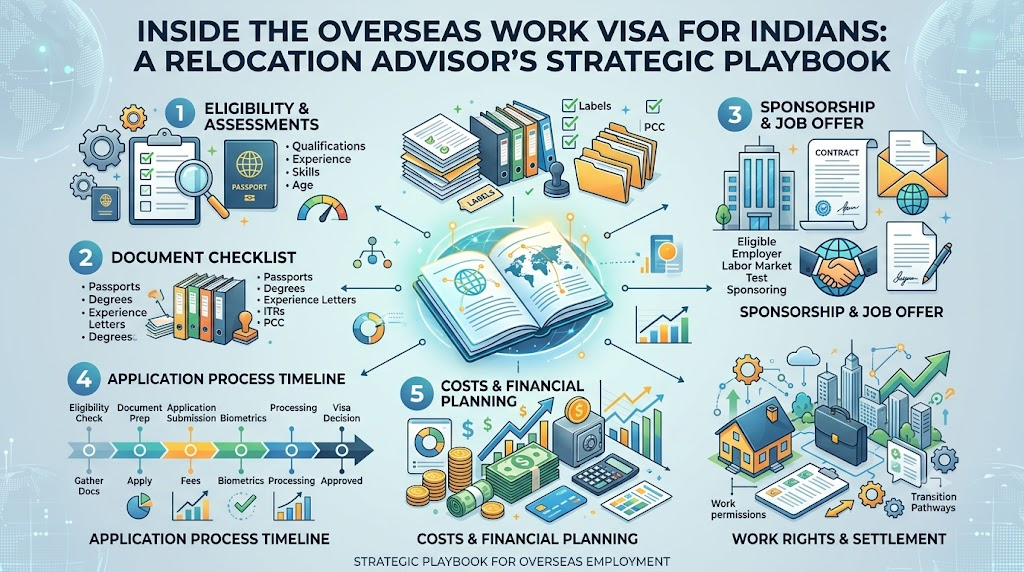
The Step-by-Step Application Process
While specific interfaces and forms differ across consular systems, a successful application generally follows this sequential roadmap:
1. Employment Offer & Labor Certification
   └── Employer secures local labor clearance and issues a compliant offer.

2. Document Assembly & Skill Verification
   └── Academic equivalence checks, language exams, and experience verification.

3. Formal Application Filing
   └── Electronic form completion and non-refundable statutory fee payment.

4. Biometric Enrollment & Background Clearances
   └── In-person fingerprints/photos, medical exam, and police clearance certificates.

5. Consular Adjudication & Passport Endorsement
   └── Case officer review, potential interview, and visa vignette issuance.
1. Job Offer and Sponsorship Clearance
Your overseas employer initiates the process locally by advertising the role, validating compliance with local labor authorities, and paying domestic sponsorship levies. Once cleared, they issue your official certificate or letter of sponsorship.
2. Skills Assessment and Document Preparation
Collect and notarize your academic degrees, past employment reference letters, and banking records. If your destination requires a formal skills assessment, submit your educational credentials and work proof to the designated evaluating body. Complete your language examination during this window.
3. Application Submission and Fee Settlement
Create a profile on the target country’s official government immigration portal. Complete the required personal, educational, and employment schedules accurately. Pay the statutory visa processing fees and mandatory health surcharges online.
4. Biometrics, Police Checks, and Medical Clearances
Book an appointment at an authorized visa application center in India (such as VFS Global or TLScontact) to register your fingerprints and facial photograph. Complete an immigration health assessment with a panel physician approved by the target government, and obtain a Police Clearance Certificate (PCC) through your regional Passport Seva Kendra (PSK).
5. Consular Adjudication and Decision
The immigration department reviews your supporting evidence. If queries arise, they will issue an administrative Request for Information (RFI) or schedule a consular interview. Once approved, you will submit your physical passport for visa endorsement or receive an official digital status notification.
Global Work Pathways Compared
Different regions handle international recruitment under distinct regulatory philosophies:
| Country / Region | Primary Skilled Work Route | Employer Sponsorship Mandatory? | Language Exam Required? | Pathway to Permanent Residency? |
| United Kingdom | Skilled Worker Visa | Yes (Licensed Home Office Sponsor) | Yes (SELT / Secure English Test) | Yes (Typically after 5 qualifying years) |
| Germany | EU Blue Card / Opportunity Card | Yes for Blue Card; No for Opportunity Card | Dependent on role language | Yes (Accelerated PR for Blue Card holders) |
| Canada | Express Entry / LMIA Work Permit | No for Federal Skilled Worker; Yes for LMIA | Yes (IELTS General / CELPIP) | Yes (Direct PR or transition options) |
| Australia | Skills in Demand / Subclass 482 | Yes (Approved Standard Business Sponsor) | Yes (IELTS / PTE Academic) | Yes (Nomination pathways available) |
| United Arab Emirates | Standard Employment Residence Visa | Yes (Mainland or Free Zone Entity) | Typically No | Long-term residency via Golden Visa routes |
Essential Document Checklist
Presenting complete and verifiable paperwork prevents prolonged administrative delays or summary refusals.
- Primary Identity Documents:
- Current Indian passport with a minimum of six months of validity and blank visa leaves.
- Previous physical passports illustrating international travel history.
- Government-issued identity cards and certified birth certificates.
- Employment and Career Evidence:
- Formal employment contract detailing job title, hours, occupational code, and exact salary.
- Official Certificate of Sponsorship or government authorization reference number.
- Detailed experience letters printed on company letterhead outlining specific duties.
- Consecutive payslips (typically covering the past 6 to 12 months) and matching bank deposit statements.
- Income Tax Returns (ITR-V) or Form 16 statements verifying historical Indian employment.
- Educational Credentials:
- Original degree certificates, diplomas, and comprehensive consolidated mark sheets.
- Official third-party credential equivalence assessments where required.
- Language and Background Records:
- Certified score sheets from an approved language testing service.
- Police Clearance Certificate (PCC) issued by the Ministry of External Affairs via Passport Seva.
- Medical clearance certificate from an officially designated panel clinic.
- Tuberculosis (TB) clearance certificate from an approved diagnostic center (mandatory for select destinations).
Navigating the Career Side of Overseas Employment
A valid immigration route requires an actual job offer first. Indian candidates must approach international job hunting with a clear understanding of international market standards:
- Resume Formatting: Indian-style bio-data formats featuring photographs, marital status, and personal details do not meet North American or European recruitment standards. Adopt reverse-chronological resumes highlighting concrete outcomes and measurable project contributions.
- Targeting Skills Shortages: Focus applications on sectors experiencing structural talent deficits, such as enterprise software engineering, data infrastructure, civil engineering, specialized nursing, and green technology.
- Direct Outreach and Verified Networks: Apply directly through corporate careers portals, legitimate international job boards, or verified regional recruitment agencies. Be cautious of unsolicited employment offers delivered via messaging platforms without formal, multi-stage interviews.
Work Rights, Restrictions, and Dependents
Work authorizations come with explicit statutory conditions. Overstepping these limitations can invalidate your status.
Employer Exclusivity
Most sponsored work permits allow you to work solely for the entity named on your authorization. Taking on unauthorized supplementary freelancing, casual shifts, or gig work often violates your visa terms.
Changing Employers
If your working relationship ends, your visa does not instantly renew with a new firm. You must secure a new job offer from another licensed employer willing to lodge a new sponsorship application before your grace period expires.
Dependent Accompaniment
Most skilled work categories permit you to bring your legally married spouse and dependent minor children. However, dependent work rights differ across borders: some countries grant spouses unrestricted open work rights, while others require them to secure independent employer sponsorship.
Path to Permanent Residency
A temporary work visa is often the initial phase of a multi-year settlement plan. Transitioning from temporary work status to permanent residency requires forward planning.
Points-tested economies like Canada and Australia grant substantial credit to candidates who have accumulated domestic in-country work experience. In Canada, one year of continuous skilled Canadian employment unlocks eligibility under the Canadian Experience Class. In Australia, temporary sponsored workers can frequently transition to permanent status via employer-nominated schemes.
Meanwhile, European jurisdictions like Germany offer accelerated settlement permits for EU Blue Card holders who demonstrate ongoing employment and functional local language proficiency. Track your eligibility systematically through official resources and diagnostic tools, including point scoring guides, to monitor your long-term residency options.
Avoiding Common Mistakes and Recruitment Scams
Many Indian applicants experience setbacks or financial losses due to avoidable errors or predatory third parties.
- Job Offer vs. Work Permit Confusion: An appointment letter from an overseas company is not a visa. Only an official embassy, high commission, or interior ministry can issue a work permit.
- Upfront Recruitment Fees: Legitimate employers cover their own international recruitment costs and government sponsorship charges. Demands for processing fees or security deposits are a common indicator of recruitment fraud.
- Inconsistent Work Evidence: Immigration officers cross-examine your submitted experience letters against your tax filings and banking histories. Gaps, missing documentation, or exaggerated duties can trigger refusals on character or credibility grounds.
- Incomplete PCC Declarations: Failing to disclose minor legal disputes or historic traffic convictions can be interpreted as intentional deception, leading to multi-year entry bans.
- Relying on Unofficial Guidance: Social media forums and unverified immigration advisors regularly circulate outdated rules. Always verify policy details directly with official government immigration sources.
Relocation Realities for Indian Professionals
Transitioning from India to an overseas workplace involves substantial logistical and financial preparation:
- Initial Settlement Capital: Budget for upfront deposits, two to three months of rent, temporary lodging, transport passes, and groceries while awaiting your first payroll cycle.
- Tax Compliance and Residential Status: Consult a qualified chartered accountant regarding your Indian residential status under Section 6 of the Income-tax Act. Transitioning to Non-Resident Indian (NRI) status requires updating domestic bank accounts to NRO/NRE designations.
- Community Integration: Connecting with established cultural groups, professional chapters, and Indian diaspora networks abroad helps you navigate local housing markets, healthcare registration, and daily life in a new country.
Practical Application Scenario
Consider an Indian technical architect based in Pune who receives a formal offer from a financial technology enterprise in Dublin, Ireland.
1. Employer Action:
   └── Secures a Critical Skills Employment Permit from Ireland's DETE.

2. Candidate Preparation:
   └── Gathers ITR filings, bank statements, certified degree certificates, and an employment reference letter.

3. Background Clearances:
   └── Secures a PCC via the regional Passport Seva Kendra and books biometric enrollment.

4. Entry Visa Submission:
   └── Submits an Employment Visa (D-Visa) application online via AVATS and delivers documents to VFS Global.

5. In-Country Registration:
   └── Travels to Dublin, completes registration with immigration authorities, and receives an Irish Residence Permit (IRP).
By verifying that the occupation code qualified under Ireland’s critical skills schedule and ensuring the base salary cleared statutory floors, the candidate avoided procedural delays.
Frequently Asked Questions
What are the main requirements for an overseas work visa for Indians?
Applicants generally require an official job offer from an approved foreign employer, documented work experience, recognized educational qualifications, passing language test results, and clear medical and police background checks. The role must also satisfy government wage and occupation rules.
Does having an overseas job offer guarantee my work visa will be approved?
No. An employment contract is an essential prerequisite, but the final decision rests solely with the destination country’s immigration department. Consular officers independently assess your background, credentials, and regulatory compliance before granting entry.
How can Indian applicants confirm if an overseas job offer is legitimate?
Verify the hiring company through local corporate registries and ensure communications come from official corporate domains rather than public email providers. Genuine employers conduct comprehensive interviews and never demand payments for job placement or visa guarantees.
Can I bring my family abroad on a temporary work visa?
Most skilled work permits allow primary holders to sponsor their legal spouse and dependent minor children. You must prove adequate living accommodations and financial resources to support your family without relying on public welfare funds.
Are spouses of Indian work visa holders permitted to work locally?
Work permissions for dependents vary by country. Some destinations grant accompanying spouses open work authorizations, while others require them to find their own employer and qualify for an independent work visa.
What is the purpose of a Police Clearance Certificate (PCC) in the visa process?
A PCC confirms an applicant has no disqualifying criminal convictions or active criminal proceedings. For Indian citizens, official PCCs are processed through the Ministry of External Affairs via local Passport Seva Kendras.
How long does it take to process a work visa for Indians?
Processing timelines vary from two weeks to several months depending on the destination, category, and seasonal application volume. Incomplete applications, background check delays, or requests for additional evidence can extend these timelines.
Can an overseas work visa lead to permanent residency?
Many countries allow skilled workers to transition from temporary work visas to permanent residency after completing a set period of continuous employment, provided they meet language, tax, and residency criteria.
What happens to my visa status if I resign or get laid off abroad?
Your visa status is typically linked to your sponsoring employer. If that relationship ends, governments usually grant a grace period (often 30 to 90 days) to secure a new approved sponsor, switch visa categories, or depart the country.
Where should Indian applicants verify current immigration rules?
Always consult the official immigration, interior ministry, or consular websites of your target country. Avoid relying entirely on social media advice, unverified forums, or unauthorized placement agencies.
Conclusion
Securing an overseas work visa is a major career milestone that demands equal attention to international job hunting and immigration compliance. While landing a verified employment offer is an essential first step, your ultimate success hinges on meeting statutory wage baselines, proving your qualifications through recognized assessment bodies, and providing clean, corroborated tax and employment records. Rushing the application process or relying on informal social media advice often leads to costly delays or avoidable refusals. Treat the journey methodically: verify your employer’s official sponsorship status, assemble your documents well in advance, and plan for the practical financial realities of initial relocation. By staying aligned with official government immigration updates, you protect your professional future and set yourself up for a smooth transition abroad.
