Enhancing DataTables Experience: Custom ID Column with Sequential Index

DataTables is a powerful jQuery plugin that provides an interactive and feature-rich interface for displaying tabular data. One common requirement is to display a custom ID column with a sequential index. In this blog post, we will explore how to implement this feature to enhance the DataTables experience.

The Need for a Custom ID Column

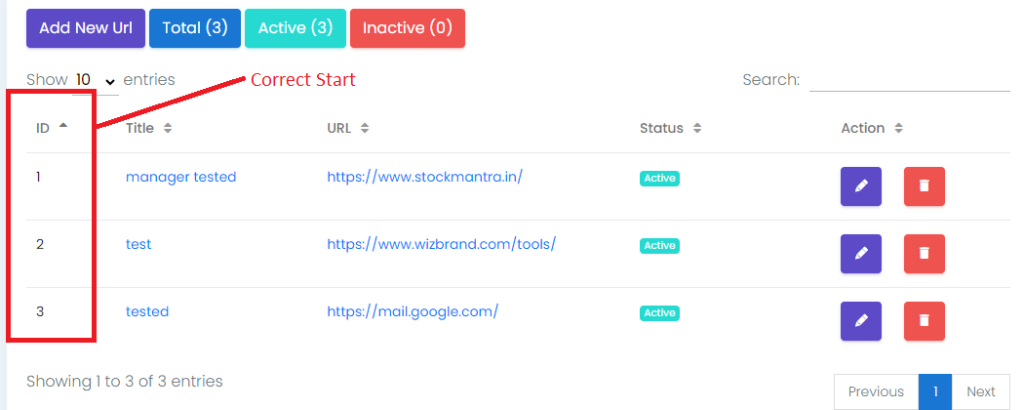
While DataTables automatically generates an ID column for each row, it might not always align with the user’s expectations. In some cases, displaying a custom ID column that starts from 1 and increments sequentially can provide a clearer representation of the data.

Implementing the Custom ID Column

Let’s dive into the implementation. Assume we have a DataTable configuration with the following column definition:

"columns": [{
    "title": "ID",
    "targets": 0,
    "width": "10%",
    "data": 'id',
    "render": function(data, type, row, meta) {
        if (type === 'display') {
            // Generate a sequential index starting from 1
            return meta.row + 1;
        }
        return data;
    }
},

Here’s a breakdown of the key elements:

  • title: Sets the column header to “ID”.
  • targets: Specifies the target column index (0-based).
  • width: Defines the column width.
  • data: Refers to the ‘id’ attribute in the dataset.
  • render: Contains a function to customize the rendering of the data.

The Render Function

The render function is crucial for customizing the display. In this case, it checks the rendering type. If the type is ‘display’, it generates a sequential index using meta.row + 1. This ensures that the index starts from 1 and increments for each row. For other types, such as sorting or filtering, it returns the original data.

Output:-

First, see Original the ID
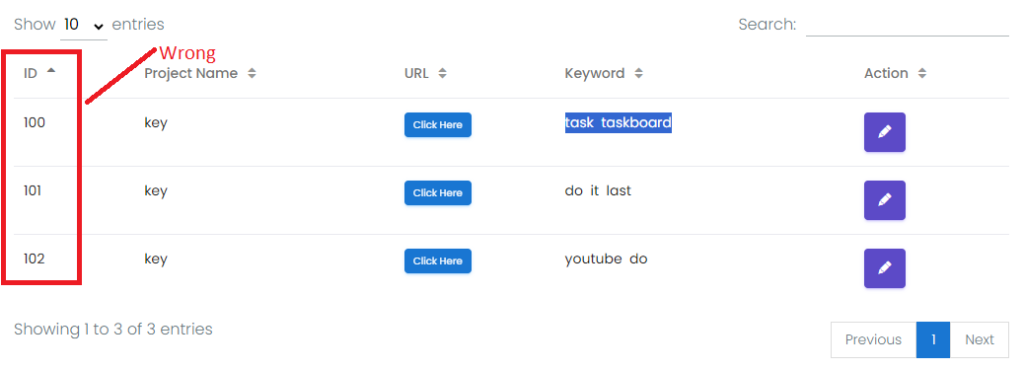
Then, Custom ID
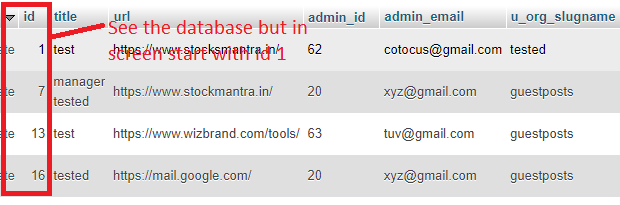
Also, see the database But the Result in the above Image with Custom ID
Hopefully, It will help you …!!!!

Related Posts

Site Reliability Engineering: Key Concepts, Tools, and Best Practices

Introduction Imagine your favorite video game crashes during a match. You feel annoyed because the game stopped working. Websites face this exact problem every single day. Millions…

Read More

The Future of Computer Operations: How Smart Systems Fix Problems

Every day, millions of people tap smartphone screens to navigate morning traffic, order groceries to their doorsteps, and transfer money between bank accounts in seconds. Behind every…

Read More

How DataOps Improves Alert Accuracy with AI Tools

Data pipelines run constantly to deliver numbers, reports, and dashboards. When something breaks, monitoring systems send alerts to data engineers. But when these notifications ring every ten…

Read More

Core Engineering Skills Needed to Master Data Pipeline Automation Systems

Introduction Imagine building a giant LEGO castle, but someone keeps swapping out your plastic bricks for blocks of melting ice. That is what working with raw digital…

Read More

Continuous Data Validation in DataOps: The Complete Architecture Guide

Continuous data validation is the systematic practice of asserting data correctness, schema consistency, and distribution integrity across every state boundary of an enterprise data pipeline. In DataOps,…

Read More

Implementing XOps: Key Pillars, Common Challenges, and Real-World Solutions

Introduction Modern engineering teams rarely run on pure application code alone. Enterprise software delivery now relies on distributed microservices, complex telemetry pipelines, machine learning inference engines, high-throughput…

Read More
Subscribe
Notify of
guest
0 Comments
Oldest
Newest Most Voted
Inline Feedbacks
View all comments
0
Would love your thoughts, please comment.x
()
x