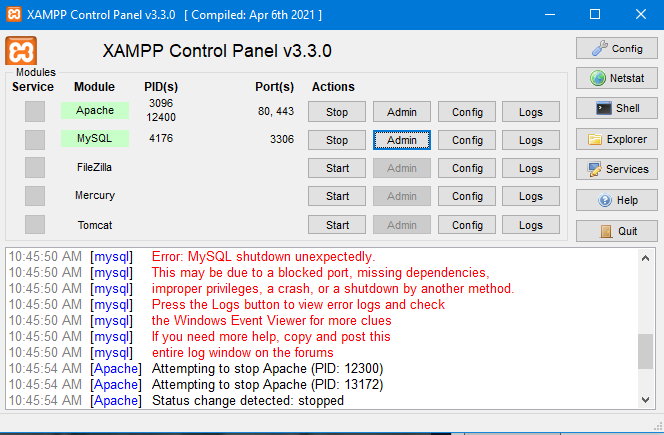
Error: MySQL shutdown unexpectedly.

Solution :-

IMPORTANT: do NOT delete ibdata1 file. You could destroy all your databases.

Instead, first, try using the MySQL backup folder which is included with XAMPP. So do the next steps:

  1. Rename folder mysql/data to mysql/data_old
  2. Make a copy of mysql/backup folder and name it as mysql/data
  3. Copy all your database folders from mysql/data_old into mysql/data (except mysqlperformance_schema, and phpmyadmin folders)
  4. Copy mysql/data_old/ibdata1 file into mysql/data folder
  5. Start MySQL from the XAMPP control panel
Related Posts

The Architecture of Intelligent DataOps: From Ingestion to Automation

Introduction Modern organizations run on distributed data ecosystems. On any given day, an enterprise environment ingests, transforms, and serves petabytes of records sourced from transactional databases, external…

Read More

Transforming Data Reliability: How DataOps Platforms Drive Proactive Monitoring

Introduction Traditional monitoring focuses almost entirely on infrastructure availability and binary job execution states—whether a server is up or whether a task completed. However, modern distributed environments…

Read More

Navigating Pipeline Risks with Expert DevSecOps Consulting Services

Software delivery moves faster today than at any point in technological history. High-performing engineering organizations push code changes to production multiple times a day using automated deployment…

Read More

DevOps Support Services: Key Practices for Stable Production Environments

Introduction Running modern software infrastructure is an ongoing responsibility. A development team may successfully launch an application, but keeping that application reliable in production requires continuous attention….

Read More

DevOps Learning Paths for Kubernetes, Cloud, Security, SRE, and MLOps

Introduction DevOps has become an important part of modern software engineering because development teams are expected to release software quickly without losing control over quality, security, or…

Read More

Best Practices for Multi-Cloud Tool Integration: A Practical DataOps Guide

Introduction Modern organizations rarely rely on a single cloud provider. As enterprise data architectures evolve, teams frequently operate across combinations of Amazon Web Services (AWS), Microsoft Azure,…

Read More