How to Change PHP Version in Ubuntu Server?

Introduction

Hey there! Are you struggling with changing the PHP version on your Ubuntu server? Don’t worry, I’ve got you covered! In this blog post, I’m going to walk you through the step-by-step process of changing the PHP version on your Ubuntu server, and I’ll even provide live examples to make it easier for you. So, let’s dive right in!

Why Change PHP Version?

Before we get into the nitty-gritty of changing the PHP version, let’s quickly discuss why you might want to do this. Upgrading or downgrading your PHP version can be necessary for various reasons:

  1. Compatibility: Some applications or frameworks require specific PHP versions to function properly. Changing the PHP version allows you to make sure your applications are compatible.
  2. Performance: Newer PHP versions often come with performance improvements and optimizations. Upgrading your PHP version can help boost the performance of your server and applications.
  3. Security: Older PHP versions may have security vulnerabilities that have been patched in newer versions. By upgrading to a newer PHP version, you can ensure the security of your server and applications.

Now that you understand the importance of changing the PHP version, let’s get into the steps!

Method 1: Change PHP Version

Change php version by following command:

sudo update-alternatives --config php

you have to choose from the list below:
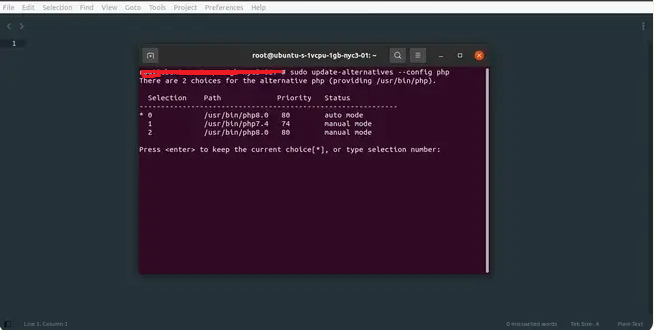
let’s restart server:

sudo service apache2 restart

Method 2: Change PHP Version

you need to a2dismod old version and a2enmod new php version so let’s run following command:

sudo a2dismod php7.3
sudo a2enmod php7.4

let’s restart server:

sudo service apache2 restart

Method 3: Change PHP Version

You can direct change php version by following command:

sudo update-alternatives --set php /usr/bin/php7.4

restart server:

sudo service apache2 restart

I hope it will help you ..!!!

Related Posts

Navigating Pipeline Risks with Expert DevSecOps Consulting Services

Software delivery moves faster today than at any point in technological history. High-performing engineering organizations push code changes to production multiple times a day using automated deployment…

Read More

DevOps Support Services: Key Practices for Stable Production Environments

Introduction Running modern software infrastructure is an ongoing responsibility. A development team may successfully launch an application, but keeping that application reliable in production requires continuous attention….

Read More

DevOps Learning Paths for Kubernetes, Cloud, Security, SRE, and MLOps

Introduction DevOps has become an important part of modern software engineering because development teams are expected to release software quickly without losing control over quality, security, or…

Read More

Best Practices for Multi-Cloud Tool Integration: A Practical DataOps Guide

Introduction Modern organizations rarely rely on a single cloud provider. As enterprise data architectures evolve, teams frequently operate across combinations of Amazon Web Services (AWS), Microsoft Azure,…

Read More

Enterprise DataOps Adoption: How TheDataOps.org Simplifies Transformation

Introduction Modern enterprises run on data. Every strategic business decision, real-time dashboard, predictive financial forecast, and customer-facing machine learning model relies on continuous data streams. However, as…

Read More

Expert Tips for Evaluating Best Dental Hospitals Overseas

Introduction Navigating complex dental care—whether for a single missing tooth, extensive cosmetic restoration, or full-mouth reconstruction—represents a significant personal, clinical, and financial decision. In recent years, global…

Read More
Subscribe
Notify of
guest
0 Comments
Oldest
Newest Most Voted
Inline Feedbacks
View all comments
0
Would love your thoughts, please comment.x
()
x