Introduction
Hey there! Are you ready to dive into the world of Laravel? In this tutorial, we’re going to explore the powerful explode() function in Laravel with live code examples. So grab your favorite beverage, sit back, and let’s get started!
What is the explode() function?
The explode() function in Laravel is a handy tool that allows you to split a string into an array. It takes two parameters: the delimiter and the string you want to split. The delimiter is used to determine where the string should be split.
How to use the explode() function?
Using the explode() function is super easy. Let’s say you have a string that contains multiple words separated by commas, and you want to split it into an array. Here’s how you can do it:
$string = "Hello, Roshan, Jha";
$array = explode(", ", $string);
In this example, we’re using ", " as the delimiter to split the string. The explode() function will separate the string at each occurrence of ", ", resulting in the following array:
$array = [
  0 => "Hello",
  1 => "Roshan",
  2 => "Jha"
];
code example
Now that you understand the basics of the explode() function, let’s dive into a live code example. Imagine you have a form where users can enter multiple tags separated by commas. You want to store these tags in your database as individual records. Here’s how you can achieve that using the explode() function:
public function store(Request $request)
{
    $tags = explode(",", $request->input('tags'));

    foreach ($tags as $tag) {
        Tag::create([
            'name' => trim($tag)
        ]);
    }

    return redirect()->back()->with('success', 'Tags created successfully!');
}
One More live Example
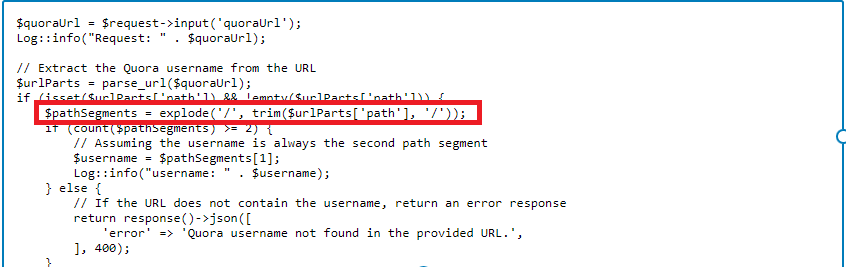
In this example, we’re using the explode() function to split the user-entered tags into an array. We then loop through the array and create a new Tag record for each tag.
Conclusion
And there you have it! You’ve just learned how to use the explode() function in Laravel with live code examples. The explode() function is a powerful tool that can make your life as a Laravel developer much easier. So go ahead, give it a try in your next project.
