Have you ever wondered what MLOps is? Well, wonder no more! In this article, we will explore this topic in-depth and provide you with a comprehensive understanding of what MLOps entails.
Introduction
MLOps is a term that refers to the process of developing, deploying and managing machine learning models in a production environment. It is a relatively new field that has gained significant attention in recent years due to the rapid growth of artificial intelligence (AI) and machine learning (ML).
What is Machine Learning?
Before we dive into MLOps, let’s first define what machine learning is. Machine learning is a subset of AI that involves training algorithms to make predictions or decisions based on data. This is achieved by feeding large amounts of data into an algorithm, which then learns patterns in the data and uses those patterns to make predictions or decisions.
What is MLOps?
MLOps, or Machine Learning Operations, is the process of operationalizing machine learning models. It involves the development, deployment, monitoring, and optimization of machine learning models in a production environment. This process is critical to the success of any machine learning project, as it ensures that the models are performing as expected and delivering value to the organization.
The Importance of MLOps
MLOps is essential because it helps organizations ensure that their machine learning models are performing as expected and delivering value. Without proper MLOps practices in place, machine learning models can become inefficient, inaccurate, and difficult to manage. This can lead to wasted resources, lost opportunities, and ultimately, a failed project.
The Components of MLOps
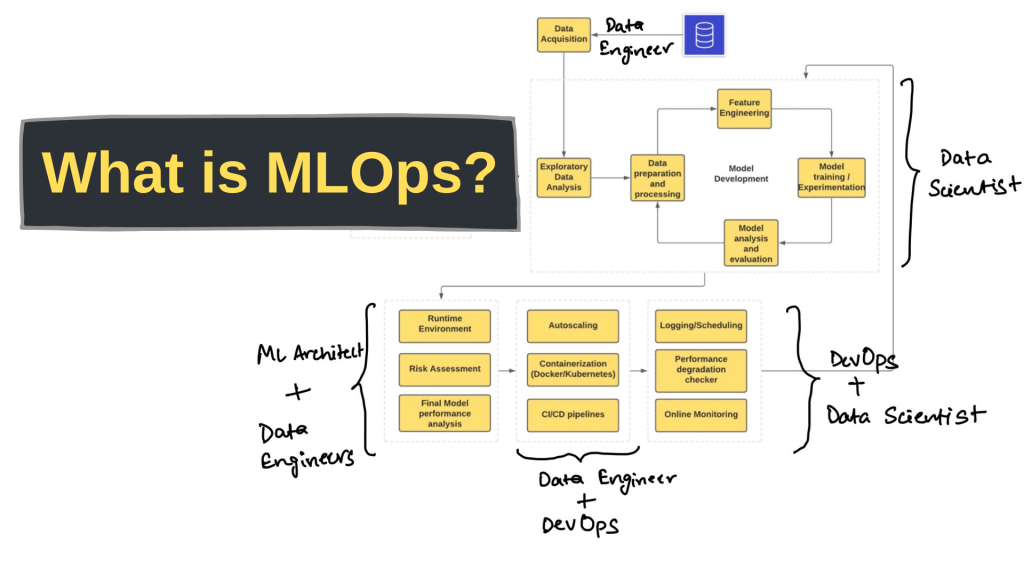
MLOps consists of several components that work together to operationalize machine learning models. These components include:
Data Management
Data management is the process of acquiring, storing, and processing data for machine learning purposes. This involves data cleaning, data integration, and data transformation.
Model Training
Model training is the process of training machine learning models using data. This involves selecting the appropriate algorithm, tuning hyperparameters, and evaluating the model’s performance.
Model Deployment
Model deployment is the process of deploying machine learning models in a production environment. This involves deploying the model to a server, setting up an API, and integrating the model with other systems.
Model Monitoring
Model monitoring is the process of monitoring machine learning models in a production environment. This involves monitoring the model’s performance, detecting anomalies, and triggering alerts when necessary.
Model Optimization
Model optimization is the process of optimizing machine learning models to improve their performance. This involves retraining the model with new data, tuning hyperparameters, and making other adjustments as necessary.
Challenges with MLOps
MLOps can be challenging for several reasons. One of the biggest challenges is the complexity of machine learning models. Machine learning models can be difficult to understand, and it can be challenging to determine why they are behaving in a certain way. Additionally, machine learning models can be computationally expensive, which can make deploying and managing them a challenge.
Conclusion
In conclusion, MLOps is a critical component of any machine learning project. It is the process of developing, deploying, and managing machine learning models in a production environment. By following best practices in MLOps, organizations can ensure that their machine learning models are performing as expected and delivering value. So, if you’re working on a machine learning project, be sure to incorporate MLOps practices into your workflow.
