Introduction
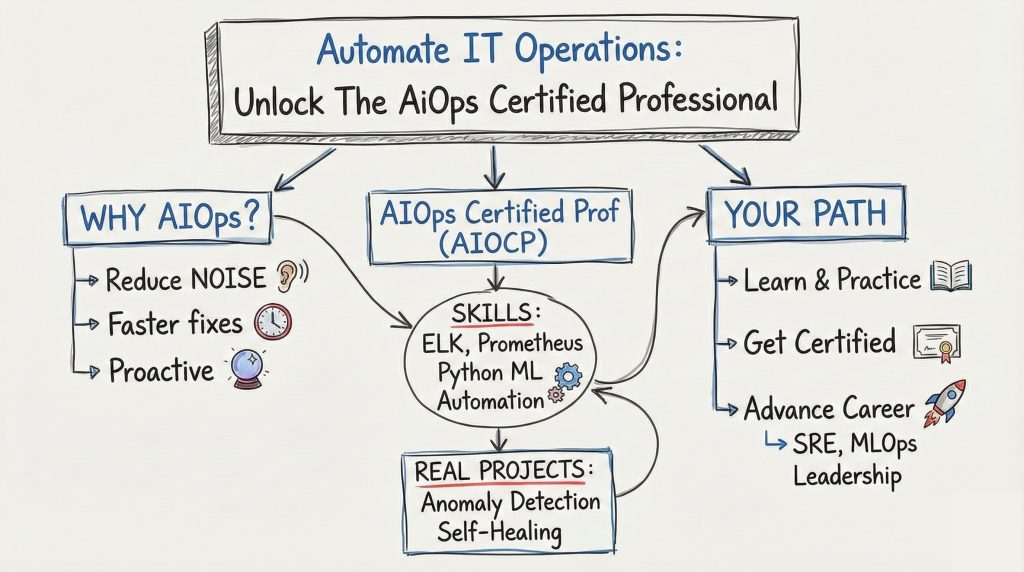
I have seen too many talented engineering teams burn out. They drown in “alert storms”—thousands of error emails flooding their inboxes every day. When a system crashes, they scramble to find the problem while the clock ticks. In the modern world of microservices and cloud computing, manual “fix-it” work is a losing battle.This is where AIOps (Artificial Intelligence for IT Operations) changes the game. It shifts us from “reacting to fires” to “predicting and preventing them.”The AiOps Certified Professional (AIOCP) is the credential that proves you can build this intelligence. It validates that you can stop staring at dashboards and start building systems that manage themselves.This guide covers everything you need to know about the AIOCP certification: the curriculum, the preparation plan, and why it is a career-defining move for engineers and managers alike.
AiOps Certified Professional (AIOCP) – At a Glance
| Feature | Details |
|---|---|
| Certification Name | AiOps Certified Professional (AIOCP) |
| Track | AIOps / Intelligence / Automation |
| Level | Professional (Intermediate to Advanced) |
| Who it is for | DevOps Engineers, SREs, IT Managers, Data Engineers, System Admins |
| Prerequisites | Basic knowledge of Linux, Cloud (AWS/Azure), and fundamental DevOps concepts. |
| Skills Covered | Event Management, Anomaly Detection, Self-Healing, RCA Automation, Python/Bash, Prometheus/Grafana. |
| Recommended Order | Linux Basics → Cloud Fundamentals → DevOps Certified Professional → AIOCP |
What is the AIOCP Certification?
The AiOps Certified Professional (AIOCP) is a comprehensive certification program designed to bridge the gap between IT Operations (keeping systems running) and Artificial Intelligence. In my experience, many people think AIOps is just about “chatbots.” It is much more. This certification teaches you to use machine learning to automate the hardest parts of operations: finding the root cause of a crash and fixing it without human intervention.
Who Should Take It?
- DevOps Engineers: Who want to automate “noise reduction” in alerts.
- SREs (Site Reliability Engineers): Who need to fix problems before customers even notice them.
- System Administrators: Who are transitioning into modern cloud automation.
- AI/ML Engineers: Who need to apply their models to real-world IT Ops.
- IT Managers: Who need to reduce operational costs and improve team efficiency.
Skills You Will Gain
By the end of this certification, you won’t just “know” the concepts; you will be able to implement them in production. The curriculum covers:
- Event Correlation: Reducing thousands of alert emails into single actionable insights. You will learn to filter out the noise.
- Automated Root Cause Analysis (RCA): Using ML to pinpoint why a service failed. Instead of guessing, the system tells you where the bug is.
- Self-Healing Systems: Writing scripts that fix problems without human help. If a server is slow, the system automatically adds more power.
- Cloud Observability: Mastering tools like Prometheus and Grafana to see everything happening inside your applications.
- ML for Ops: Building and deploying models using TensorFlow and PyTorch to detect anomalies in your logs.
- GitOps Integration: integrating AI insights into your deployment pipelines to stop bad code from reaching production.
Real-World Projects You Will Master
Certification is useless without application. After this course, I expect you to be able to build:
- Project 1: The “Noise Reduction” Engine
- Goal: Ingest logs from AWS CloudWatch.
- Outcome: A system that filters out 90% of false alarms, passing only real emergencies to your team.
- Project 2: Self-Healing Pipeline
- Goal: Detect a high-CPU issue in Kubernetes.
- Outcome: The system automatically scales the pod or restarts it to restore health.
- Project 3: Predictive Dashboard
- Goal: Visualize server load trends.
- Outcome: A dashboard that alerts you: “Disk space will be full in 48 hours,” allowing you to act early.
- Project 4: Automated Incident Response
- Goal: Integrate PagerDuty with AI triggers.
- Outcome: A system that only wakes up engineers for real emergencies, not false alarms.
Choose Your Path: Where Does AIOCP Fit?
The IT landscape is vast. Here is how AIOCP fits into your specific career trajectory.
1. The DevOps Path
- Focus: CI/CD + Infrastructure Automation.
- Role: DevOps Engineer -> Sr. DevOps -> AIOps Engineer.
- Why AIOCP: Automates the “Ops” part of DevOps, reducing burnout.
2. The DevSecOps Path
- Focus: Security + Compliance.
- Role: Security Engineer -> DevSecOps Lead.
- Why AIOCP: Uses AI to detect security threats in real-time logs much faster than a human can.
3. The SRE (Site Reliability Engineering) Path
- Focus: Reliability + Scalability.
- Role: SRE -> Principal SRE.
- Why AIOCP: Critical for reducing MTTR (Mean Time To Recovery). This is the core toolkit for a modern SRE.
4. The AIOps / MLOps Path
- Focus: Model Training + Model Serving.
- Role: ML Engineer -> MLOps Architect.
- Why AIOCP: Teaches you how to serve and monitor the models you build in a real production environment.
5. The DataOps Path
- Focus: Data Pipelines + Analytics.
- Role: Data Engineer -> DataOps Lead.
- Why AIOCP: Ensures data pipelines are monitored and self-correcting.
6. The FinOps Path
- Focus: Cloud Cost Optimization.
- Role: Cloud Architect -> FinOps Practitioner.
- Why AIOCP: Uses predictive analytics to forecast cloud bills and identify waste automatically.
Role → Recommended Certification Mapping
| Current Role | Recommended Certification Path | Why? |
|---|---|---|
| DevOps Engineer | CKA (Kubernetes) → AIOCP | You know how to build it; now learn how to let AI run it. |
| SRE | AIOCP → CKS (Security) | Automating reliability is the core job of an SRE. |
| Platform Engineer | Terraform Associate → AIOCP | Build self-service platforms that auto-remediate issues. |
| Cloud Engineer | AWS Solutions Architect → AIOCP | Move beyond “setup” to “intelligent operation.” |
| Security Engineer | CKS → AIOCP | AI-driven threat detection is the future of security. |
| Data Engineer | Kafka/Airflow Certs → AIOCP | Learn to monitor your heavy data pipelines intelligently. |
| Eng. Manager | PMP / Agile → AIOCP | Understand what your team is building and how to reduce costs. |
| FinOps Practitioner | FinOps Certified Practitioner → AIOCP | Predict cloud spend anomalies before the bill arrives. |
Step-by-Step Preparation Plan
Phase 1: Foundations (Days 1–10)
- Focus: Linux, Bash Scripting, and Python Basics.
- Action: Write a Bash script to parse a log file. Write a Python script to hit an API.
- Goal: Get comfortable with the command line and basic automation logic.
Phase 2: Core Ops & Cloud (Days 11–20)
- Focus: AWS Services (EC2, Lambda, CloudWatch) and Docker.
- Action: Deploy a containerized app on AWS. Set up CloudWatch alarms.
- Goal: Understand the “infrastructure” data you will soon be analyzing.
Phase 3: The “AI” in AIOps (Days 21–40)
- Focus: Prometheus, Grafana, and Machine Learning concepts.
- Action: Set up Prometheus to scrape metrics. Build a basic dashboard. Train a simple model in Jupyter.
- Goal: Bridge the gap between data collection and data visualization.
Phase 4: Advanced Integration (Days 41–60)
- Focus: Moogsoft, PagerDuty, Rundeck, and KServe.
- Action: Simulate a crash. Watch your system detect it, alert, and fix it.
- Goal: Achieve the “Self-Healing” state.
Common Mistakes to Avoid
- Skipping the Basics: Don’t jump to AI models if you can’t write a script. AIOps relies on underlying OS automation.
- Ignoring Data Quality: AI is only as good as the data it gets. If your logs are messy, your AIOps will fail.
- Over-alerting: One of the main goals is reducing noise. If you alert on everything, you failed.
- The “Black Box” Trap: Don’t trust the AI blindly. Always verify why the model made a decision.
Best Next Certification After This
- Same Track: Certified Kubernetes Security Specialist (CKS). Securing the automated workloads you just built.
- Cross-Track: Certified Data Engineer. To better handle the massive data pipelines feeding your AI.
- Leadership: Certified Agile Leadership (CAL). If you want to manage the teams building these systems.
Top Training Institutions for AIOCP
While self-study is possible, structured training accelerates mastery. These institutions are known for their delivery of the AIOCP curriculum:
1. DevOpsSchool
This is widely considered the “gold standard” and the primary provider for the AIOCP certification. They are famous for their hands-on lab approach, ensuring you don’t just learn theory but actually build AIOps pipelines. Their instructors are usually working professionals, so you get real industry insights and lifetime access to their community.
2. Cotocus
Cotocus specializes in high-end consulting and corporate training for large enterprises. If you are looking for training that focuses on large-scale digital transformation and how to implement AIOps in big companies, this is the best choice. They often use real case studies from their consulting projects in their classes.
3. Scmgalaxy
If your background is in Build and Release Engineering, Scmgalaxy is the perfect fit. They focus heavily on the “Supply Chain” side of operations, teaching you how to integrate AI tools directly into CI/CD pipelines (like Jenkins or GitLab). They bridge the gap between classic configuration management and modern AI automation.
4. BestDevOps
This platform is excellent for career guidance and roadmaps. They don’t just teach you the subject; they help you understand how to position yourself in the job market after getting certified. If you are a beginner or looking to switch careers, they provide great mentorship on how to stack AIOCP with other skills.
5. devsecopsschool
As the name suggests, this institution focuses on the intersection of Security and AI. If your goal is to use AIOps specifically for threat detection, identifying hackers in logs, or automated security compliance, this is the place to go. They teach you how to turn your monitoring tools into a security shield.
6. sreschool
Tailored specifically for Site Reliability Engineers (SREs). Their curriculum aligns AIOps perfectly with SRE concepts like SLOs (Service Level Objectives) and Error Budgets. They teach you how to use AI not just to fix things, but to measure and improve system reliability mathematically.
7. aiopsschool
This is a niche institute dedicated entirely to AIOps tools and methodologies. Unlike broader schools, they dive very deep into specific tools like Moogsoft, BigPanda, and Prometheus. If you want to become a tool-specific expert, their focused curriculum is very powerful.
8. dataopsschool
AIOps relies entirely on data, and this school focuses on that foundation. They are perfect for Data Engineers or those who want to master log parsing, data pipelines, and data quality before applying AI. They teach you how to ensure the “garbage in, garbage out” problem doesn’t happen to your models.
9. finopsschool
This is unique because it focuses on the financial side of operations. They teach you how to use AIOps to predict cloud bills, find wasted resources (zombie servers), and optimize costs automatically. It is the ideal choice for Cloud Architects and Managers who want to save money for their company.
Frequently Asked Questions (FAQs)
1. Is AIOps hard to learn for a non-programmer?
It requires some coding (Python/Bash), but you don’t need to be a developer. The focus is on scripting for automation.
2. How long does it take to get certified?
Typically 4-8 weeks if you dedicate 5-8 hours a week.
3. Do I need to know Machine Learning math?
No. You need to know how to apply ML models, not how to derive the math behind them.
4. Is this certification recognized globally?
Yes, companies worldwide are moving toward “Autonomous Operations.”
5. Can I take this if I am a fresher?
Yes, but it is recommended to have at least basic Linux/Cloud knowledge first.
6. What is the difference between DevOps and AIOps?
DevOps is about speed (CI/CD). AIOps is about intelligence (using data to make operations smarter).
7. Does this cover Generative AI (LLMs)?
Modern AIOps curriculums are increasingly incorporating GenAI for things like log analysis.
8. What is the salary impact?
AIOps specialists often command a premium over standard DevOps engineers due to the niche skills.
9. Is the exam fee included in the training?
Typically yes, but always check with the specific institution (like DevOpsSchool).
10. Do I need a powerful computer?
No, most labs are cloud-based, so a standard laptop is fine.
11. Is the exam online?
Yes, the certification exam can be taken online from anywhere.
12. Why is this better than just learning Python?
Python is a tool. AIOCP teaches you the methodology of applying that tool to solve operational problems.
Frequently Asked Questions (FAQs) on AiOps Certified Professional (AIOCP)
1. Do I need to be a Data Scientist or a Math expert to take this course?
No. This is the most common myth. You do not need to know complex calculus or how to build algorithms from scratch. The AIOCP focuses on Applied AIOps. You will learn how to use existing AI models and tools (like TensorFlow or ready-made AIOps platforms) to solve IT problems. If you understand basic logic and data flow, you can do this.
2. How is AIOCP different from a standard DevOps certification?
Standard DevOps certifications (like Docker or Jenkins) focus on building and deploying software quickly. AIOCP focuses on running and monitoring that software intelligently. DevOps helps you ship code; AIOCP helps you ensure that code doesn’t crash, and if it does, it helps you fix it automatically. It is the “Level 2” of DevOps.
3. What specific tools will I learn in this certification?
The curriculum is hands-on. You will typically master:
- Monitoring: Prometheus, Grafana, ELK Stack (Elasticsearch, Logstash, Kibana).
- Automation: Rundeck, Ansible, or Python scripting.
- AI/ML Libraries: Basics of TensorFlow and Scikit-learn for log analysis.
- AIOps Platforms: Concepts used in tools like Moogsoft, BigPanda, or Dynatrace.
4. Will this certification help me get a salary hike?
Yes. AIOps is a niche skill. While there are thousands of DevOps engineers, there are very few AIOps specialists. Companies are willing to pay a premium for engineers who can reduce downtime and cloud costs using automation. It moves you from being a “doer” to a “strategic asset.”
5. How much time do I need to prepare for the exam?
For most working professionals, I recommend 4 to 6 weeks. If you spend about 5-8 hours per week studying and doing the labs, you will be ready. If you are already very strong in Linux and Python, you might finish in 3 weeks.
6. Is the certification exam online?
Yes. The AiOps Certified Professional (AIOCP) exam is conducted online. You can take it from your home or office. It usually consists of multiple-choice questions and scenario-based questions where you have to choose the best AIOps solution for a specific problem.
7. Does the AIOCP certification expire?
Certifications in fast-moving fields usually have a validity period (often 2-3 years), or they require you to stay updated. Since AIOps tools change quickly, it is good practice to refresh your knowledge. However, check the specific policy on the DevOpsSchool official page for the exact validity rules of the current version.
8. What are the prerequisites? Can a fresher take this?
While a fresher can take it, I strongly advise having some foundation first. You should be comfortable with Linux command line (using the terminal) and have a basic understanding of Cloud (AWS/Azure). If you try to learn AIOps without knowing how a server works, you will struggle. I recommend finishing a “DevOps Fundamentals” course first.
Testimonials
“I was drowning in alerts every night. The AIOCP course taught me how to use tools to filter out the noise. I finally have my weekends back.”
— Rajesh K., Senior SRE, Bangalore
“The module on Self-Healing with Rundeck was a game changer. We reduced our downtime by 40%.”
— Sarah J., Platform Lead, London
“DevOpsSchool’s instructor didn’t just teach theory; they showed us real production failures and how AIOps solves them.”
— Amit V., Cloud Engineer, Pune
Conclusion
The era of staring at dashboards and waiting for red lights is over. The AiOps Certified Professional (AIOCP) is your gateway to the future of IT Operations—a future where systems are self-aware, self-healing, and efficient. I have seen firsthand how these skills transform careers. Whether you are in India or anywhere else in the world, this certification equips you with the tools to lead that transformation. Don’t just manage infrastructure; engineer it to manage itself.
