Introduction
Have you ever stopped to think about what actually keeps a bank running? It is easy to picture vaults full of cash or gold bars, but the absolute lifeblood of the modern financial world is data. Banks, stock traders, and insurance companies run entirely on numbers. If those numbers are late, missing, or even slightly wrong, these companies can lose millions of dollars in the blink of an eye. In finance, speed and accuracy are everything, and there is no room for guesswork.
However, many financial institutions are still relying on old, slow methods to manage their numbers. Analysts often wait days for reports to load, and by the time they get the information, it is already old news. This is where a new approach comes in. By adopting the principles found at Thedataops.org, banks are completely replacing their outdated data habits. They are building smart, automated systems that help them make lightning-fast decisions based on facts they can actually trust.
DataOps is essentially a set of best practices that acts as a super-fast, highly secure highway for financial information. Instead of people manually moving numbers around in spreadsheets, this methodology automates the entire process. It constantly tests the numbers for accuracy and watches over the system to catch errors long before they ever reach a manager’s final dashboard.
The High Cost of Bad Data in Banking
Imagine trying to buy a house, but the only information you have about your bank account balance is from three weeks ago. You would have no idea if you actually had enough money to make the purchase. Surprisingly, many large banks and investment firms operate in a very similar way. They rely on manual data entry, where human workers spend hours typing numbers from one system into another. Humans get tired, and it only takes one missed decimal point or one small typo to create a massive, expensive mistake on a financial report.
Beyond human error, traditional banking systems often suffer from broken data pipelines. A pipeline is just the path that information takes to get from a storage database to the screen of the person who needs to read it. In older setups, these paths break down constantly. A system update in one department might accidentally cut off the flow of information to another. When this happens, financial analysts are left sitting around, unable to do their jobs while they wait for technical support to fix the broken connection.
Another huge problem is what experts call “siloed” departments. A silo simply means that different teams within the same bank are not sharing their information easily. The loan department might have one set of numbers, while the credit card department has a completely different set. When these teams try to meet and look at the big picture, their numbers do not match up. They end up arguing over who has the correct information instead of actually making decisions to help the business grow.
The ultimate danger of all these issues is making a massive financial choice based on an outdated or incorrect spreadsheet. If an investment firm decides to buy shares in a company based on a report that is missing the last two days of market activity, they are flying blind. They might invest millions of dollars right before a major drop in value, simply because their slow, broken data systems could not warn them in time.
How DataOps Fixes Broken Financial Analytics
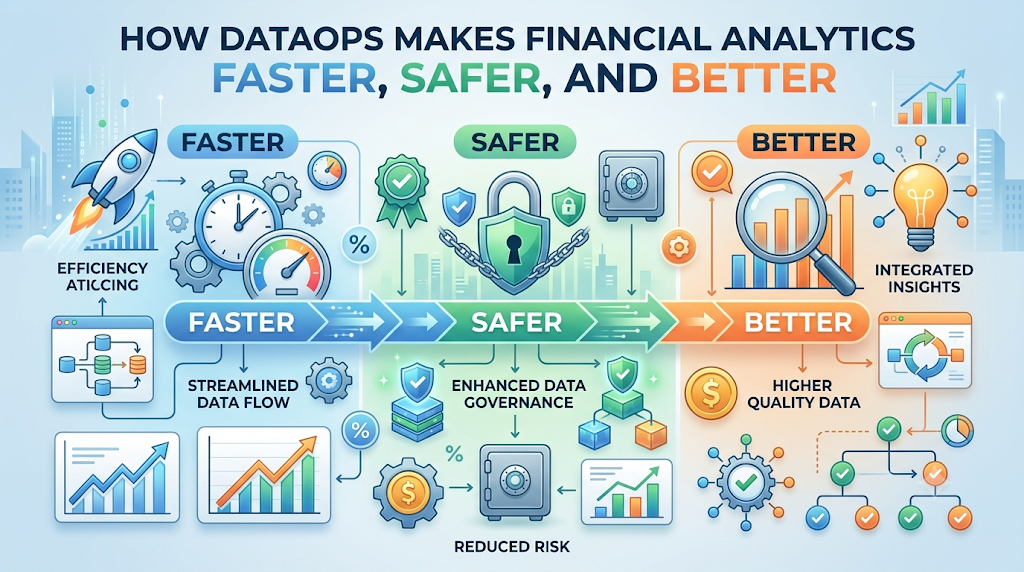
DataOps steps in to fix this mess by acting like a highly organized, modern factory for information. Instead of treating data as a messy pile of numbers that humans have to sort out by hand, it treats data as a product that needs to be moved quickly, safely, and perfectly. This approach brings order, speed, and safety to financial numbers through a few core steps.
Automating the Data Flow
The first major fix is automation. In a DataOps setup, humans are no longer responsible for copying and pasting information between different banking software programs. The system is set up so that the moment a customer makes a deposit, that number automatically flows through the entire bank’s network. The reporting dashboards update instantly on their own. This means financial analysts never have to wait days for a fresh report; the freshest numbers are always sitting right in front of them, ready to be used.
Spotting Errors Instantly
The second crucial fix is continuous testing. Think of this like an extremely powerful spell-checker, but instead of looking for misspelled words, it looks for mathematical mistakes and missing numbers. As the data moves through the automated pipeline, the system runs thousands of automated tests every second. If a file is missing a chunk of numbers, or if a total does not add up properly, the system spots it instantly. It stops the broken data from moving forward and alerts an engineer right away, ensuring that managers never see or use bad information.
Keeping Sensitive Data Secure
In the financial world, keeping information safe is just as important as keeping it fast. Banks handle incredibly private details, like social security numbers and bank account passwords. DataOps methodology includes strict security rules built right into the automated pipeline. For example, when software engineers are testing a new app for the bank, the system will automatically mask or hide the real customer information. The engineers can see the structure of the data to do their work, but the sensitive personal details remain completely hidden and secure.
Comparing Traditional Finance Data vs. DataOps
| Feature | Traditional Financial Data Team | DataOps-Driven Team |
|---|---|---|
| Speed of Decision Making | Very slow. Analysts wait days or weeks for data reports to be manually generated. | Lightning-fast. Data flows in real-time, allowing instant decisions on the most current numbers. |
| Error Rate in Reports | High. Manual copy-pasting and human data entry lead to typos and mismatched numbers. | Extremely low. Automated, continuous testing catches missing or incorrect numbers instantly. |
| Security and Compliance | Risky. Customer information is often passed loosely in unencrypted emails or files. | Highly secure. Sensitive information is automatically masked, tracked, and protected at every step. |
Looking at the table above, the contrast between the old way of doing things and the modern approach is night and day. A traditional financial data team is constantly fighting an uphill battle. They spend the vast majority of their time just trying to find the right numbers and making sure those numbers are correct. By the time they actually get to analyze the information and make a choice, the opportunity to make a good investment or fix a customer problem might have already passed them by.
On the other hand, a team using modern, automated pipelines is completely freed from the tedious chore of manual data gathering. Because the system handles the heavy lifting of moving, checking, and securing the numbers, the human workers can focus entirely on their actual jobs. They can spend their day looking at real-time market trends, finding new ways to help their clients, and spotting long-term financial patterns that a slow, traditional team would completely miss.
Real-World Scenario: Catching Fraud Before It Happens
To truly understand how powerful this is, let us look at a real-world scenario involving a credit card company. Imagine you are visiting your local grocery store, and you use your credit card to buy a simple cup of coffee. At that exact same moment, a hacker halfway across the world is trying to use your stolen credit card number to buy a brand-new television online.
In an older, traditional banking setup, the data from those two purchases might be batched together and processed at the end of the day, or even the next morning. By the time the bank’s security team receives the report showing that your card was used in two different countries at the exact same time, the hacker has already walked away with the television. The bank is then forced to refund your money, eat the cost of the stolen item, and spend weeks investigating the issue.
Now, picture that same scenario with a modern, automated pipeline in place. As soon as both card swipes happen, the data instantly enters a high-speed flow. Within a fraction of a second, the system runs an automated test checking the physical location of the purchases. The system instantly realizes that it is physically impossible for you to be in a local grocery store and a foreign electronics shop at the exact same moment.
Because the system caught the error instantly in real-time, it automatically blocks the transaction for the television before the payment ever goes through. The hacker gets denied, your money stays safe, and the bank does not lose a single penny. There is no human intervention required to stop the theft; the automated, well-tested data pipeline simply did its job perfectly.
The Future of Financial Decision Making
As we look ahead, the way banks and financial institutions handle their numbers is going to keep getting faster and smarter. The current focus on organizing and speeding up data is really just setting the foundation for the next big leap forward, which involves Artificial Intelligence. Everyone is talking about how AI will change finance, but AI is completely useless if it is fed bad, messy, or outdated information.
Because DataOps acts as a giant filter that cleans and organizes information perfectly, it is the exact tool needed to make AI work in the real world. In the near future, financial companies will blend their highly organized data pipelines directly with artificial intelligence software. Instead of just catching credit card fraud as it happens, the systems will be able to look at years of clean data and predict exactly when and where fraud is most likely to happen next.
This blend of clean data and smart software will also completely automate financial forecasting. Today, experts try to guess if the stock market will go up or down based on the news. Tomorrow, automated systems will analyze millions of clean data points from around the world in seconds, predicting market shifts and managing investment risks with a level of accuracy that human brains simply cannot match. The banks that master their data pipelines today will be the ones that rule the financial world tomorrow.
Conclusion
In the end, the financial industry is built on trust and accuracy. When banks rely on slow, manual processes, they break that trust by making errors, delaying decisions, and leaving their customers vulnerable. The modern DataOps approach offers a clear, logical way out of the mess. By treating information like a valuable product moving down an automated, highly inspected assembly line, financial organizations can finally stop worrying about whether their spreadsheets are accurate. They can trust their numbers, speed up their choices, and provide a much safer, smarter service to the people who trust them with their money.
FAQs
What is DataOps?
It is a set of practices that automates and improves how data flows through a company, making sure the information is fast, accurate, and secure.
Why is data so important in finance?
Banks and investment firms make all their decisions based on numbers. If the numbers are wrong or late, they can lose massive amounts of money.
What is a data pipeline?
A data pipeline is the digital path that information travels to get from a storage system to the screen of the person who needs to read it.
How does traditional banking handle data?
Many traditional banks still use manual data entry and move numbers around using outdated spreadsheets, which is slow and causes errors.
What happens if a bank uses bad data?
Using bad data can lead to huge mistakes, like making a bad investment, approving a bad loan, or failing to stop credit card fraud.
How does automation help financial analysts?
Automation moves and updates the numbers instantly, so analysts do not have to wait days for a report to be created by hand.
What is continuous testing in data?
It is like an automated spell-checker for numbers. It constantly checks the data for errors as it moves through the system, stopping bad numbers instantly.
How does DataOps keep customer information secure?
It automatically masks or hides sensitive details like passwords and social security numbers while software engineers test the banking systems.
Can automated pipelines stop credit card fraud?
Yes. By analyzing transactions in real-time, the system can spot impossible scenarios (like a card used in two countries at once) and block the payment instantly.
How will this affect the future of banking?
Clean, automated data is the foundation for Artificial Intelligence. In the future, AI will use this clean data to predict market changes and stop fraud before it even happens.
