Introduction
In my time watching the tech world shift from physical data centers to the cloud, I have seen security move from a “last-minute check” to the very foundation of business. Today, a single security flaw can ruin a company’s reputation and its finances in minutes, making cloud security a primary concern for every CEO. As organizations move their most sensitive data to AWS, they are searching for experts who can do more than just follow a checklist. They need people who can think like an attacker and build like an architect. This guide is your roadmap to becoming that expert through the AWS Certified Security – Specialty program.
Why Cloud Security is the Defining Skill of This Decade
The job market has changed; it is no longer enough to just know how to deploy an application or manage a database. Companies are now prioritizing “Security First” cultures, where every engineer is expected to understand how to protect the assets they build and manage. Whether you are working in India’s booming tech sector or for a global firm, having a specialized security credential sets you apart from the general cloud workforce. It proves that you have the discipline to master the most complex parts of the AWS platform, such as encryption and identity management.
AWS Certified Security – Specialty: At a Glance
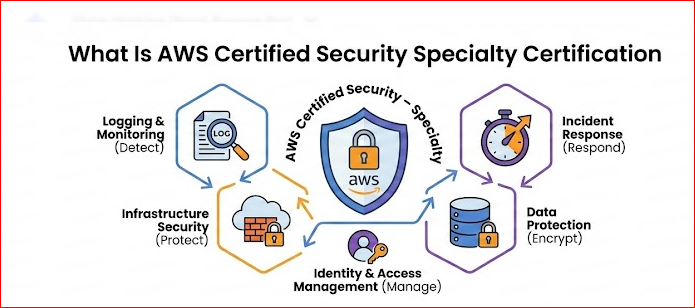
This certification is designed to prove that you are not just a user of AWS, but a guardian of it. It focuses on five key areas: Incident Response, Logging and Monitoring, Infrastructure Security, Identity and Access Management, and Data Protection.
| Feature | Details |
| Certification Name | AWS Certified Security – Specialty (SCS-C02) |
| Track | Specialty |
| Level | Advanced / Expert |
| Who it’s for | Experienced cloud professionals, Security Engineers, DevOps/SecOps Engineers. |
| Prerequisites | None officially, but hands-on AWS experience is vital. |
| Skills Covered | Incident response, logging, network security, IAM, and data encryption. |
| Recommended Order | Best taken after an Associate-level certification. |
Deep Dive: AWS Certified Security – Specialty
What it is
This is a deep-dive exam that covers the technical nuances of securing the AWS ecosystem at scale. It tests your ability to use services like KMS for encryption, Identity and Access Management (IAM) for permissions, and specialized tools like GuardDuty for threat detection.
Who should take it
This certification is perfect for Cloud Engineers who want to move into high-paying security roles or for Senior Developers who lead project architecture. It is also highly valuable for Technical Managers who need to understand the security risks their teams are managing every day.
Skills you’ll gain
- You will learn how to design complex IAM policies that follow the “Principle of Least Privilege” to keep systems safe.
- You will master the art of data protection, ensuring that information is encrypted perfectly both when it is stored and when it is moving.
- You will gain the ability to build automated systems that detect threats and fix security gaps without any human intervention.
Real-world projects you should be able to do after it
- Zero-Trust Architecture: Designing a system where every request is verified, ensuring that even if one part of your network is compromised, the rest remains safe.
- Automated Log Analysis: Building a pipeline that collects logs from all your AWS accounts and uses machine learning to find and alert you about suspicious activity.
- Encryption at Scale: Setting up an organization-wide encryption strategy that automatically protects every piece of data uploaded to your cloud environment.
Preparation plan
- 7–14 Days (The Sprint): This is for those who are already living in the AWS security console daily. Focus on taking multiple practice exams to get used to the long, scenario-based questions that AWS uses.
- 30 Days (The Professional): Spend two hours a day watching deep-dive videos and another hour performing hands-on labs in your own AWS account. This helps connect the theory to the actual buttons you have to click.
- 60 Days (The Career Changer): If you are moving from a different area of IT, take your time to read the official AWS whitepapers on security. Build, break, and fix security configurations until you understand exactly how they work.
Common mistakes
- Ignoring the “Why”: Many people memorize what a service does but fail to understand why you would choose it over another similar service in a specific business situation.
- Over-complicating IAM: Beginners often create “Star” (*) permissions because they are easier, but the exam—and real life—demands that you be specific and restrictive with access.
- Skipping Documentation: The exam often covers small details found in the official AWS FAQs and documentation that are not always covered in basic training videos.
Choose Your Path: 6 Learning Journeys
DevOps
In a DevOps world, speed is everything, but it cannot come at the cost of safety. This path teaches you how to embed security checks into your automated pipelines so that vulnerabilities are caught before the code is even deployed.
DevSecOps
This is the ultimate career path for security-minded engineers who want to lead. You will learn how to build “Security as Code,” making sure that every piece of infrastructure you create is automatically compliant and secure by design.
SRE (Site Reliability Engineering)
Reliability is impossible without security, as a single attack can take your whole system offline. This path focuses on building resilient systems that can withstand attacks and recover automatically, ensuring your services stay up and running.
AIOps / MLOps
As we move into the age of AI, the data used to train models has become a prime target for theft. This path teaches you how to secure your data lakes and model training environments, ensuring your intellectual property remains private and protected.
DataOps
Data is the most valuable asset a company has, and protecting it is a huge responsibility. This path focuses on managing massive amounts of data while ensuring it is encrypted and that only the right people have access to the right parts of it.
FinOps
Security breaches often lead to massive, unexpected cloud bills from unauthorized resource usage. This path helps you understand how strong security governance and IAM controls are actually the best tools for managing and reducing your cloud costs.
Role → Recommended Certifications Mapping
| Current Role | Why the Security Specialty? | Recommended Roadmap |
| DevOps Engineer | To build safer deployment pipelines. | SysOps Associate → Security Specialty |
| SRE | To harden systems against outages. | Solutions Architect Associate → Security Specialty |
| Platform Engineer | To create secure foundations for apps. | Developer Associate → Security Specialty |
| Cloud Engineer | To specialize in high-demand roles. | Cloud Practitioner → Security Specialty |
| Security Engineer | To validate your professional expertise. | Solutions Architect Associate → Security Specialty |
| Data Engineer | To protect sensitive company data. | Data Analytics Specialty → Security Specialty |
| FinOps Professional | To prevent cost spikes from breaches. | Cloud Practitioner → Security Specialty |
| Engineering Manager | To lead with technical authority. | Cloud Practitioner → Security Specialty |
Top Institutions for AWS Security Training
- DevOpsSchool: This institution stands out for its practical, job-oriented approach. They focus on real-world scenarios that help you understand how to apply security in a professional environment, making them a top choice for career growth.
- Cotocus: They provide specialized training that is deeply aligned with current industry standards. Their courses are designed for those who want to master the technical details of cloud security through intensive, hands-on learning experiences.
- Scmgalaxy: A long-standing community leader that offers a wealth of resources and training. They are excellent for engineers who want to understand the broader ecosystem of configuration management alongside their security studies.
- BestDevOps: This provider focuses on high-quality, streamlined training programs. Their curriculum is designed to help you reach your certification goals quickly without sacrificing the depth of knowledge required for the actual job.
- devsecopsschool: If you want to focus specifically on the intersection of security and development, this is the place. They offer niche training that prepares you for the specific challenges of modern, automated security workflows.
- sreschool: Their programs are tailored for those who care about system uptime and performance. They teach security through the lens of reliability, helping you build systems that are both fast and incredibly hard to break.
- aiopsschool: They are at the forefront of the AI revolution, offering training that covers how to secure modern AI workflows. This is perfect for engineers looking to future-proof their careers in the age of automation.
- dataopsschool: Focused entirely on the data lifecycle, this school helps you master the security of data pipelines. They provide the specific tools needed to manage compliance and data protection at a massive scale.
- finopsschool: They bridge the gap between finance and technology. Their training shows you how a secure environment leads to better financial health, teaching you how to manage both risk and cloud spend simultaneously.
FAQs (AWS Certified Security – Specialty)
Q1: Is this exam harder than the Solutions Architect Associate?
Yes, it is much more difficult because it requires a very deep understanding of specific services. While the Associate exam asks what a service does, the Security Specialty asks how you would configure it to solve a complex security problem.
Q2: Do I need to be a programmer to pass?
You don’t need to write complex software, but you must be comfortable reading and editing JSON files. This is because all AWS security policies and many automation scripts are written in this format.
Q3: How much does the certification help with salary?
In my experience, security specialists are among the highest-paid cloud professionals. This certification serves as proof of your advanced skills, often leading to significant pay increases and more senior job titles.
Q4: Can I take this as my first AWS certification?
Technically you can, but I don’t recommend it. It is much better to have the foundational knowledge from an Associate-level exam first, so you aren’t struggling with basic cloud concepts while trying to learn advanced security.
Q5: How relevant is this for the Indian job market?
It is incredibly relevant. As India becomes a global hub for cloud operations and digital transformation, the demand for certified security experts is far higher than the number of people who actually have the skills.
Q6: What is the most important service to study?
Identity and Access Management (IAM) is the most critical. It is the core of almost every question on the exam, and if you don’t understand how IAM works, you cannot pass the certification.
Q7: Does the exam cover hybrid cloud security?
Yes, you will likely see questions about how to securely connect your on-premise data center to AWS using VPNs or Direct Connect. You need to know how to maintain security across both environments.
Q8: How long is the certification valid?
Like most AWS certifications, it is valid for three years. After that, you will need to recertify to show that you are still up-to-date with the latest security features and best practices.
Frequently Asked Questions (FAQs)
Q1: How difficult is the AWS Security Specialty exam compared to Associate-level certifications?
The difficulty is significantly higher. Associate exams often test your knowledge of what service to use, whereas the Security Specialty tests your ability to troubleshoot complex, multi-layered security failures. You must be able to distinguish between several “correct” technical answers to find the one that is the most secure and follows AWS best practices.
Q2: What is the ideal time commitment for preparation?
For most working professionals, I recommend budgeting between 60 to 80 hours of total study time. This usually translates to about 6 to 8 weeks if you are studying 10–12 hours per week. If you have very little hands-on experience with advanced IAM or KMS, you may need to extend this to 12 weeks to accommodate extra lab time.
Q3: Are there any hard prerequisites before I can sit for the exam?
Officially, AWS no longer requires you to hold an Associate certification before taking a Specialty exam. However, from a practical standpoint, attempting this without at least the AWS Certified Solutions Architect – Associate is risky. The exam assumes you already understand VPC networking, compute, and storage fundamentals inside and out.
Q4: In what sequence should I take my AWS certifications to reach this level?
The most effective path is: Solutions Architect – Associate → SysOps Administrator – Associate → Security – Specialty. The Solutions Architect gives you the big picture, the SysOps Admin gives you the operational “how-to,” and the Security Specialty then dives deep into the specific guardrails and defense mechanisms needed to protect those environments.
Q5: What is the real-world value of this certification for an engineer?
The value lies in “authority.” When you hold this certification, your architectural recommendations carry more weight during design reviews. It proves to your peers and leadership that you aren’t just guessing—you understand the cryptographic and identity-based underpinnings that keep the company’s data safe from breaches.
Q6: What are the primary career outcomes after becoming certified?
Common career moves include transitioning from a Cloud Engineer to a Senior Security Architect or a DevSecOps Lead. In the global market, particularly in high-growth regions like India and the US, this certification is often a gatekeeper for roles that involve managing sensitive data in finance, healthcare, or government sectors.
Q7: Does this certification help in moving into leadership roles like Engineering Manager?
Absolutely. For a manager, this certification provides the technical depth needed to audit a team’s work and ask the right questions during a crisis. It ensures you aren’t just “managing people,” but leading a technically sound organization that prioritizes risk management as a core business value.
Q8: How does the exam handle the “Security vs. Usability” trade-off?
The exam will often present scenarios where a security measure might break an application. You are expected to choose the solution that provides the highest level of security while maintaining the required functionality. Understanding how to use “Condition keys” in IAM is a great example of where this technical balance is tested.
Q9: Is the investment in this certification worth it for Software Engineers?
Yes, because modern software engineering is increasingly focused on “shifting left.” If you can write code that is secure by design and understand how to manage your own application’s secrets using AWS Secrets Manager, you become much more valuable to a modern, agile development team.
Q10: What is the passing score and format of the exam?
You need a minimum score of 750 out of 1000 to pass. The exam consists of 65 questions, which are either multiple-choice or multiple-response. You have 170 minutes to complete it, which sounds like a lot, but the scenario-based questions are often very long and require careful reading.
Q11: Will I be tested on non-AWS security tools?
The exam focuses strictly on AWS native services like WAF, Shield, Macie, and GuardDuty. While you might see mentions of “third-party logs,” the focus is always on how AWS tools (like Kinesis or S3) ingest and analyze that data, rather than the configuration of the third-party tool itself.
Q12: How do I maintain the certification once I pass?
The certification is valid for three years. To remain certified, you must pass the current version of the AWS Certified Security – Specialty exam again. This ensures that you stay current with the rapidly changing landscape of cloud security and the new services AWS launches every year.
Testimonials
“The depth of this guide matches what I faced in the exam. Understanding the ‘Role Mapping’ helped me realize that as a Data Engineer, I was missing out on the critical encryption skills I needed for my daily work.”
— Rajesh V., Data Engineer
“I used the 30-day plan mentioned here, and it worked perfectly. The focus on hands-on labs instead of just watching videos was the key to me finally understanding how KMS and IAM work together.”
— Priya S., Cloud Architect
Conclusion
Mastering AWS security is a journey that requires patience, practice, and a willingness to dive into the most complex parts of the cloud. This certification is not just a badge; it is a sign that you have the expertise to protect the digital world. The path ahead is challenging, but the rewards—both in terms of your career and your technical ability—are well worth the effort. Start your preparation today, focus on the fundamentals, and soon you will be the expert that every organization is looking for.
