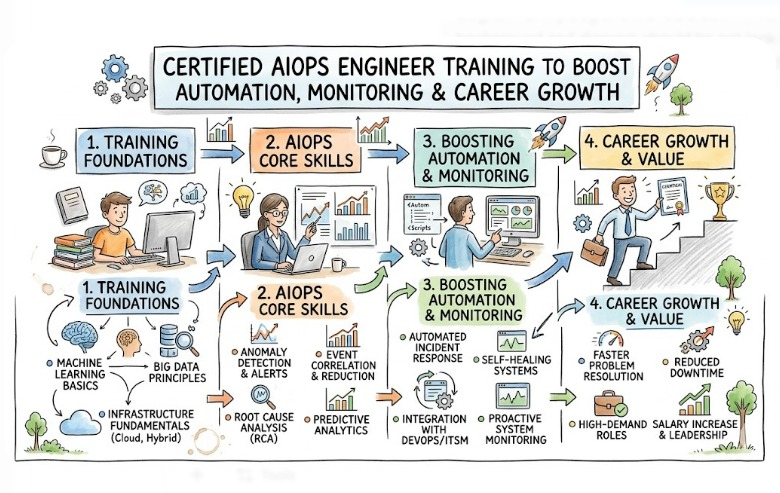
The Certified AIOps Engineer is a specialized professional program designed to integrate artificial intelligence into modern IT operations. As systems scale and generate massive amounts of telemetry data, human operators can no longer manage performance and reliability manually. This guide is built specifically for engineers and technical managers who want to transition from traditional monitoring to intelligent automation. It provides a clear roadmap for mastering the tools and logic required to build self-healing systems. By choosing this path through aiopsschool, professionals can stay ahead of the curve in a rapidly changing technical landscape.
What is the Certified AIOps Engineer
The Certified AIOps Engineer represents the next evolution of the SRE and DevOps roles. It exists because modern enterprise environments have become too complex for standard rule-based alerting. This program emphasizes production-focused learning, where engineers move beyond theory to solve real-world problems using machine learning. It aligns perfectly with cloud-native workflows and helps organizations handle high-velocity software delivery. By learning how to apply AI to operations, professionals can ensure that their systems are not only stable but also capable of predicting and preventing issues before they impact the business.
Who Should Pursue Certified AIOps Engineer
This program is highly beneficial for a wide range of roles including DevOps engineers, SREs, and platform architects who are responsible for system uptime. Security professionals can use these skills for threat detection, while data engineers can apply them to monitor complex data pipelines. It is suitable for beginners who want a strong foundation in modern ops and for senior managers who need to lead AI-driven teams. In India and across the globe, companies are looking for experts who can reduce operational noise. Whether you are an individual contributor or a technical lead, this certification provides the expertise needed to manage large-scale infrastructure efficiently.
Why Certified AIOps Engineer is Valuable and Beyond
The value of this certification lies in its focus on long-term career relevance rather than just learning a specific tool. As the industry moves toward autonomous operations, being an early adopter of AIOps practices ensures job security and career growth. It helps professionals stay relevant even as cloud providers and orchestration tools change over time. The return on investment is significant because it teaches you how to save time and reduce burnout through intelligent automation. Enterprise adoption of AI is only increasing, making this skill set one of the most sought-after in the current engineering market.
Certified AIOps Engineer Certification Overview
The program is a comprehensive educational journey that focuses on the practical application of data science in a technical environment. It covers the entire lifecycle of an AIOps project, from data collection and ingestion to model deployment and monitoring. The assessment approach is designed to test your ability to solve production-grade issues rather than just memorizing definitions. Ownership of the program ensures that the content remains current with the latest breakthroughs in artificial intelligence and infrastructure management. It provides a structured path for anyone looking to master the intersection of operations and machine learning.
Certified AIOps Engineer Certification Tracks and Levels
The certification is divided into foundation, professional, and advanced levels to support continuous career progression. The foundation level focuses on core concepts like telemetry, logging, and basic data analysis for operations. The professional level introduces more complex topics like anomaly detection, root cause analysis, and automated remediation. The advanced level is for those who want to design and architect entire AIOps platforms at an enterprise scale. These tracks allow engineers to build their skills gradually, moving from basic implementation to high-level strategic planning within their organizations.
Complete Certified AIOps Engineer Certification Table
| Track | Level | Who it’s for | Prerequisites | Skills Covered | Recommended Order |
| Core AIOps | Foundation | Junior Engineers | Basic Linux | Data Ingestion, Monitoring | 1st |
| Core AIOps | Professional | Mid-level SREs | 2+ Years Experience | Anomaly Detection, RPA | 2nd |
| Core AIOps | Advanced | Architects | Professional Cert | Scaling Models, Governance | 3rd |
| Specialized | Expert | Principal Leads | Advanced Cert | Custom Algorithm Design | 4th |
Detailed Guide for Each Certified AIOps Engineer Certification
Certified AIOps Engineer – Foundation Level
What it is
The foundation level validates a basic understanding of how artificial intelligence and machine learning can be applied to IT operations. It ensures that an engineer knows the difference between traditional monitoring and AI-driven observability.
Who should take it
This is for entry-level professionals or sysadmins who are looking to move into modern cloud roles. It is also great for managers who want a high-level understanding of the technology their teams are using.
Skills you’ll gain
- Understanding of telemetry and log data
- Knowledge of basic AIOps terminology
- Ability to set up simple automated alerts
- Understanding the AIOps project lifecycle
Real-world projects you should be able to do
- Set up a centralized logging environment
- Create a basic dashboard to monitor system health
- Implement a simple threshold-based alerting system
Preparation plan
- 7–14 days: Review core concepts and terminology through online modules.
- 30 days: Spend time practicing with basic data ingestion tools and labs.
- 60 days: For beginners, focus on learning basic networking and Linux before the exam.
Common mistakes
- Underestimating the importance of data quality
- Focusing only on the tool and not the logic
- Skipping the fundamental monitoring concepts
Best next certification after this
- Same-track option: Certified AIOps Professional
- Cross-track option: Certified SRE Foundation
- Leadership option: ITIL 4 Foundation
Certified AIOps Engineer – Professional Level
What it is
The professional level is designed for hands-on practitioners who need to implement AI models in a production environment. It focuses on reducing noise, finding root causes, and automating the incident response process.
Who should take it
This level is for DevOps engineers and SREs with at least two years of experience. It is for those who are responsible for the day-to-day stability of complex application stacks.
Skills you’ll gain
- Building and deploying anomaly detection models
- Automated root cause analysis techniques
- Managing high-volume event correlation
- Implementing predictive maintenance strategies
Real-world projects you should be able to do
- Build a system that identifies rare patterns in log data
- Automate the resolution of recurring network issues
- Create a predictive model for resource scaling
Preparation plan
- 7–14 days: Deep dive into specific machine learning libraries for ops.
- 30 days: Complete end-to-end lab projects focusing on real datasets.
- 60 days: Recommended for those who need to strengthen their Python skills.
Common mistakes
- Choosing overly complex models for simple tasks
- Failing to monitor the performance of the AI models
- Not involving the security team in automation design
Best next certification after this
- Same-track option: Certified AIOps Expert
- Cross-track option: Certified DevSecOps Professional
- Leadership option: Engineering Management Cert
Certified AIOps Engineer – Advanced Level
What it is
The advanced level focuses on the architecture and governance of AIOps at an enterprise scale. It validates your ability to design systems that handle massive data streams across multiple business units.
Who should take it
This is for senior leads, architects, and technical directors who are responsible for the overall technical strategy of their company. It requires a deep background in both operations and data architecture.
Skills you’ll gain
- Designing scalable AIOps platform architectures
- Establishing data governance and privacy policies
- Cost-benefit analysis for AI-driven automation
- Strategic leadership for digital transformation
Real-world projects you should be able to do
- Design a multi-cloud AIOps strategy for a large firm
- Implement a global event correlation engine
- Architect a self-healing infrastructure framework
Preparation plan
- 7–14 days: Review high-level architecture patterns and case studies.
- 30 days: Focus on the strategic and financial aspects of AIOps.
- 60 days: Build a comprehensive portfolio project showing platform design.
Common mistakes
- Ignoring the organizational culture change required
- Building a proprietary system that causes vendor lock-in
- Neglecting the long-term maintenance costs of AI
Best next certification after this
- Same-track option: Research Fellow in AI Ops
- Cross-track option: FinOps Certified Practitioner
- Leadership option: CTO or Director Training
Choose Your Learning Path
DevOps Path
The DevOps path focuses on using AI to speed up the software delivery life cycle. Engineers learn how to use AIOps to analyze code quality and predict deployment risks before they reach users. This path is perfect for those who want to build a more resilient CI/CD pipeline. By integrating AI into the build process, teams can catch performance regressions early. This leads to a higher deployment frequency without sacrificing the stability of the production environment.
DevSecOps Path
In the DevSecOps path, the primary focus is on using artificial intelligence to enhance security. This involves automating the detection of unusual behavior and responding to potential threats in real time. Engineers learn how to use machine learning to scan for vulnerabilities in code and infrastructure. This path is essential for teams working in highly regulated industries. It allows security to scale alongside the fast-paced nature of modern cloud operations.
SRE Path
The SRE path is all about reliability and maintaining high availability. AIOps helps SREs manage complex error budgets and service level objectives by providing predictive insights. Instead of just reacting to failures, SREs can use AI to anticipate problems and take preventive action. This path emphasizes the reduction of manual toil through the use of intelligent automated agents. It is the ideal choice for those who want to build self-sustaining and reliable platforms.
AIOps Path
The dedicated AIOps path is for those who want to be specialists in the field of intelligent operations. It covers the deep technical details of data science, algorithm design, and platform engineering. This path is for individuals who want to build the underlying systems that other engineers use. It focuses on the end-to-end lifecycle of an AIOps solution, from the initial data pipe to the final automated action. This is the most specialized path for technical experts.
MLOps Path
The MLOps path focuses specifically on the operations of machine learning models. It teaches engineers how to automate the deployment, monitoring, and retraining of models in production. This path bridges the gap between data scientists and operations teams, ensuring that AI models remain accurate and reliable over time. As more companies integrate AI features into their products, the need for MLOps expertise is growing rapidly. It ensures that the AI itself is managed with the same rigor as traditional software.
DataOps Path
The DataOps path focuses on the reliability and quality of the data that feeds the AIOps systems. Without clean, high-quality data, artificial intelligence cannot provide accurate insights. This path teaches engineers how to build robust data pipelines and automate data testing. It is essential for organizations that rely on large-scale data for operational decision-making. You will learn how to manage data privacy and ensure that information is accessible to the right teams at the right time.
FinOps Path
The FinOps path uses AI to manage and optimize the cost of cloud infrastructure. By using predictive models, engineers can identify where money is being wasted and automate the scaling of resources to save costs. This path is critical for technical leaders who need to balance system performance with financial responsibility. It helps in creating a culture where everyone is accountable for the cloud spend. Learning FinOps ensures that the growth of a technical platform is financially sustainable for the long term.
Role Recommended Certified AIOps Engineer Certifications
| Role | Recommended Certifications |
| DevOps Engineer | Certified AIOps Foundation, Professional |
| SRE | Certified AIOps Professional, Advanced |
| Platform Engineer | Certified AIOps Professional, Advanced |
| Cloud Engineer | Certified AIOps Foundation, Professional |
| Security Engineer | Certified AIOps Professional (Security Track) |
| Data Engineer | Certified AIOps Foundation, DataOps Track |
| FinOps Practitioner | Certified AIOps Foundation, FinOps Track |
| Engineering Manager | Certified AIOps Foundation, Leadership Track |
Next Certifications to Take After Certified AIOps Engineer
Same Track Progression
After completing the core levels, the best move is to seek deeper technical specialization. This could mean focusing on a specific area like deep learning for systems or advanced time-series analysis. You might also explore specialized tools used for large-scale event processing. Deepening your knowledge in this track makes you an invaluable architect who can solve the most complex operational problems. It often leads to high-level technical roles where you influence the entire company’s infrastructure strategy.
Cross-Track Expansion
If you want to be a more versatile leader, consider expanding into related tracks like DevSecOps or DataOps. Understanding how these different disciplines interact gives you a broader view of the entire technical ecosystem. This versatility makes you more adaptable to different projects and team needs. Cross-track expansion is perfect for those who want to move into platform engineering where these fields often merge. It ensures you have a comprehensive set of skills that are in high demand across all industries.
Leadership & Management Track
For those who want to transition from a technical contributor to a leader, the management track is the next logical step. This involves learning about project management, team building, and strategic planning. You will need to understand how to communicate technical value to non-technical stakeholders. Certifications in leadership help you bridge the gap between engineering and business. This path is for those who want to drive the direction of the department and mentor the next generation of engineers.
Training and Certification Support Providers for Certified AIOps Engineer
DevOpsSchool
DevOpsSchool is a prominent training organization that focuses on providing practical, hands-on learning for modern engineers. Their curriculum is designed to be very relevant to the current job market, covering everything from basic automation to advanced platform design. They offer a variety of learning formats, including live sessions and self-paced modules, to suit different needs. Their trainers are experienced professionals who bring real-world insights into the classroom. By focusing on practical labs, DevOpsSchool ensures that students are not just learning theory but are actually building the skills they need for their jobs.
Cotocus
Cotocus is known for its high-end consulting and technical training services for global enterprises. They focus on helping organizations adopt complex technologies like AIOps and SRE through structured coaching. Their training programs are very detailed and are often customized to meet the specific needs of their clients. They provide a learning environment that encourages deep thinking and problem-solving. Cotocus is a great choice for senior professionals who want to push their technical boundaries. Their expertise in cloud-native infrastructure makes them a trusted partner for any engineering team looking to modernize.
Scmgalaxy
Scmgalaxy serves as a major community and resource center for professionals in the DevOps and configuration management space. They provide a huge library of tutorials, blogs, and guides that are accessible to engineers at all levels. Their community-driven approach allows for a lot of knowledge sharing and collaboration among peers. They offer specialized training in AIOps that is built on years of industry research and community feedback. Scmgalaxy is an excellent resource for self-motivated learners who want to stay up to date with the latest trends and tools in the technical world.
BestDevOps
BestDevOps focuses on providing clear and straightforward training for those looking to make a career change. They specialize in simplifying complex topics so that they are easy to understand and apply. Their roadmap is designed to take students from a basic level to a professional level in a very short amount of time. They emphasize the most in-demand skills, ensuring that their graduates are ready for the job market. BestDevOps is ideal for anyone who wants a no-nonsense approach to learning. Their training is practical, affordable, and focused on delivering immediate results for the student.
devsecopsschool.com
This provider is dedicated to the integration of security into every part of the development and operations process. They offer specialized training on how to use AI to build more secure systems and automate threat response. Their curriculum is a deep dive into security tools, compliance, and best practices in a cloud-native world. For anyone interested in the security aspect of AIOps, this is the most relevant training available. They help engineers become security-aware, which is a major requirement for most modern enterprise roles. Their labs are realistic and challenging.
sreschool.com
Sreschool.com focuses exclusively on the principles and practices of Site Reliability Engineering. They provide a deep understanding of how to build reliable systems using automation and data-driven decision-making. Their training is inspired by the practices of the world’s leading tech companies. They cover essential topics like incident management, service level objectives, and error budgets. For those looking to master AIOps within the context of reliability, sreschool.com is an invaluable resource. They help engineers move from a reactive state to a proactive and strategic approach to managing systems.
aiopsschool.com
Aiopsschool.com is the primary institution for learning everything about Artificial Intelligence for IT Operations. They offer a focused and intense learning environment where the goal is to master AIOps. Their programs are specifically designed to align with the Certified AIOps Engineer certification standards. They provide students with access to experts who are actively leading AIOps projects in the industry. This ensures that the learning is always current and relevant. If you want a deep, specialized education in this specific field, aiopsschool.com is the most authoritative place to go.
dataopsschool.com
Dataopsschool.com addresses the critical need for reliable data management in modern engineering. They provide training on how to build automated data pipelines and ensure data quality for AI systems. Their curriculum covers data governance, privacy, and the technical architecture of high-scale data systems. For anyone wanting to excel in AIOps, understanding DataOps is a must. They teach you how to treat data as a product that must be reliable and accessible. This training is essential for senior engineers who want to build truly data-driven organizations.
finopsschool.com
Finopsschool.com focuses on the intersection of cloud engineering and financial management. They teach engineers how to use AI to optimize cloud costs and drive business value. Their training program is essential for anyone who wants to manage the financial health of a large technical platform. They cover the culture, tools, and processes needed to implement FinOps successfully. By learning from finopsschool.com, you become a bridge between the engineering team and the finance department. This is a highly specialized skill set that is becoming a requirement for senior leadership roles.
Frequently Asked Questions
- How difficult is the Certified AIOps Engineer exam?
The exam is considered moderately difficult because it covers both operational knowledge and data science concepts. It requires a solid understanding of how systems work in a production environment.
- How long does it take to complete the certification?
Most people can finish the program and pass the exam within 30 to 60 days. This depends on your existing knowledge of automation and your ability to commit time to the labs.
- Are there any prerequisites for the foundation level?
There are no formal prerequisites, but having a basic understanding of Linux and a scripting language like Python will make the learning process much smoother.
- Can I take the certification exam online?
Yes, the exams are proctored and can be taken from anywhere in the world. This makes it very convenient for busy professionals to fit the exam into their schedule.
- Will this certification help me in my current job?
Absolutely, the skills you learn in this program can be applied immediately to improve your current monitoring and automation processes. It helps you work more efficiently and solve problems faster.
- What is the format of the exam?
The exam usually consists of multiple-choice questions and practical lab scenarios where you must solve real problems. This ensures that you actually know how to apply what you have learned.
- How long is the certification valid?
The certification is usually valid for two to three years. You can renew it by taking an updated exam or by completing more advanced certifications in the same track.
- Is AIOps just for large companies?
While large companies benefit the most from the scale, even small startups can use AIOps to automate their operations and scale faster with fewer people.
- Do I need to be a data scientist to get certified?
No, you do not need a background in data science. The program teaches you the specific machine learning concepts that are relevant to IT operations.
- What kind of tools are covered in the training?
The training covers a mix of open-source and enterprise tools for logging, monitoring, and machine learning. The focus is on the logic and architecture rather than just one specific tool.
- Is there a community for certified engineers?
Yes, most training providers have active communities and forums where you can connect with other certified professionals and share knowledge.
- Does this certification require a lot of coding?
It requires a basic level of scripting, primarily in Python. You need to be able to interact with APIs and manage data, but you do not need to be a professional developer.
FAQs on Certified AIOps Engineer
- How does Certified AIOps Engineer differ from a standard SRE certification?
While SRE focuses on the reliability and stability of systems, AIOps adds the layer of machine learning to automate those SRE tasks. It allows for predictive maintenance and more advanced noise reduction.
- Can I apply AIOps to on-premise data centers?
Yes, AIOps can be applied to any system that generates log and telemetry data. While it is common in the cloud, it is very effective for managing complex on-premise infrastructure.
- What is the role of anomaly detection in this certification?
Anomaly detection is a core skill. You will learn how to build models that identify behavior that deviates from the normal baseline, which is the first step in identifying a potential system failure.
- How does this program handle data privacy?
The program includes sections on data governance and privacy to ensure that you are managing sensitive system and user data responsibly and in compliance with global regulations.
- Will I learn about automated remediation?
Yes, the professional and advanced levels focus heavily on how to take the insights from AI and turn them into automated actions to fix problems without human intervention.
- Is there a focus on specific cloud providers like AWS or Azure?
The principles are cloud-agnostic, meaning they apply to any provider. However, many labs use popular cloud environments to give you a realistic experience.
- How does AIOps help with root cause analysis?
AIOps uses event correlation to find the common source of multiple alerts. This allows engineers to find the actual root cause in minutes rather than hours.
- What is the future of the AIOps role?
The role is expected to grow as more companies move toward autonomous systems. Engineers who can bridge the gap between AI and operations will be the architects of the future.
Conclusion
In my experience, the technical field is always moving toward more automation. Those who embrace this change early are the ones who find the most success. The Certified AIOps Engineer program is a solid investment because it moves you away from manual firefighting and toward strategic system management. It gives you a clear edge in a competitive job market and prepares you for the next decade of engineering challenges. If you want to work on the most interesting projects and lead high-performing teams, this certification is the right way to start. It is practical, relevant, and built for the future. Take the step to modernize your career and start your journey into intelligent operations today.
