Introduction
DevOps has evolved from a niche engineering practice into a boardroom priority that directly impacts customer experience, revenue, and competitiveness. Yet many enterprises still struggle to move beyond siloed teams, fragile releases, and slow change cycles. For CTOs, CIOs, and engineering leaders, the question is no longer “Should we adopt DevOps?” but “How do we implement it in a way that actually works at enterprise scale?” This guide explains how a specialized DevOps consulting company Cotocus and structured DevOps corporate training empower organizations to modernize their software delivery, strengthen reliability, and accelerate digital transformation—with reduced risk and measurable business outcomes.
What Does a DevOps Consulting Company Really Do?
A DevOps consulting company helps organizations design, implement, and scale modern software delivery practices across people, process, and platforms. Rather than focusing only on tools, effective DevOps consulting services connect business goals with architecture decisions, team workflows, and automation strategies.
Typical services include DevOps assessments, CI/CD pipeline consulting, infrastructure automation consulting, cloud consulting services, and Kubernetes consulting services, combined with DevOps training for companies and hands-on implementation support. For enterprises, this external perspective reduces experimentation time, surfaces hidden bottlenecks, and provides proven blueprints drawn from multiple industries such as banking, healthcare, and technology.
Why Enterprises Need DevOps and Cloud Consulting Services
Enterprises face unique complexity: legacy systems, strict compliance, global teams, and multi-cloud sprawl. Internal teams often know the current environment deeply but may lack bandwidth or broad transformation experience. A specialized digital transformation consulting company bridges this gap by bringing patterns, frameworks, and accelerators that have already worked in similar organizations.
DevOps consulting services and cloud migration services help organizations move from ad-hoc scripts and manual deployments to standardized, observable, and secure delivery pipelines. When combined with SRE consulting services and DevSecOps consulting services, enterprises can improve uptime, reduce incident recovery time, and embed security into every stage of the lifecycle instead of treating it as a late-stage gate.
Core Pillars of Modern DevOps Consulting
1. Cloud and Infrastructure Modernization
Cloud consulting services and cloud migration services help enterprises move from static, on-premises infrastructure to scalable, resilient cloud or hybrid environments. Consulting teams assess existing workloads, define target architectures, and create migration roadmaps that balance risk, cost, and speed.
Infrastructure automation consulting then codifies infrastructure using tools like Terraform or CloudFormation so environments are reproducible, auditable, and version-controlled. This reduces configuration drift and makes it easier to implement standardized landing zones for multiple business units.
2. Kubernetes and Platform Engineering
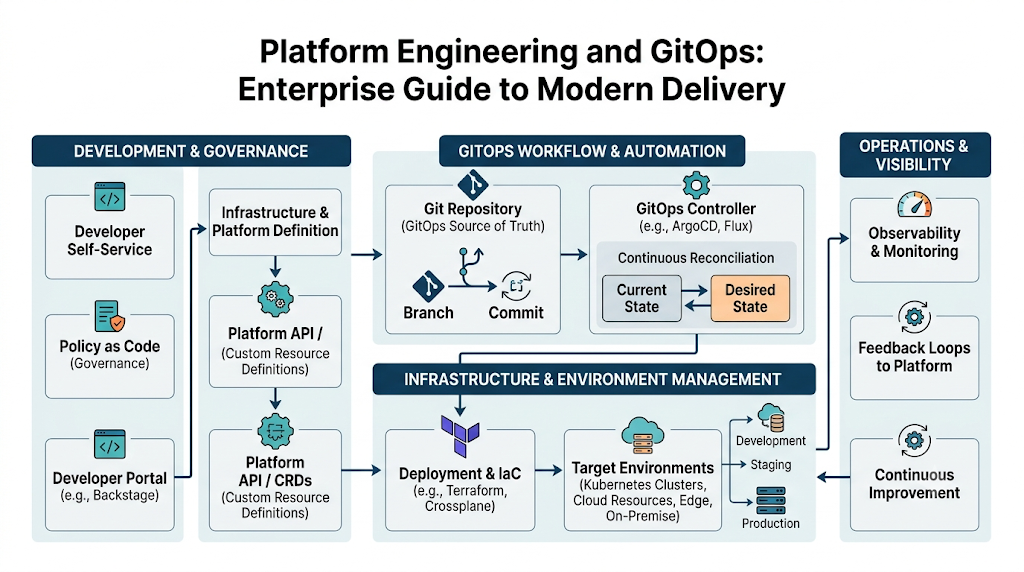
Kubernetes consulting services and platform engineering consulting focus on building internal platforms that allow product teams to ship faster without reinventing infrastructure every time. Instead of every team manually managing clusters, a platform team provides curated self-service capabilities such as standardized deployment templates, observability, and security guardrails.
Kubernetes corporate training ensures that operations, developers, and architects share a common understanding of containerization, service design, and cluster operations, which is essential for running mission-critical workloads in production.
3. Reliability, Security, and Governance
Site Reliability Engineering consulting and DevSecOps consulting services help organizations move from reactive firefighting to proactive, metrics-driven reliability and security. This includes defining SLOs and error budgets, implementing observability, automating security checks in CI/CD, and establishing standardized incident response practices.
Combined with AIOps consulting services, enterprises can use machine learning for anomaly detection, intelligent alerting, and automated remediation in complex distributed systems, reducing MTTR and improving customer experience.
Table 1: Traditional IT vs Modern DevOps Approach
| Aspect | Traditional IT | Modern DevOps & SRE | Best Choice |
|---|---|---|---|
| Release cycles | Quarterly or yearly | Daily or on-demand | DevOps/SRE |
| Deployment process | Manual, ticket-driven | Automated CI/CD pipelines | DevOps/SRE |
| Ownership | Siloed dev, ops, security | Shared product-aligned teams | DevOps/SRE |
| Incident management | Reactive, blame-oriented | Blameless, data-driven SRE practices | DevOps/SRE |
| Change risk | High, big-bang releases | Lower, small frequent changes | DevOps/SRE |
Business Benefits of DevOps Consulting Services
For technology leaders, DevOps is justified when it delivers measurable business outcomes. Done well, DevOps consulting services help enterprises achieve faster time-to-market, higher release quality, and improved developer productivity. Shorter cycle times mean faster feedback from customers and product teams, enabling more informed decisions.
Integrated SRE consulting services and DevSecOps consulting services reduce unplanned downtime, security incidents, and late-stage rework. Combined with cloud migration services and platform engineering consulting, organizations can optimize infrastructure costs while maintaining performance and compliance, which is particularly important for regulated industries and high-growth digital businesses.
DevOps Corporate Training: Building Capable Teams
Technology transformation fails when people are not enabled. DevOps corporate training and Kubernetes corporate training close skill gaps by offering structured learning paths tailored to developers, operations engineers, SREs, and security teams. Hands-on labs, real-world scenarios, and guided practice help teams move beyond theoretical understanding to practical execution.
For HR and L&D teams, DevOps training for companies provides a scalable way to upskill multiple teams across locations while maintaining consistent standards. When combined with ongoing coaching and project-based learning, training accelerates adoption of new tools such as CI/CD platforms, observability stacks, and infrastructure-as-code frameworks.
Table 2: Consulting vs Building Only an In-House DevOps Team
| Dimension | In-House Only | With DevOps Consulting Company | Best Choice |
|---|---|---|---|
| Time to expertise | Slow, trial-and-error | Faster, uses proven patterns and playbooks | Consulting |
| Upfront cost | Lower visible cost, higher hidden waste | Clear engagement cost, reduced rework | Depends |
| Perspective | Limited to internal experience | Cross-industry, vendor-neutral insights | Consulting |
| Change management | Harder to challenge status quo | Easier with external facilitator | Consulting |
| Knowledge transfer | Depends on team bandwidth | Structured training and documentation | Consulting |
Key Enterprise Use Cases for DevOps, Cloud, and Kubernetes Consulting
Modernizing Legacy Applications
Many enterprises still run critical systems on monoliths and older platforms. DevOps consulting and cloud consulting services help create modernization roadmaps, such as strangler patterns, containerization, and gradual refactoring into microservices.
Kubernetes consulting services assist in designing cluster topologies, security policies, and deployment patterns that keep risk manageable while progressively migrating workloads.
Building Secure, Compliant CI/CD Pipelines
Regulated industries need both speed and control. CI/CD pipeline consulting, combined with DevSecOps consulting services, enables automated testing, policy checks, and approvals integrated directly into pipelines.
By embedding security scans, compliance checks, and audit logs into the delivery process, organizations can demonstrate control to auditors while still supporting frequent releases.
Data-Driven Operations and AI-Enabled Platforms
As systems grow more complex, traditional monitoring often produces noise instead of insight. AIOps consulting services help enterprises implement intelligent event correlation, anomaly detection, and automated remediation.
MLOps consulting services and DataOps consulting services ensure that data pipelines and machine learning models are deployed, monitored, and governed using DevOps-like practices, aligning data initiatives with broader digital transformation goals.
Table 3: Tooling Focus vs Platform Engineering Approach
| Aspect | Team-Specific Tooling Focus | Platform Engineering Approach | Best Choice |
|---|---|---|---|
| Tool choice | Each team picks its own | Curated, standardized platform stack | Platform |
| Developer experience | Inconsistent, steep learning curves | Self-service golden paths | Platform |
| Governance | Hard to enforce | Guardrails baked into platform | Platform |
| Scaling to many apps | Leads to fragmentation | Designed for multi-team, multi-app scale | Platform |
| Maintenance | High overhead per team | Centralized with shared responsibility | Platform |
Common Challenges in DevOps Adoption (and How Consulting Helps)
Enterprises often face recurring obstacles: unclear ownership, tool sprawl, resistance to change, and lack of shared metrics. Without a clear strategy, teams end up with multiple CI servers, overlapping monitoring tools, and conflicting workflows. This creates frustration and undermines confidence in DevOps initiatives.
A seasoned DevOps consulting company helps define target operating models, clarify responsibilities, and rationalize tooling. They also provide playbooks for communication, training, and change management so that DevOps is adopted as a culture shift rather than just a tool rollout.
Best Practices for Enterprise-Grade DevOps Implementation
Implementing DevOps at scale requires deliberate design. Start with a clear understanding of business drivers—such as reducing lead time, improving reliability, or enabling new digital products—then align architecture and process changes with those outcomes.
Adopt infrastructure automation consulting and CI/CD pipeline consulting to standardize how code, configuration, and infrastructure are built and released. Invest in DevOps corporate training so teams share common language and practices, and integrate SRE consulting services to define SLOs and error budgets that guide release decisions. Finally, treat cloud consulting services and Kubernetes consulting services as enablers, not goals, focusing on measurable improvements in delivery and reliability rather than tool adoption alone.
Expert Tips for CTOs and Engineering Leaders
- Start with a focused pilot
Choose one or two business-critical products to demonstrate the value of DevOps consulting services before scaling across the enterprise. - Make reliability a product feature
Use Site Reliability Engineering consulting to set clear SLOs and prioritize work that reduces incidents and protects customer trust. - Invest in continuous learning
Pair DevOps consulting with ongoing DevOps training for companies and Kubernetes corporate training so teams can sustain improvements after the initial engagement. - Align incentives with outcomes
Update KPIs to reward collaboration, deployment frequency, and reliability, not just individual throughput. - Treat security as code
Leverage DevSecOps consulting services to integrate security scanning, policy-as-code, and compliance automation into pipelines from day one.
Common Mistakes to Avoid in DevOps and Cloud Transformation
One frequent mistake is treating DevOps as a tool purchase instead of an operating model change. Buying a CI tool or container platform without redefining processes and responsibilities leads to confusion and low adoption. Another pitfall is jumping directly into complex Kubernetes or multi-cloud designs before teams have mastered foundational automation and version control practices.
Organizations also underestimate the importance of structured DevOps corporate training and change management, assuming teams will “pick it up” organically. Finally, many initiatives fail to define clear metrics, making it hard to prove value to business stakeholders and secure ongoing investment. Partnering with an experienced DevOps consulting company helps avoid these traps through proven frameworks and guided implementation.
Future Outlook: AIOps, MLOps, DataOps and Platform Engineering
The future of DevOps in enterprises is increasingly data-driven and platform-centric. AIOps consulting services will play a larger role in managing complex hybrid and multi-cloud environments, using machine intelligence to keep systems healthy at scale. MLOps consulting services and DataOps consulting services will become essential for businesses that rely on analytics and machine learning in customer-facing products.
Platform engineering consulting will help organizations move from fragmented toolchains to unified internal developer platforms, with GitOps consulting services enabling declarative, auditable operations across clusters and environments. For digital transformation consulting companies and their clients, the focus will shift from individual projects to long-term capability building, where DevOps, SRE, and security are embedded into the organization’s DNA.
Why Partner with a Specialized DevOps and Digital Transformation Consulting Company
A specialized digital transformation consulting company that combines DevOps consulting services, cloud consulting services, and corporate training offers a comprehensive approach: strategy, implementation, and enablement. Instead of working with multiple fragmented vendors, enterprises get a partner who understands the full lifecycle—from initial assessments and roadmaps to platform engineering, SRE practices, and DevSecOps integration.
Such partners typically bring accelerators, reusable templates, and training curricula that shorten time-to-value. They can also align with internal centers of excellence, HR, and L&D teams to create sustainable learning and certification paths in areas like Kubernetes consulting services, CI/CD pipeline consulting, infrastructure automation consulting, and AIOps consulting services.
Frequently Asked Questions
- What is a DevOps consulting company and how does it help enterprises?
A DevOps consulting company helps organizations redesign how they build, test, and operate software by aligning people, processes, and platforms. It brings external expertise, proven patterns, and accelerators to implement CI/CD, automation, observability, and collaboration practices that improve speed, quality, and reliability at scale. - When should a business consider DevOps consulting services?
Businesses should consider DevOps consulting services when they experience slow releases, frequent production incidents, tool sprawl, or difficulty scaling existing practices. It is also valuable during cloud migration, platform modernization, or when launching new digital products that require faster, more reliable delivery. - How do DevOps corporate training programs work for enterprises?
DevOps corporate training typically combines instructor-led sessions, hands-on labs, and project-based learning tailored to different roles such as developers, ops, and SREs. Programs can be delivered on-site or online and are often customized to the organization’s tooling, processes, and transformation roadmap to maximize relevance and adoption. - What is the difference between cloud consulting services and cloud migration services?
Cloud consulting services focus on strategy, architecture, operating models, and governance for cloud and hybrid environments. Cloud migration services focus on planning and executing the move of applications and data, including rehosting, refactoring, and re-architecting based on business and technical constraints. - Why are Kubernetes consulting services important for enterprises?
Kubernetes consulting services help organizations design, secure, and operate container platforms reliably across environments. Consultants assist with cluster design, multi-tenancy, networking, observability, and governance, ensuring that business-critical workloads can run at scale without compromising security or performance. - How does Site Reliability Engineering consulting differ from traditional operations?
Site Reliability Engineering consulting focuses on reliability as an engineering discipline using SLOs, error budgets, automation, and observability. Unlike traditional operations, it works closely with development teams, uses data to guide decisions, and prioritizes proactive improvements over reactive firefighting. - What value does DevSecOps consulting services provide beyond security tools?
DevSecOps consulting services integrate security into everyday development and operations workflows through automation, policies, and culture change. It helps organizations design secure SDLCs, embed security checks in CI/CD, and align security teams with product and platform engineering goals. - When should enterprises invest in GitOps consulting services?
Enterprises should consider GitOps consulting services when they operate multiple Kubernetes clusters or environments and need consistent, auditable configuration management. GitOps enables declarative, version-controlled operations, making rollbacks, approvals, and environment promotions more predictable and secure. - How does platform engineering consulting support digital transformation?
Platform engineering consulting supports digital transformation by building internal platforms that standardize deployments, observability, and security while offering self-service to product teams. This reduces time spent on repetitive infrastructure tasks and enables teams to focus on delivering business value. - What is the role of CI/CD pipeline consulting in regulated industries?
CI/CD pipeline consulting in regulated industries focuses on designing pipelines that embed approvals, traceability, and compliance checks. It helps organizations meet regulatory requirements while still delivering changes frequently and reliably, reducing manual paperwork and audit overhead. - Why are AIOps consulting services becoming more relevant?
AIOps consulting services are becoming more relevant as systems grow more distributed and traditional monitoring generates too many alerts. AIOps uses machine learning to correlate events, detect anomalies, and trigger automated remediation, improving incident response and reducing noise. - How do MLOps and DataOps consulting services help data-driven organizations?
MLOps consulting services help operationalize machine learning models by standardizing deployment, monitoring, and governance. DataOps consulting services improve the reliability and agility of data pipelines, ensuring data quality and faster analytics delivery, which is crucial for data-driven decision-making. - Can DevOps training for companies be customized to our toolchain?
Yes, DevOps training for companies is often customized to an organization’s preferred tools, cloud platforms, and workflows. Customized training improves relevance, accelerates adoption, and enables teams to immediately apply what they learn to real projects and environments. - How long does a typical DevOps consulting engagement last?
Engagements vary, but many enterprises start with a 4–12 week assessment and pilot implementation, followed by multi-quarter rollout phases. The duration depends on the size of the organization, complexity of systems, and scope—such as including SRE, DevSecOps, and platform engineering. - How should CTOs measure the success of DevOps and cloud consulting?
CTOs should track metrics like deployment frequency, change lead time, change failure rate, MTTR, and infrastructure cost efficiency. Improvements in developer satisfaction, incident volume, and customer-facing reliability are also strong indicators that DevOps and cloud consulting are delivering real business value.
Conclusion
For modern enterprises, DevOps is no longer optional—it is the backbone of digital products, customer experience, and competitive differentiation. When combined with cloud consulting services, Kubernetes consulting services, SRE consulting services, and DevSecOps consulting services, DevOps becomes a structured way to deliver software faster, safer, and more reliably.
By partnering with a specialized digital transformation consulting company and investing in DevOps corporate training, organizations can build sustainable capabilities rather than one-off projects. The result is a high-performing engineering culture, resilient platforms, and a continuous flow of innovation that supports long-term business growth.
