Introduction
Artificial Intelligence for IT Operations is the future of managing complex systems and large scale digital environments. The Certified AIOps Professional program is designed for those who want to master this shift in the tech industry. This guide is written for engineers and managers who need to understand how AI can improve system reliability and automate manual tasks. By reading this, you will learn how to choose the right path and make better decisions for your technical career. Working with AIOpsSchool allows you to gain the skills needed to stay relevant in the changing world of cloud and platform engineering.
What is the Certified AIOps Professional?
The Certified AIOps Professional is a program that focuses on using data and machine learning to improve IT operations. It is built to help engineers move away from manual troubleshooting and toward automated, proactive system management. Instead of just learning theory, this program emphasizes real-world skills that you can use in production environments immediately. It aligns with modern engineering workflows where speed and reliability are both required for success. Large enterprises now look for these skills to manage the massive amount of data generated by their digital systems.
Who Should Pursue Certified AIOps Professional?
This program is perfect for software engineers, SREs, and cloud professionals who want to work with smarter systems. Security and data roles also benefit greatly because AIOps helps in identifying patterns that humans might miss in huge datasets. It is suitable for beginners who want a strong start in the field, as well as experienced engineers and managers who need to lead technical teams. In India and across the globe, companies are hiring people who can bridge the gap between traditional operations and artificial intelligence. Whether you are building new platforms or maintaining old ones, these skills are now essential for career growth.
Why Certified AIOps Professional is Valuable and Beyond
The demand for AIOps skills is growing because systems are becoming too complex for human teams to manage alone. This certification offers longevity because it focuses on the logic of automation rather than just one specific tool. It helps professionals stay relevant even when specific software or cloud providers change their offerings over time. For an engineer, it represents a strong return on time because it targets the most difficult problems in modern tech. Companies are adopting these practices to reduce downtime and save money, making those who have the certification very valuable to the business.
Certified AIOps Professional Certification Overview
The program is delivered via the official course page and is officially hosted on AIOpsSchool. It offers different certification levels to match your current experience and where you want to go in your career. The assessment approach is practical, focusing on how you apply knowledge to solve enterprise problems rather than just memorizing facts. The ownership and structure of the program ensure that the content is always updated to match current industry standards. It provides a clear roadmap for anyone looking to transition into more advanced technical roles.
Certified AIOps Professional Certification Tracks & Levels
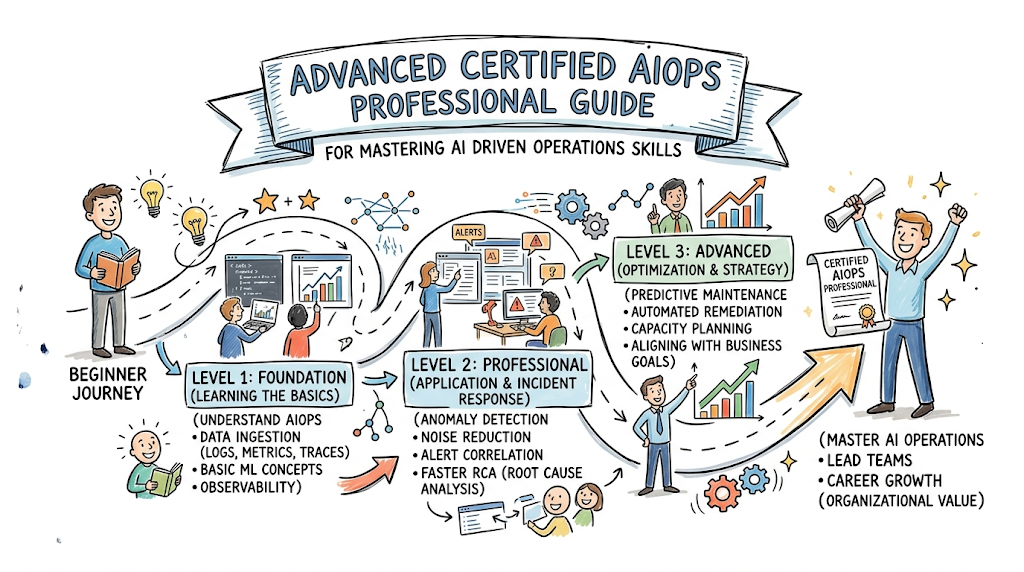
The certification is divided into foundation, professional, and advanced levels to support continuous learning. The foundation level introduces basic concepts of data and automation for those starting their journey. The professional level goes deeper into specialized tracks like DevOps, SRE, and FinOps to show how AI applies to those specific areas. Advanced levels are for those who want to lead major projects or design entire AIOps strategies for large organizations. This structure allows you to progress through your career at a pace that fits your professional goals.
Complete Certified AIOps Professional Certification Table
| Track | Level | Who it’s for | Prerequisites | Skills Covered | Recommended Order |
| Operations | Foundation | Junior Engineers | Basic IT knowledge | Data analysis, Automation | First |
| Engineering | Professional | DevOps / SRE | 2 years experience | ML models, Log analysis | Second |
| Architecture | Advanced | Tech Leads | 5 years experience | Strategy, AI scaling | Third |
| Security | Professional | Security Ops | Security basics | Threat detection, AI | Optional |
| Management | Professional | Team Leads | Management exp | ROI, Team building | Optional |
Detailed Guide for Each Certified AIOps Professional Certification
Certified AIOps Professional – Foundation Level
What it is
This level validates your basic understanding of how artificial intelligence and machine learning help in IT operations. It confirms you know the terminology and core concepts used in the industry.
Who should take it
This is for junior engineers or those moving from traditional IT roles into modern cloud-native environments. It is also good for students who want a head start.
Skills you’ll gain
- Understanding the lifecycle of AIOps data.
- Basic knowledge of automation tools.
- Identifying common patterns in system logs.
- Learning how AI reduces the noise in monitoring systems.
Real-world projects you should be able to do
- Setting up a basic monitoring dashboard that uses simple alerts.
- Cleaning and organizing log data for better analysis.
Preparation plan
- Explain 7–14 days: Review core terminology and watch introductory videos.
- 30 days: Complete all lab exercises and read the official guide.
- 60 days: Take practice exams and join community study groups.
Common mistakes
- Skipping the basic data management steps to jump into AI tools.
- Not spending enough time understanding the different types of monitoring.
Best next certification after this
- Same-track option: Professional Engineering Level
- Cross-track option: Cloud Practitioner
- Leadership option: Team Lead Foundation
Certified AIOps Professional – Professional Level
What it is
This validates your ability to implement AI solutions in a live production environment. It shows you can manage complex data streams and automate response actions.
Who should take it
This is for mid-level engineers, SREs, and DevOps professionals who are already working with cloud systems. You should have some hands-on experience before starting this.
Skills you’ll gain
- Developing automated incident response workflows.
- Integrating machine learning models into existing pipelines.
- Managing large scale observability platforms.
- Optimizing system performance using predictive analytics.
Real-world projects you should be able to do
- Building an automated system that fixes common server errors without human help.
- Creating a predictive model to warn teams about potential outages before they happen.
Preparation plan
- Explain 7–14 days: Focus on integration points between tools.
- 30 days: Build three small projects using the official syllabus.
- 60 days: Review case studies and perform full system simulations.
Common mistakes
- Ignoring the cost of running AI models in the cloud.
- Over-complicating simple automation tasks with unnecessary AI.
Best next certification after this
- Same-track option: Advanced Architecture Level
- Cross-track option: DevSecOps Professional
- Leadership option: Technical Program Manager
Choose Your Learning Path
DevOps Path
The DevOps path focuses on making the software delivery cycle faster and safer using automation. It teaches you how to use AI to find bugs in the code before it is even deployed to production. You will learn how to monitor the health of your applications in real-time and fix issues automatically. This path is ideal for those who want to improve the relationship between development and operations teams. It provides the tools needed to manage modern applications that run on Kubernetes or cloud services.
DevSecOps Path
In this path, the focus is on integrating security into every step of the automated workflow. You will learn how to use AI to detect security threats and vulnerabilities much faster than manual scanning. It covers how to protect data and ensure that all automation follows strict compliance rules. This is a critical path because security is often the biggest bottleneck in fast-moving tech companies. Professionals here become experts at building systems that are both fast and very secure.
SRE Path
The Site Reliability Engineering path is about keeping systems up and running no matter what happens. You will use AI to understand the limits of your systems and predict when they might fail. It teaches you how to manage error budgets and improve the reliability of large-scale services. This path is highly technical and focuses on the intersection of software engineering and operations. It is perfect for those who enjoy solving deep technical puzzles and building resilient systems.
AIOps Path
This specific path focuses entirely on the data science side of IT operations. You will learn how to collect, store, and analyze massive amounts of operational data to find hidden insights. It covers the creation of custom machine learning models that are tailored to specific business needs. You will spend time learning about data pipelines and how to make them work for IT teams. It is best for those who want to become specialists in the intersection of data science and system engineering.
MLOps Path
The MLOps path is for those who want to manage the lifecycle of machine learning models in production. It bridges the gap between data scientists and operations engineers to ensure models are updated and perform well. You will learn how to automate the training and deployment of AI systems. This is a rapidly growing field as more companies try to use AI for their core business products. Engineers on this path ensure that AI remains a reliable part of the enterprise infrastructure.
DataOps Path
DataOps is all about improving the quality and speed of data delivery within an organization. You will learn how to build automated pipelines that move data from one place to another without errors. It focuses on using AI to check for data quality and to fix problems automatically. This path is essential for companies that rely on big data to make their daily business decisions. It turns data management into a streamlined, automated process that serves the whole company.
FinOps Path
The FinOps path teaches you how to use AI to manage and reduce the cost of cloud computing. You will learn how to track spending in real-time and find where money is being wasted. It involves using predictive models to forecast future cloud costs and suggest ways to save money. This path is very popular with management because it directly affects the company’s profit. Professionals here combine technical cloud knowledge with financial management skills to drive efficiency.
Role → Recommended Certified AIOps Professional Certifications
| Role | Recommended Certifications |
| DevOps Engineer | Foundation Level, Professional Engineering |
| SRE | Professional Engineering, Advanced Architecture |
| Platform Engineer | Professional Engineering, DataOps Specialist |
| Cloud Engineer | Foundation Level, FinOps Specialist |
| Security Engineer | DevSecOps Specialist, Professional Level |
| Data Engineer | DataOps Specialist, MLOps Specialist |
| FinOps Practitioner | FinOps Specialist, Foundation Level |
| Engineering Manager | Management Professional, Foundation Level |
Next Certifications to Take After Certified AIOps Professional
Same Track Progression
Once the professional levels are finished, looking toward advanced architecture or specialized research certifications is a great move. This allows an engineer to become a deep subject matter expert that other teams come to for advice. It involves staying on top of the latest papers and tools in the AI space. Deep specialization often leads to roles like Principal Architect or Distinguished Engineer. It is the best way to ensure you remain at the top of the field for many years.
Cross-Track Expansion
If the operations side is mastered, it is a great idea to expand into security or financial management. Learning how different parts of the business work makes for a much more versatile engineer. It allows for leading larger, multi-disciplinary teams that handle diverse technical challenges. Expanding skills this way protects against changes in any one specific area of the market. Most high-level tech leaders have a broad range of skills across multiple domains.
Leadership & Management Track
For those who want to move away from daily coding and into management, this track is the right choice. Learning how to build teams, manage budgets, and align technical work with business goals is the primary focus. It highlights the soft skills needed to lead people while still understanding the technical details of the work. This transition is important for growing a career and increasing impact on the company. It allows an individual to shape the culture and strategy of the entire engineering department.
Training & Certification Support Providers for Certified AIOps Professional
DevOpsSchool
DevOpsSchool is well known for its strong community focus and deep technical training. They offer a wide range of courses that cover everything from basic Linux to advanced AI automation. The instructors are people who have worked in the industry and bring real stories to the classroom. They provide a lot of support through forums and live sessions to help students pass their exams. Their focus is on making sure the tools are understood, not just a test passed.
Cotocus
Cotocus provides training that is very focused on the needs of large enterprises and consulting. They understand what big companies are looking for when they hire engineers. Their courses often include complex projects that mimic the challenges faced in a corporate job. They are a great choice for learning how to implement AIOps in a professional consulting environment. Their materials are updated often to keep up with the fast pace of the tech world.
Scmgalaxy
Scmgalaxy has been a long-time resource for engineers looking for tutorials and community support. They offer a huge library of articles and videos that cover almost every technical topic imaginable. Their training for certifications is detailed and provides many practical examples. It is a good place to go for those who like to learn through reading and participating in community discussions. They have a reputation for being helpful to both beginners and advanced professionals.
BestDevOps
BestDevOps focuses on providing high-quality video content and structured learning paths for busy engineers. They break down complex topics into small, easy to understand lessons. This makes it easier to study while still working a full-time job. They emphasize the most important skills that are in demand by top tech companies right now. Their approach is very efficient and respects the time of the professional learner.
devsecopsschool.com
This site is dedicated specifically to the intersection of development, security, and operations. They are the best place to go for specializing in the security side of AIOps. Their training covers how to automate security checks and protect cloud systems from modern threats. They provide very specific labs that focus on finding and fixing security holes using AI. It is an essential resource for anyone who wants to become a security-focused automation engineer.
sreschool.com
Sreschool.com focuses on the principles of reliability and system stability. They teach the math and the logic behind keeping huge websites running smoothly. Their certification support includes deep dives into monitoring, alerting, and incident management. They help with understanding how to use data to make systems more resilient. This is a great place for engineers who want to move into high-paying SRE roles at major tech firms.
Aiopsschool.com is the primary host for these certifications and provides the most direct and accurate information. They offer the official curriculum and the most up-to-date exam guides. Their labs are designed to match the certification requirements exactly, ensuring study is focused on the right things. They also offer a career path guide to help with deciding which level is right. It is the first place to look when starting the journey into AIOps.
dataopsschool.com
Dataopsschool.com specializes in the data management side of the industry. They teach how to handle the massive amounts of information that AI systems need to function. Their courses cover data pipelines, storage, and automated quality checks. If a data engineer or someone who wants to work with big data is looking for a path, this is the best training resource. They focus on the practical side of moving and protecting data at scale.
finopsschool.com
Finopsschool.com is the leader in teaching engineers how to manage the financial side of the cloud. They show how to use AI to find hidden costs and save a company money. Their training is very practical and includes tools that can be used to track spending immediately. This is a very valuable skill set for anyone who wants to be seen as a leader by upper management. They bridge the gap between technical engineering and business finance perfectly.
Frequently Asked Questions (General)
- How difficult is the Certified AIOps Professional exam?
The exam is designed to be challenging but fair for those who have studied the material and completed the labs. It focuses on practical application rather than just memorizing facts.
- How much time should be spent studying each day?
Spending one to two hours a day is usually enough to finish the foundation level in about a month. For professional levels, a bit more time might be needed to master the labs.
- Is coding knowledge needed before starting?
Having some basic knowledge of scripting like Python or Bash is very helpful. However, the foundation courses will help with learning what is needed as the course progresses.
- Is this certification recognized by big tech companies?
Yes, many enterprises are looking for people with these specific skills as they move their systems to the cloud. It shows a commitment to modern engineering practices.
- Can the exam be taken online?
Most of the certification exams are available through online proctoring services. This allows the test to be taken from anywhere in the world as long as there is a good internet connection.
- Are there any prerequisites for the professional level?
It is highly recommended to have either the foundation level or a few years of experience in operations before trying the professional exam.
- How long does the certification last?
The certification is typically valid for two or three years. After that, a recertification exam may be needed to show that skills are still current.
- Does the program include hands-on lab exercises?
Yes, the labs are a major part of the training and are required to understand the material. Real cloud environments are used to build skills.
- Will this help with getting a higher salary?
Many engineers find that adding AIOps skills leads to promotions or better job offers. Companies value the efficiency and cost savings that these skills provide.
- Can someone move from a developer role into AIOps?
Absolutely, many developers find that their coding skills make them excellent at building automated operations systems. This certification is a great way to bridge that gap.
- What is the best order to take the different tracks?
Starting with the foundation level to get the basics down first is best. After that, picking the track that most closely matches a current job or the intended next job is the way to go.
- Is there a community for asking questions while studying?
Most of the top training providers offer forums or chat groups for talking to other students and instructors. This is a great way to get help when stuck.
FAQs on Certified AIOps Professional
- What specific tools are covered in the Certified AIOps Professional program?
The program covers a wide range of industry-standard tools for monitoring, log analysis, and machine learning. Individuals learn how to use these tools together to build a complete AIOps strategy for an enterprise.
- How does this certification differ from a standard DevOps certification?
Standard DevOps focuses on the pipeline and delivery, while AIOps adds the layer of intelligent automation and data analysis. It uses AI to make the DevOps process even more efficient and proactive.
- Can managers benefit from this technical certification?
Yes, managers gain a deep understanding of what their teams are doing and how to measure success. It helps with making better hiring decisions and justifying the budget for new automation tools.
- Are there specialized tracks for specific cloud providers like AWS or Azure?
While the core principles are the same, the training often includes examples of how to implement these ideas on all the major cloud platforms. This makes the skills transferable across different jobs.
- How does AIOps help in reducing alert fatigue for SRE teams?
It uses machine learning to group related alerts together and filter out the noise. This means engineers only get notified when there is a real problem that needs attention.
- What is the return on investment for a company that trains its staff in AIOps?
Companies see a return through reduced system downtime, faster incident resolution, and lower operational costs. It also keeps the engineering team happier by removing boring, manual tasks.
- Is the certification exam more multiple choice or performance based?
The exam usually includes a mix of both to ensure knowledge and the ability to apply it are present. Performance-based questions often involve solving a problem in a simulated environment.
- How does the program stay updated with new AI technologies?
The curriculum is reviewed regularly by industry experts to ensure it includes the latest trends and tools. This ensures the certification remains relevant in a fast-changing market.
Final Thoughts
Advancing a career in the modern tech world requires staying ahead of the curve, and this certification is a very strong investment. It moves an engineer beyond the basics of cloud and operations and into the next phase of intelligent automation. The skills learned are exactly what large companies are looking for right now to manage their complex systems. It requires hard work and a commitment to learning, but the career rewards are worth the effort. By choosing this path, an individual is positioned as a leader in the future of IT operations. Focus on the practical labs, join the community, and these skills will open many new doors for a professional future.
