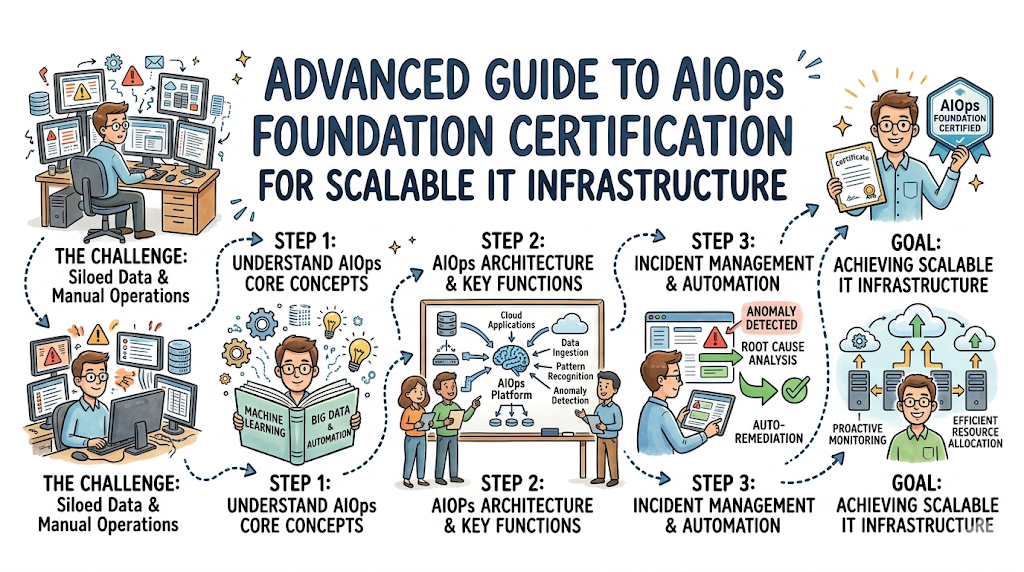
In an era where infrastructure and applications generate massive amounts of telemetry data, manual intervention is no longer a sustainable strategy for maintaining system uptime. The AIOps Foundation Certification serves as the primary gateway for engineers and managers to understand how artificial intelligence and machine learning can be applied to IT operations. This guide is designed for professionals who want to transition from reactive troubleshooting to proactive, data-driven system management. By pursuing this credential at Aiopsschool, you gain the theoretical and practical knowledge required to navigate the complexities of modern cloud-native environments. This resource will clarify the certification path, helping you make informed decisions that align with your long-term career goals in platform engineering and reliability.
What is the AIOps Foundation Certification?
The AIOps Foundation Certification is an entry-level professional credential that introduces the core principles of Artificial Intelligence for IT Operations. It focuses on how algorithmic processing and machine learning models can be used to automate event correlation, anomaly detection, and root cause analysis. Instead of relying purely on static thresholds, this certification teaches you how to leverage dynamic data to gain deeper insights into system behavior. It represents a shift from traditional monitoring to intelligent observability, which is essential for managing hyper-scale distributed systems.
This certification exists to bridge the gap between traditional operations and data science. It emphasizes real-world, production-focused learning, ensuring that candidates understand how these tools fit into a standard enterprise workflow. By focusing on practical applications rather than abstract mathematical theory, the program ensures that engineers can immediately contribute to automation initiatives within their organizations. It aligns with modern engineering practices by treating operational data as a valuable asset that can be used to drive continuous improvement and system resilience.
Who Should Pursue AIOps Foundation Certification?
The program is ideally suited for software engineers, DevOps practitioners, and Site Reliability Engineers (SREs) who are managing complex, noisy production environments. It is also highly beneficial for cloud architects and platform engineers who need to design systems that are self-healing and highly automated. Security and data professionals will find value here as well, as the principles of anomaly detection and data orchestration are universally applicable across the technical stack.
For technical leaders and engineering managers, this certification provides the necessary vocabulary and framework to oversee AIOps implementations. Whether you are working in the global tech hubs of North America or the rapidly growing digital sectors in India, the need for intelligent automation is universal. Beginners looking to break into the advanced tiers of cloud computing can use this certification as a roadmap for future specialization. It ensures that regardless of your current role, you are prepared for the next wave of operational technology.
Why AIOps Foundation Certification is Valuable and Beyond
The longevity of this certification stems from its focus on principles rather than specific, fleeting tools. As enterprises continue to adopt multi-cloud and hybrid-cloud strategies, the sheer volume of logs, metrics, and traces will continue to grow beyond human capacity. AIOps ensures that professionals remain relevant by teaching them how to manage the algorithms that manage the machines. This level of skill is in high demand, as organizations seek to reduce the “mean time to resolution” (MTTR) and improve the overall reliability of their services.
Investing in this certification offers a clear return on time because it positions you at the intersection of two high-growth fields: IT operations and artificial intelligence. It helps you stay relevant even as specific monitoring tools evolve or change, because the fundamental logic of data-driven operations remains the same. Enterprise adoption of AI-driven tools is accelerating, and having a verified foundation in these concepts makes you a critical asset during digital transformation projects. It provides a long-term career cushion by making you an expert in the automation of operations.
AIOps Foundation Certification Overview
The AIOps Foundation Certification program is delivered via the official portal at AIOps Foundation Certification and is hosted on the aiopsschool.com website. The certification structure is designed to be accessible yet rigorous, focusing on the core competencies required to implement AI in a production environment. It uses a practical assessment approach that evaluates a candidate’s understanding of data pipelines, algorithmic logic, and the operational lifecycle of AI models.
The program is owned and managed by industry experts who ensure the curriculum stays aligned with the latest trends in the SRE and DevOps communities. The structure typically includes a series of learning modules followed by a comprehensive exam that tests both conceptual knowledge and situational decision-making. This approach ensures that a certified professional is not just someone who can pass a test, but someone who can think critically about how to apply AI to solve real-world operational challenges.
AIOps Foundation Certification Tracks & Levels
The certification is structured into three distinct levels to support career progression from junior roles to executive leadership. The Foundation level provides the essential vocabulary and concepts, while the Professional level focuses on the technical implementation and tuning of AIOps tools. The Advanced level is reserved for those who design the overall strategy and governance for AI-driven operations at an enterprise scale. These levels allow you to build your expertise incrementally as your responsibilities grow.
Beyond the general levels, there are specialization tracks available for different domains such as SRE, FinOps, and Security. For instance, an SRE might focus on tracks that emphasize automated incident response, while a FinOps practitioner might focus on AI-driven cost forecasting. This modular approach ensures that the certification remains relevant to your specific job function while providing a broad understanding of the AIOps ecosystem. It allows for a tailored learning path that aligns with your professional interests and organizational needs.
Complete AIOps Foundation Certification Table
| Track | Level | Who it’s for | Prerequisites | Skills Covered | Recommended Order |
| Core AIOps | Foundation | Engineers/Beginners | Basic IT Knowledge | Event Correlation, Metrics | 1 |
| SRE Automation | Professional | Senior SREs | Foundation Cert | Predictive Alerts, Self-healing | 2 |
| Ops Strategy | Advanced | Managers/Architects | Professional Cert | Governance, ROI Analysis | 3 |
| Data Analytics | Professional | Data Engineers | Foundation Cert | Pipeline Design, Feature Eng | 2 |
| Global Strategy | Advanced | Directors/CTOs | Professional Cert | Org Transformation, Ethics | 3 |
Detailed Guide for Each AIOps Foundation Certification
AIOps Foundation Certification – Foundation
What it is
This certification validates the fundamental understanding of how AI and ML models interact with IT operations. It ensures you know the difference between traditional monitoring and AIOps and understand the basic data lifecycle.
Who should take it
Aspiring DevOps engineers, junior SREs, and IT managers who need a conceptual understanding of intelligent automation should take this. It is also suitable for students looking to enter the IT field with a modern skill set.
Skills you’ll gain
- Understanding the difference between supervised and unsupervised learning in Ops.
- Knowledge of the AIOps architectural framework.
- Ability to identify noise versus signal in telemetry data.
- Familiarity with the concepts of event suppression and correlation.
Real-world projects you should be able to do
- Map an existing monitoring stack to an AIOps framework.
- Identify three manual tasks that could be automated via ML.
- Define a data collection strategy for a simple microservice.
Preparation plan
- 7–14 days: Read the official study guide and familiarize yourself with the AIOps glossary.
- 30 days: Review case studies of successful AIOps implementations in large enterprises.
- 60 days: Take practice exams and participate in community webinars to understand real-world hurdles.
Common mistakes
- Treating AIOps as a “magic box” that solves all problems without configuration.
- Ignoring the quality of the input data before applying models.
- Failing to understand the cultural shift required for automated operations.
Best next certification after this
- Same-track option: AIOps Professional Certification
- Cross-track option: SRE Foundation Certification
- Leadership option: Engineering Management Essentials
AIOps Foundation Certification – Professional
What it is
The Professional level validates your ability to configure, tune, and maintain AIOps platforms. It focuses on the technical integration of machine learning models into existing CI/CD and monitoring pipelines.
Who should take it
Senior DevOps engineers, SREs, and Tooling Architects who are responsible for implementing AIOps tools like Moogsoft, BigPanda, or custom-built ML solutions should take this.
Skills you’ll gain
- Configuring algorithmic event correlation patterns.
- Implementing automated root cause analysis workflows.
- Tuning machine learning models to reduce false positives.
- Managing the lifecycle of operational data pipelines.
Real-world projects you should be able to do
- Implement an automated incident suppression rule based on historical data.
- Integrate an AIOps platform with a standard ITSM tool like ServiceNow.
- Design a predictive alerting system for disk space or memory usage.
Preparation plan
- 7–14 days: Focus on specific algorithms used for time-series forecasting.
- 30 days: Set up a lab environment to practice data ingestion and model tuning.
- 60 days: Work through advanced troubleshooting scenarios in a simulated production environment.
Common mistakes
- Over-tuning models, which leads to missing actual incidents.
- Neglecting the integration with the incident management workflow.
- Not setting clear success metrics for the AIOps implementation.
Best next certification after this
- Same-track option: AIOps Advanced Strategy
- Cross-track option: MLOps Professional Certification
- Leadership option: Technical Program Manager Certification
AIOps Foundation Certification – Advanced
What it is
The Advanced certification validates the ability to lead an organization’s AIOps strategy. It focuses on governance, large-scale architecture, and the business impact of intelligent automation.
Who should take it
Principal Architects, CTOs, and Directors of Engineering who are responsible for long-term technology roadmaps and operational excellence across multiple business units.
Skills you’ll gain
- Designing enterprise-wide AIOps governance and compliance frameworks.
- Calculating the ROI of AIOps initiatives for executive reporting.
- Leading organizational change and training for AI-driven Ops.
- Managing ethical considerations and bias in operational AI.
Real-world projects you should be able to do
- Create a 3-year AIOps roadmap for a global enterprise.
- Lead a cross-functional team through a major AIOps platform migration.
- Define service level objectives (SLOs) that are supported by AI-driven insights.
Preparation plan
- 7–14 days: Study leadership frameworks and executive communication strategies.
- 30 days: Review global standards and regulations regarding AI and data privacy.
- 60 days: Develop a comprehensive business case for a major AI-driven automation project.
Common mistakes
- Focusing purely on technology and ignoring the people and process aspects.
- Failing to align AIOps goals with the broader business strategy.
- Underestimating the cost and time required for high-quality data cleanup.
Best next certification after this
- Same-track option: Specialized Industry Expert Badges
- Cross-track option: FinOps Strategic Leader
- Leadership option: Executive Leadership Program for Tech Leaders
Choose Your Learning Path
DevOps Path
The DevOps path focuses on integrating AIOps into the continuous integration and delivery pipeline. It teaches you how to use AI to analyze build logs, predict deployment failures, and automate the rollback process. By using intelligent insights, DevOps teams can increase their deployment frequency while maintaining a high level of stability. This path is ideal for those who want to build a truly “smart” CI/CD ecosystem.
DevSecOps Path
The DevSecOps path emphasizes the use of AI for proactive security monitoring and threat detection. You will learn how to apply machine learning models to identify unusual patterns in network traffic or user behavior that might indicate a breach. This path ensures that security is not just a gatekeeper but an automated, intelligent layer that protects the system in real-time. It is perfect for professionals who want to specialize in automated security operations.
SRE Path
In the SRE path, the focus is on system reliability and the reduction of manual toil. You will learn how to use AIOps to automate the incident management lifecycle, from detection to remediation. This path teaches you how to define intelligent SLOs and manage error budgets using predictive analytics. It is the most direct path for those who want to be at the forefront of modern, highly reliable system management.
AIOps Path
The pure AIOps path is for those who want to become specialists in the intersection of AI and IT operations. This path covers everything from data ingestion and cleaning to model training and deployment for operational use cases. You will gain a deep understanding of the various algorithms used for different types of IT data. It is the foundational path for anyone looking to make AIOps their primary professional focus.
MLOps Path
This path applies the principles of SRE and DevOps specifically to the lifecycle of machine learning models. You will learn how to build reliable pipelines for training, testing, and deploying AI models at scale. It addresses the unique challenges of model drift and data quality that are not present in traditional software engineering. This path is essential for organizations that are building AI-powered products and need to maintain their performance in production.
DataOps Path
DataOps focuses on the reliability and automation of data pipelines. In this path, you will learn how to use AIOps principles to monitor the health of data flows and ensure that the right data reaches the right person at the right time. It is a critical path for data engineers who want to apply SRE-like discipline to their data infrastructure. This ensures that the data used by the business is always accurate, available, and trustworthy.
FinOps Path
The FinOps path uses AI to optimize cloud spending and financial forecasting. You will learn how to apply machine learning to identify unused resources and predict future cloud costs based on historical usage patterns. This path is vital for organizations that want to ensure their technical reliability does not come at an unsustainable financial cost. It allows you to make data-driven decisions that balance performance with fiscal responsibility.
Role → Recommended AIOps Foundation Certification Certifications
| Role | Recommended Certifications |
| DevOps Engineer | AIOps Foundation, DevOps Professional |
| SRE | AIOps Foundation, SRE Automation Track |
| Platform Engineer | AIOps Foundation, Core AIOps Professional |
| Cloud Engineer | AIOps Foundation, Cloud Reliability Track |
| Security Engineer | AIOps Foundation, DevSecOps Specialist |
| Data Engineer | AIOps Foundation, DataOps Track |
| FinOps Practitioner | AIOps Foundation, FinOps Specialist |
| Engineering Manager | AIOps Foundation, Ops Strategy Advanced |
Next Certifications to Take After AIOps Foundation Certification
Same Track Progression
Deep specialization within the AIOps track involves moving into specific technical niches such as Natural Language Processing (NLP) for log analysis or advanced time-series forecasting for capacity planning. Once you have the foundation, you can pursue professional-level credentials that focus on the specific tools used by your organization. This deep dive ensures you remain a technical expert in the nuances of AI-driven IT operations.
Cross-Track Expansion
Skill broadening is essential for a well-rounded technical career. After mastering AIOps, many professionals move into MLOps to understand the development side of AI, or into FinOps to understand the financial implications of their technical decisions. This cross-track expansion makes you a versatile leader who can speak the language of developers, data scientists, and business executives alike, increasing your overall value to any organization.
Leadership & Management Track
For those who want to move away from day-to-day coding and into strategic leadership, the management track is the next logical step. This involves certifications in technical project management or executive leadership. These programs teach you how to lead large teams, manage complex budgets, and drive cultural change within an enterprise. Combining an AIOps background with formal leadership training makes you a prime candidate for roles like Director of Platform Engineering or CTO.
Training & Certification Support Providers for AIOps Foundation Certification
DevOpsSchool
DevOpsSchool provides a robust ecosystem of learning materials that cater to the broad needs of modern IT professionals. Their approach to AIOps training is integrated within the wider DevOps framework, ensuring that students understand how AI complements traditional automation practices. They offer a variety of self-paced and instructor-led courses that are designed to help engineers bridge the gap between their current skills and the requirements of an AI-driven industry. With a heavy emphasis on community and peer learning, DevOpsSchool is an excellent choice for those who want a supported and comprehensive educational journey that covers the entire software delivery lifecycle.
Cotocus
Cotocus focuses on providing high-impact, hands-on training that is designed for immediate application in the workplace. Their AIOps curriculum is built around practical labs and real-world scenarios, allowing students to experiment with different AI models and operational data sets. This “learn by doing” approach is particularly effective for senior engineers who need to quickly gain new technical skills without spending months on purely theoretical study. Cotocus is known for its agility in updating its course content to reflect the latest changes in cloud technology and AIOps toolsets, making it a preferred choice for professionals working in fast-paced environments.
Scmgalaxy
Scmgalaxy serves as a massive repository of knowledge and a vibrant community hub for the DevOps and SRE space. They offer extensive documentation, video tutorials, and interactive learning paths that cover a wide range of AIOps concepts. Their training programs are often praised for their depth and their ability to explain complex technical ideas in a simple, accessible way. By providing a wealth of free and premium resources, Scmgalaxy helps engineers stay current with the latest industry trends and best practices. It is a go-to platform for self-starters who want to build a deep, foundational understanding of automated operations.
BestDevOps
BestDevOps focuses on a curated approach to technical education, prioritizing the quality and architectural depth of their training programs. Their AIOps courses are designed to help professionals think like architects, focusing on the “why” behind the technology as much as the “how.” They provide a structured and disciplined environment that is ideal for those who want a guided path to mastery. BestDevOps often includes mentorship as a part of their training, giving students the chance to learn from industry veterans who have successfully implemented AIOps at scale. This makes it an excellent option for those aiming for principal or director-level roles.
devsecopsschool.com
This platform is dedicated to the intersection of security, development, and operations. Their AIOps training focuses specifically on how artificial intelligence can be used to strengthen the security posture of an organization. They offer specialized courses in automated threat hunting and AI-driven compliance monitoring. In a world where security incidents are a major threat to system reliability, the training provided here is invaluable. It ensures that security is not an afterthought but an intelligent, integrated part of the operational lifecycle. Professionals who want to lead in the space of automated security will find this platform indispensable.
sreschool.com
Sreschool.com is a specialized training center that focuses exclusively on the principles and practices of Site Reliability Engineering. Their AIOps curriculum is tailored to the specific needs of SREs, emphasizing the reduction of toil and the automation of incident management. They provide deep dives into service level objectives (SLOs) and error budgets, showing how AI can provide more accurate and actionable insights than traditional monitoring. For those whose primary goal is to improve system uptime and resilience, sreschool.com provides a highly technical and focused environment that mirrors the challenges of modern production environments.
aiopsschool.com
As the primary host for the AIOps Foundation Certification, aiopsschool.com is the definitive resource for anyone specializing in this field. They provide the official curriculum and assessment tools, ensuring that learners have access to the most accurate and up-to-date information. Their programs are designed to take a student from a complete beginner to an advanced strategist in the space of intelligent operations. The platform offers a variety of learning formats and is deeply connected to the global community of AIOps practitioners, making it an essential destination for anyone serious about making this their career focus.
dataopsschool.com
Dataopsschool.com focuses on the operational excellence required to manage modern data infrastructures. Their AIOps modules teach students how to apply the principles of intelligent automation to data pipelines and distributed storage systems. This training is critical for data engineers who are responsible for the health and availability of the organization’s most valuable asset: its data. By teaching how to use AI to monitor data quality and predict pipeline failures, this platform ensures that the data flowing into the business is always reliable and ready for analysis. It bridges the gap between data engineering and traditional operations management.
finopsschool.com
Finopsschool.com is the premier destination for learning the financial side of cloud management. Their AIOps training shows how machine learning can be used to manage cloud costs with the same rigor as system reliability. They provide courses on AI-driven cost forecasting, automated resource optimization, and the calculation of cloud ROI. This is a vital resource for technical leaders who need to justify their infrastructure spending to the finance department. By learning how to balance performance with cost-efficiency using intelligent tools, professionals can ensure their engineering organizations remain financially sustainable and well-optimized.
Frequently Asked Questions (General)
- What is the difficulty level of the AIOps Foundation Certification?The difficulty is considered moderate. While it introduces complex AI concepts, it focuses on their practical application in IT operations rather than the underlying mathematics.
- How long does it typically take to prepare for the exam?Most professionals with a basic background in DevOps or SRE can prepare for the foundation level in 30 to 60 days of consistent study.
- Are there any strict prerequisites for the foundation level?No strict prerequisites are required, but a general understanding of cloud computing and monitoring tools is highly recommended for success.
- What is the cost of the certification exam?Pricing varies by provider and region, but it generally ranges between 200 and 400 USD. It is best to check the official website for current rates.
- Is the exam conducted online or in person?Most certification providers offer proctored online exams, allowing you to take the test from the comfort of your home or office.
- How does this certification help my career in India?India has a massive IT sector that is rapidly moving toward automation. This certification makes you a prime candidate for high-paying roles in top Indian tech firms and global captives.
- What is the passing score for the AIOps Foundation exam?The passing score is typically around 70% to 75%, depending on the specific version of the exam being administered.
- Does the certification expire, and how do I renew it?The certification is usually valid for two to three years. You can renew it by retaking the latest exam or by earning continuing education credits.
- Can I take this certification if I don’t know how to code?Yes, the foundation level is more about concepts and strategy. However, moving to professional levels will eventually require some basic scripting or coding knowledge.
- Are there any group discounts for enterprise training?Yes, most training providers like Aiopsschool and DevOpsSchool offer significant discounts for corporate teams and large groups.
- What kind of job titles can I expect after getting certified?Common titles include AIOps Engineer, SRE, DevOps Lead, Cloud Architect, and Operations Manager.
- Does the certification cover specific tools like Splunk or Datadog?It covers the general principles of how these tools work within an AIOps framework rather than focusing on the proprietary details of a single vendor.
FAQs on AIOps Foundation Certification
- Why should I choose the AIOps Foundation Certification over a general AI course?General AI courses focus on broad concepts like computer vision or language translation. This certification is laser-focused on IT operations, teaching you only what you need to manage production systems effectively.
- How does AIOps differ from traditional automated monitoring?Traditional monitoring uses static, human-defined thresholds. AIOps uses dynamic, machine-learned patterns to identify issues, meaning it can catch “unknown unknowns” that a human might never think to monitor.
- Can this certification help me if my company is still using legacy systems?Yes, AIOps is often used to bridge the gap between legacy and modern systems by aggregating data from both and providing a unified, intelligent view of the entire environment.
- Is there a lot of math involved in the foundation curriculum?The foundation level explains how the algorithms work at a high level but does not require you to perform complex manual calculations or write machine learning algorithms from scratch.
- How does AIOps impact the daily life of an SRE?It significantly reduces “alert fatigue” by suppressing redundant alerts and correlating events, allowing the SRE to focus on high-value problem solving instead of manual ticket triaging.
- What is the most important skill for an AIOps practitioner to have?Beyond technical knowledge, the most important skill is “data literacy”—the ability to understand what data is telling you about the health and performance of a system.
- Does this certification cover the ethical aspects of AI in Ops?Yes, the curriculum includes discussions on algorithmic bias and the importance of human-in-the-loop systems to ensure that automated decisions are fair and transparent.
- Is AIOps a replacement for human operations teams?No, AIOps is a force multiplier. It automates the tedious, repetitive tasks, allowing humans to focus on complex architectural decisions and strategic improvements.
Conclusion
If you are looking at the future of IT operations, it is impossible to ignore the role of intelligence and automation. The complexity of our systems has already surpassed the human ability to manage them through manual effort or simple scripts. The AIOps Foundation Certification is more than just a credential; it is an investment in your ability to remain effective in a high-scale, high-velocity environment. It provides you with a structured way to think about data, algorithms, and the lifecycle of system health. For the experienced engineer, it is a way to stay at the cutting edge of the field. For the aspiring professional, it is a clear signal to employers that you understand where the industry is heading. In a crowded job market, having a specialized understanding of how AI can solve operational problems sets you apart as a forward-thinking leader. My advice is simple: don’t wait for the industry to move past you. Take the initiative to master these concepts now, and you will find yourself in high demand for years to come.
