A primary key and a foreign key are both database concepts related to table design and establishing relationships between tables.

Primary Key
A primary key is a column or a set of columns in a database table that uniquely identifies each record (row) in that table. The primary key is used to ensure the integrity and uniqueness of the data within the table.
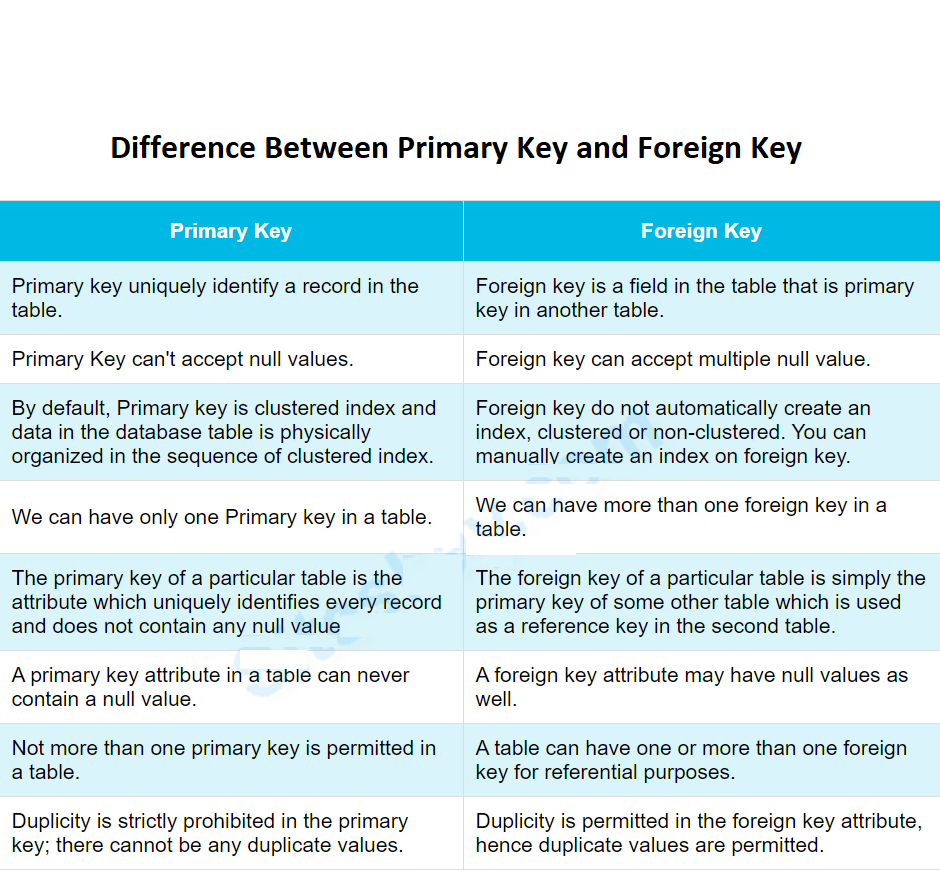
- Uniqueness: A primary key must contain unique values, meaning that no two rows in the table can have the same primary key value.
- Non-nullability: Primary key values cannot be NULL, meaning they must always have a value.
- Identification: The primary key is used to identify and retrieve specific rows in the table. It provides a way to uniquely reference each record.
Typically, a primary key is defined when creating a table, and it can be composed of one or multiple columns. The primary key can be created using auto-incrementing integers, unique identifiers, or a combination of existing columns that guarantee uniqueness.
Foreign Key:
A foreign key is a column or a set of columns in a database table that establishes a link or relationship to the primary key of another table. It creates a connection between two tables and defines the referential integrity between them.
- Relationship: The foreign key column in one table refers to the primary key column of another table. This relationship defines dependencies between the tables.
- Referential Integrity: The foreign key constraint ensures that the values in the foreign key column(s) of the child table correspond to existing values in the primary key column(s) of the referenced (parent) table.
- Navigation: The foreign key enables navigation between related tables. It allows retrieving related data from the referenced table based on the values in the foreign key column.
Foreign keys help establish and maintain relationships between tables, enforce data integrity, and support actions like cascading updates and deletions.
In summary, a primary key uniquely identifies each record in a table, while a foreign key establishes relationships between tables by referencing the primary key of another table. The primary key is local to a table, while the foreign key refers to a primary key in a different table.
