Introduction
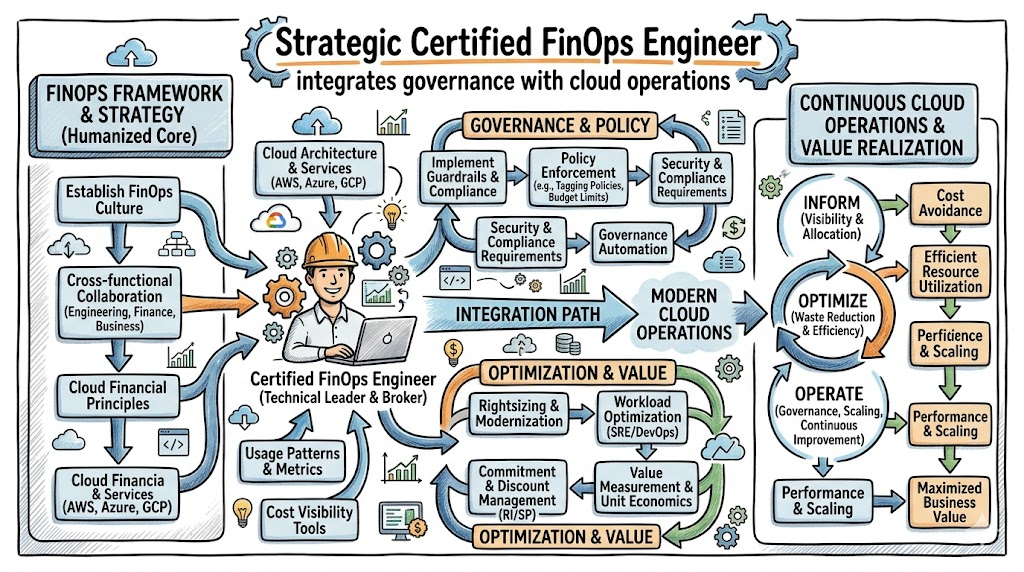
The shift to cloud computing has fundamentally altered how businesses manage infrastructure, but it has also introduced significant financial complexities that many engineering teams struggle to control. A Certified FinOps Engineer acts as the vital link between finance, procurement, and engineering, ensuring that every cloud investment translates into tangible business value. By mastering the frameworks provided by Finopsschool, technical professionals can move beyond basic administration and step into the high-demand world of cloud financial management. This guide is designed to help professionals navigate this evolving landscape and make informed decisions about their career trajectory in cloud-native environments.
This comprehensive guide serves as a strategic roadmap for engineers and managers who want to understand the depth and impact of this certification. We will examine the core competencies required, the real-world application of these skills, and how this path integrates with modern SRE and platform engineering roles. Whether you are looking to optimize large-scale infrastructure or justify technical budgets to executive leadership, understanding this certification is a critical step. Our goal is to provide a clear, unbiased overview that helps you determine if this specialization aligns with your professional aspirations and the needs of the global market.
What is the Certified FinOps Engineer?
The Certified FinOps Engineer is a professional credential that validates an individual’s ability to apply financial management principles to technical cloud operations. Unlike traditional finance roles, this program focuses on the technical levers engineers can pull, such as rightsizing, automation, and architectural optimization, to improve cloud efficiency. It exists because modern cloud spend is a real-time engineering challenge that requires deep visibility into consumption patterns and resource utilization.
This certification represents a move toward production-focused learning, where the emphasis is on managing live cloud ecosystems rather than just theoretical concepts. It aligns perfectly with modern engineering workflows by integrating cost-awareness into the infrastructure-as-code development lifecycle and CI/CD pipelines. For enterprise organizations, having a certified professional on the team ensures that cloud-native transformations remain economically sustainable and aligned with long-term business goals.
Who Should Pursue Certified FinOps Engineer?
This certification is specifically designed for cloud engineers, SREs, and DevOps professionals who are responsible for managing and scaling cloud infrastructure. It is also highly relevant for platform engineers who build internal tools aimed at simplifying resource usage for development teams. While the curriculum is technical, it is equally beneficial for engineering managers and technical leads who need to communicate infrastructure costs and ROI to stakeholders.
In the global technology sector, including the rapidly growing tech hubs in India, there is a massive demand for professionals who can manage the “Inform, Optimize, and Operate” phases of the FinOps lifecycle. Beginners with a solid foundation in cloud services will find this a clear path to specialization, while experienced architects can use it to formalize their knowledge of cloud unit economics. Security and data roles also benefit significantly, as their resource-heavy workloads are often the primary targets for financial optimization.
Why Certified FinOps Engineer is Valuable and Beyond
The demand for FinOps expertise is surging as companies realize that cloud migration does not automatically lead to cost savings without active management. Organizations are shifting their focus from “cloud first” to “cloud smart,” requiring a workforce that understands how to correlate cloud spending with actual business output. This certification offers long-term value because the principles it teaches are applicable across all major cloud providers, including AWS, Azure, and Google Cloud.
As cloud tools and automated management systems continue to evolve, the human element—collaboration and cultural alignment—remains a constant necessity. The Certified FinOps Engineer program prepares professionals for this future by focusing on the strategy and logic behind the tools. By investing in this certification, you position yourself as a business-aligned engineer, a role that traditionally commands higher salaries and offers greater job security in an era of fiscal responsibility.
Certified FinOps Engineer Certification Overview
The certification program is delivered through the official training platform and hosted on the primary website mentioned in our introduction. It is structured as a rigorous assessment of both conceptual knowledge and practical implementation, moving away from simple memorization toward scenario-based problem-solving. The levels are designed to take a candidate from understanding basic billing concepts to mastering complex cloud governance and automated financial reporting.
The overarching structure emphasizes technical ownership, where engineers are taught to treat cloud costs with the same priority as system performance or security. The assessment validates that a candidate can not only identify financial waste but also implement the architectural changes needed to eliminate it. This ownership model is what distinguishes a certified professional from a general cloud practitioner, making them a key stakeholder in the modern software development lifecycle.
Certified FinOps Engineer Certification Tracks & Levels
The certification is structured into three distinct tracks: Foundation, Professional, and Advanced. The Foundation level is intended to establish a common language across finance and engineering departments, ensuring all stakeholders understand terms like amortized costs and committed use discounts. It serves as the primary entry point for anyone entering the cloud financial management domain, regardless of their prior background.
The Professional and Advanced tracks offer a deeper dive into technical specialization, allowing engineers to focus on areas like SRE-driven cost management or DevOps integration. These levels are designed to align with career progression, moving from individual tasks to architectural oversight and leadership. As a professional moves through these levels, the focus shifts from simple cost-saving tactics to maximizing the value of every dollar spent on cloud resources.
Complete Certified FinOps Engineer Certification Table
| Track | Level | Who it’s for | Prerequisites | Skills Covered | Recommended Order |
| Core FinOps | Foundation | Beginners, Managers | Basic Cloud Literacy | Vocabulary, Lifecycle, Principles | First |
| Engineering | Professional | SREs, DevOps | Foundation Cert | Rightsizing, Automation, Tagging | Second |
| Architecture | Advanced | Solutions Architects | Professional Cert | Unit Economics, Multi-cloud | Third |
| Management | Leadership | CTOs, VP Eng | Professional Cert | Cultural Change, Governance | Optional |
Detailed Guide for Each Certified FinOps Engineer Certification
Certified FinOps Engineer – Foundation
What it is
The Foundation level validates a basic understanding of the FinOps framework and its core pillars. It ensures that the candidate understands the lifecycle of cloud financial management and can participate effectively in cross-functional team discussions.
Who should take it
This level is suitable for junior cloud engineers, project managers, and finance professionals who interact with technical teams. It is the ideal starting point for anyone looking to transition into a career focused on cloud efficiency.
Skills you’ll gain
- Understanding of cloud billing concepts and common terminology.
- Ability to identify the three phases: Inform, Optimize, and Operate.
- Knowledge of FinOps personas and their specific responsibilities.
- Competency in explaining the technical difference between CapEx and OpEx.
Real-world projects you should be able to do
- Create a basic dashboard to track cloud spend by team or department.
- Identify unallocated or “unlabeled” costs in a standard cloud billing report.
- Conduct a basic review of tag compliance across a development environment.
Preparation plan
- 7-14 Days: Focus on the official glossary and the six core principles of the FinOps framework.
- 30 Days: Review whitepapers on cloud cost management and attend introductory webinars.
- 60 Days: Useful for non-technical candidates to gain basic cloud literacy alongside the framework.
Common mistakes
- Underestimating the importance of cultural and organizational change.
- Focusing exclusively on technical tools rather than the underlying framework.
Best next certification after this
- Same-track option: Professional FinOps Engineer
- Cross-track option: Cloud Practitioner (AWS/Azure/GCP)
- Leadership option: Project Management Professional (PMP)
Certified FinOps Engineer – Professional
What it is
The Professional level is a technical deep dive into the execution of FinOps strategies. It validates the ability to implement automated solutions for cost optimization and perform complex architectural adjustments for efficiency.
Who should take it
This is designed for SREs, DevOps engineers, and Cloud Architects with at least two years of hands-on experience. Candidates should be comfortable with infrastructure-as-code and cloud automation tools.
Skills you’ll gain
- Advanced rightsizing techniques for compute, storage, and database resources.
- Implementation of automated scaling and resource shutdown policies.
- Mastery of commitment-based discounts and their impact on architecture.
- Ability to build cost-aware CI/CD pipelines and developer feedback loops.
Real-world projects you should be able to do
- Build a script to automatically terminate orphaned volumes or snapshots.
- Implement a tagging enforcement policy using cloud-native governance tools.
- Design a multi-account cloud structure that simplifies showback and chargeback.
Preparation plan
- 7-14 Days: Intensive review of cloud provider billing APIs and automation SDKs.
- 30 Days: Hands-on lab work focusing on cost-optimization scripts and policy engines.
- 60 Days: Deep study of real-world case studies and complex scenario simulations.
Common mistakes
- Ignoring the “Operate” phase and focusing only on one-time cost reductions.
- Failing to account for the impact of cost-saving measures on system performance.
Best next certification after this
- Same-track option: Advanced FinOps Architect
- Cross-track option: Certified Kubernetes Administrator (CKA)
- Leadership option: FinOps Director or Team Lead
Certified FinOps Engineer – Advanced
What it is
The Advanced certification validates the ability to lead a FinOps practice at an enterprise level. It focuses on unit economics, long-term forecasting, and driving cultural shifts across large engineering departments.
Who should take it
Senior Architects and Principal Engineers responsible for the overall cloud strategy of an organization. It requires a high level of both technical expertise and business acumen.
Skills you’ll gain
- Developing custom unit metrics to measure the value of cloud spend.
- Managing complex multi-cloud and hybrid cloud financial reporting.
- Leading organizational change and establishing a FinOps Center of Excellence.
- Advanced forecasting using machine learning and historical consumption data.
Real-world projects you should be able to do
- Establish a unit-cost model for a specific business service (e.g., cost per user).
- Negotiate and manage enterprise-level discount agreements with cloud vendors.
- Design a global governance framework for cloud financial accountability.
Preparation plan
- 7-14 Days: High-level review of financial reporting standards and executive communication.
- 30 Days: Detailed study of unit economics and advanced forecasting methodologies.
- 60 Days: Practical application of governance frameworks in a simulated enterprise.
Common mistakes
- Losing sight of technical implementation while focusing on high-level strategy.
- Failing to build consensus across disparate business units and departments.
Best next certification after this
- Same-track option: Industry-specific specialized FinOps tracks
- Cross-track option: MBA or Business Management credentials
- Leadership option: Chief Technology Officer (CTO) roadmap
Choose Your Learning Path
DevOps Path
The DevOps path focuses on integrating cost visibility directly into the continuous integration and delivery pipeline. Engineers on this path learn how to provide developers with real-time feedback on the cost impact of their code changes. By utilizing automated tools, DevOps professionals can prevent cost overruns before infrastructure is even deployed. This path emphasizes the use of infrastructure-as-code to enforce financial policies and ensures cost is treated as a core performance metric.
DevSecOps Path
In the DevSecOps path, the focus is on the intersection of cloud security, compliance, and financial management. Professionals learn how security configurations, such as high-availability data replication and encryption, impact the monthly cloud bill. This path involves building automated guardrails that ensure resources are both secure and cost-effective. By auditing infrastructure for both vulnerabilities and financial waste, DevSecOps engineers provide a dual value proposition to the organization.
SRE Path
The SRE path views FinOps through the lens of system reliability and operational efficiency. Site Reliability Engineers learn to balance the cost of redundancy with the requirements of Service Level Objectives (SLOs). This path focuses on the concept of “error budgets for cost,” where engineers must justify high-cost availability strategies against actual business needs. By optimizing resource utilization without compromising system uptime, SREs ensure infrastructure is both resilient and economically lean.
AIOps Path
The AIOps path leverages artificial intelligence and machine learning to automate the “Inform” and “Optimize” phases of the lifecycle. Professionals on this path work with intelligent monitoring tools that can predict spending spikes and automatically adjust resources based on demand. The focus is on using algorithmic insights to manage complex environments where manual optimization is no longer feasible. This path is ideal for those looking to build autonomous infrastructure that self-corrects based on financial data.
MLOps Path
The MLOps path addresses the unique financial challenges of machine learning workloads, which involve expensive GPU resources and massive data transfer costs. Engineers learn how to manage the cost of model training, deployment, and monitoring at scale. This path focuses on optimizing data pipelines and selecting the most cost-effective compute instances for specific ML tasks. By managing the high costs associated with AI development, MLOps professionals ensure that machine learning projects remain financially viable.
DataOps Path
The DataOps path focuses on the financial management of data at scale, including storage, egress, and processing costs for big data. Data professionals learn to optimize architectures like data lakes and warehouses to minimize wasted spend while maintaining high performance. This path emphasizes the importance of data lifecycle management and choosing the most cost-effective storage tiers. As data volumes grow, the ability to control data-related cloud spend is a critical skill for modern data engineers.
FinOps Path
The dedicated FinOps path is for those who want to specialize entirely in cloud financial management as their primary career focus. This path covers the full spectrum of the framework, from technical optimization to cultural leadership and detailed financial reporting. It is designed for individuals who want to lead FinOps teams or establish a Center of Excellence within an enterprise. This path provides a comprehensive understanding of how to align cloud spending with corporate strategy and maximize value.
Role → Recommended Certified FinOps Engineer Certifications
| Role | Recommended Certifications |
| DevOps Engineer | Foundation, Professional |
| SRE | Professional, Advanced |
| Platform Engineer | Foundation, Professional |
| Cloud Engineer | Foundation, Professional |
| Security Engineer | Foundation, DevSecOps Track |
| Data Engineer | Foundation, DataOps Track |
| FinOps Practitioner | Foundation, Professional, Advanced |
| Engineering Manager | Foundation, Advanced |
Next Certifications to Take After Certified FinOps Engineer
Same Track Progression
After completing the core tracks, engineers should focus on deep specialization in specific cloud platforms. While the principles are agnostic, the implementation details vary significantly between AWS, Azure, and Google Cloud. Earning a professional-level architect certification from a major provider allows you to apply FinOps strategies with much greater technical precision. This progression ensures you are not just a strategist but also a master of the tools required to execute those strategies effectively.
Cross-Track Expansion
Expanding into related fields like Kubernetes management or Security is a logical next step for a FinOps professional. As containerization becomes the enterprise standard, understanding the financial implications of Kubernetes is essential for any cost-management strategy. Certifications like the CKA (Certified Kubernetes Administrator) provide the technical depth needed to optimize microservices environments. Similarly, security certifications help you understand the cost-risk trade-offs inherent in any enterprise-scale cloud architecture.
Leadership & Management Track
For those looking to transition into leadership, the next steps involve business and project management credentials. Understanding organizational behavior and strategic planning is crucial for scaling a FinOps practice across a global company. Certifications that focus on ITIL or PMP can complement your technical FinOps knowledge, making you an ideal candidate for roles like Director of Cloud Operations. This path focuses on the “Operate” phase and the long-term cultural transformation required for sustained success.
Training & Certification Support Providers for Certified FinOps Engineer
DevOpsSchool
DevOpsSchool is widely recognized as a premier training institution for those seeking practical, hands-on knowledge in the DevOps and cloud financial management space. With a track record of training thousands of professionals globally, they offer a curriculum that is deeply rooted in actual industry requirements. Their approach to the FinOps Engineer certification includes intensive lab sessions where students can practice rightsizing and cost-allocation on live cloud environments. The institution is particularly well-regarded for its community support and the extensive library of resources available to its alumni. By focusing on the entire ecosystem rather than just the exam, DevOpsSchool ensures that its graduates are ready for the technical challenges of a modern production environment.
Cotocus
Cotocus is a specialized training and consulting firm that brings a unique, implementation-focused perspective to cloud financial education. They distinguish themselves by using instructors who are active industry consultants, meaning they bring current, field-tested strategies into every session. Their training for the FinOps Engineer track emphasizes technical automation, teaching students how to write scripts and build policies that manage cloud spend automatically. Cotocus is an excellent choice for enterprises looking to upskill entire teams, as they offer tailored programs that can be aligned with a company’s specific architecture. Their focus on technical mastery and real-world application makes them a top choice for SREs and platform engineers who need to deliver immediate results.
Scmgalaxy
Scmgalaxy has long been a trusted name in the software configuration management and DevOps community, serving as a massive repository of technical knowledge. Their support for the FinOps Engineer certification is built around a comprehensive learning path that covers everything from basic billing to advanced unit economics. They excel at providing community-driven insights and a platform where professionals can share their experiences with different cloud management tools. For an engineer who prefers a resource-rich environment with extensive documentation and community interaction, Scmgalaxy is an invaluable partner. Their commitment to continuous learning ensures that students stay updated on the latest trends in the rapidly evolving cloud financial landscape.
BestDevOps
BestDevOps focuses on career-oriented training designed to help professionals transition into high-demand roles like FinOps engineering. Their curriculum is structured to be both accessible and rigorous, ensuring that even those new to the domain can build a solid foundation. They place a strong emphasis on mentorship, providing students with guidance from industry veterans who have successfully implemented cost management at scale. BestDevOps is known for its practical approach, using case studies from various industries to illustrate the impact of cloud financial management. For those looking for a clear, guided path to certification with a focus on job-market relevance and professional growth, BestDevOps offers a compelling and effective training solution.
Devsecopsschool.com
Devsecopsschool.com is the go-to provider for professionals who want to understand the critical intersection of security and cloud financial management. Their training for the FinOps Engineer track incorporates security best practices, teaching students how to optimize costs without creating vulnerabilities. This is particularly important for organizations in highly regulated sectors where compliance is as vital as cost control. Their instructors provide deep insights into how security tools and configurations impact the monthly cloud bill, helping engineers make informed trade-offs. By adding a security lens to the FinOps framework, Devsecopsschool.com prepares engineers for a more holistic role where they are responsible for both the safety and the efficiency of the infrastructure.
Sreschool.com
Sreschool.com approaches cloud financial management from the perspective of site reliability and system performance. They understand that every cost-saving measure must be weighed against its potential impact on system availability and user experience. Their training for the FinOps Engineer certification focuses on building cost-aware SLOs and using error budgets to manage financial decisions. Students learn how to use monitoring and observability tools to track both performance and spend in a single pane of glass. For SREs who want to add financial accountability to their toolkit, Sreschool.com provides a specialized curriculum that speaks their language and addresses their specific operational challenges, ensuring that reliability and cost-efficiency go hand in hand.
Aiopsschool.com
Aiopsschool.com is at the forefront of the shift toward autonomous cloud operations and intelligent financial management. Their training for the FinOps Engineer track focuses heavily on the use of artificial intelligence to manage cloud financial cycles. Students learn how to implement AIOps tools that can detect spending anomalies in real-time and execute automated optimization tasks. This provider is ideal for engineers working in massive, complex environments where manual cost management is no longer sustainable. By teaching the skills needed to build and manage “self-healing” financial systems, Aiopsschool.com positions its students at the absolute cutting edge of the cloud engineering field, where automation is the key to managing scale efficiently.
Dataopsschool.com
Dataopsschool.com addresses the specialized world of data engineering and the significant costs associated with modern big data pipelines. Their FinOps training is tailored for data professionals who manage large-scale storage and processing tasks in the cloud. Students learn how to optimize data lake architectures, manage egress costs, and choose the most efficient compute engines for data analytics. As data-related cloud spend becomes a larger portion of the enterprise budget, the skills taught here are becoming increasingly vital. They provide a practical roadmap for maintaining high-performance data operations while ensuring costs remain under control, making it a critical resource for any data-driven organization looking to maximize its ROI.
Finopsschool.com
Finopsschool.com is the primary authority and hosting site for the certification, providing the most direct and comprehensive learning path available. As the creators of the core curriculum, they offer an unparalleled level of depth and accuracy in their training programs. Their courses are designed to take a student through the entire FinOps lifecycle, ensuring a thorough understanding of the principles, personas, and phases. Because they are the central hub for the global community, students also gain access to a network of practitioners and the latest framework updates. Choosing Finopsschool.com ensures that you are learning from the “source of truth” for the industry, providing the highest level of credibility and professional recognition.
Frequently Asked Questions (General)
- What is the primary objective of a FinOps Engineer?
The primary goal is to ensure the organization maximizes business value from cloud investments by fostering collaboration between engineering, finance, and business teams. - Is this certification difficult for someone with a purely technical background?
It can be challenging as it requires learning financial concepts, but technical professionals usually adapt quickly to the logic-based approach of cloud billing and optimization. - How much time should I dedicate to preparing for the exam?
For the Foundation level, 20-30 hours of study is usually sufficient, while the Professional level may require 60-80 hours of hands-on practice and theory. - Do I need to be an expert in all major cloud providers?
No, the framework is agnostic, but you should have a strong working knowledge of at least one major provider (AWS, Azure, or GCP) to understand the technical examples. - Is the FinOps Engineer certification recognized by major tech companies?
Yes, it is currently the gold standard for cloud financial management and is highly regarded by enterprises that are scaling their cloud infrastructure globally. - Does getting certified lead to an immediate salary increase?
While not guaranteed, professionals with this certification often command higher salaries due to the direct impact their skills have on the company’s bottom line. - How does FinOps differ from traditional IT procurement?
FinOps is a real-time, iterative process that involves engineering teams, whereas traditional procurement is often a centralized, infrequent, and bureaucratic activity. - Can I pass the exam without having hands-on cloud experience?
It is possible for the Foundation level, but highly discouraged for the Professional and Advanced levels where practical implementation knowledge is strictly tested. - What are the common tools used by a FinOps Engineer?
Common tools include cloud-native billing consoles, third-party optimization platforms, and custom scripts for resource automation and tagging enforcement. - Is the certification valid indefinitely?
Typically, the certification is valid for two years, after which you must recertify to ensure you are up to date with the latest cloud financial management trends. - Who usually pays for the certification exam fees?
In most cases, enterprises cover the cost for their employees as part of a professional development budget, as the skills learned lead to significant cost savings. - Is there a community for certified professionals?
Yes, there is a large and active global community where professionals share best practices, tools, and case studies related to cloud financial management.
FAQs on Certified FinOps Engineer
- How does this certification address the issue of cloud waste in large enterprises?
The program provides a strategic framework for identifying idle resources and implementing automated governance that prevents waste from occurring in the first place. By shifting to an “ownership” culture, engineers are empowered to take responsibility for the financial impact of their infrastructure choices, which is the most effective way to drive down unnecessary costs at scale. - What is the strategic value of the “Unit Economics” concept taught in the advanced track?
Unit economics allows a business to understand the exact cost of a single transaction or user action, moving the conversation from “how much are we spending” to “how profitable is each cloud-based service.” This data is invaluable for executive decision-makers when determining where to invest or where to optimize for better margins. - Can a FinOps Engineer help in reducing “Cloud Sprawl” during rapid scaling?
Yes, by implementing automated tagging and resource lifecycle policies, the engineer ensures that every new resource is accounted for and assigned to a specific budget. This level of visibility prevents the accumulation of forgotten or orphaned resources that typically characterize cloud sprawl in fast-growing organizations. - How does the certification help in bridge the cultural gap between finance and engineering?
It establishes a common vocabulary and set of shared goals, moving away from the adversarial “gatekeeper” model to a collaborative partnership. When engineers understand the financial impact of their work and finance understands the technical requirements of the platform, the organization can move faster and more efficiently. - Is the Certified FinOps Engineer role relevant for small startups or only large enterprises?
While enterprises have the most to gain, startups benefit significantly by building a “cost-aware” culture from day one, which prevents technical debt and financial waste later. Implementing these principles early ensures that a startup can scale its cloud infrastructure without seeing its margins eroded by inefficient resource usage. - What role does automation play in the Professional level certification?
Automation is central to the professional track, as manual optimization is impossible at scale. Candidates are tested on their ability to build “self-healing” infrastructure that automatically rightsizes instances, schedules shutdowns, and manages commitment-based discounts based on real-time usage data. - How does this certification prepare engineers for a multi-cloud strategy?
The framework is designed to provide a consistent management approach across disparate platforms, allowing an engineer to normalize billing data from multiple providers. This skill is critical for modern enterprises that use different clouds for different services but need a unified view of their total financial health. - Why is the “Operate” phase considered the most difficult part of the lifecycle?
The Operate phase requires a permanent shift in organizational behavior and continuous technical refinement, which is much harder than a one-time cost-cutting exercise. The certification teaches engineers how to maintain this momentum through continuous monitoring, reporting, and building cost-awareness into every sprint.
Final Thoughts: Is Certified FinOps Engineer Worth It?
As a mentor with decades of experience in the infrastructure space, I have seen many trends come and go, but the need for fiscal efficiency in the cloud is not a trend—it is a permanent shift. The days of “growth at any cost” are over, and the engineers who will be most valuable in the coming years are those who can balance technical excellence with financial responsibility. The Certified FinOps Engineer designation is a powerful way to signal to the market that you possess this rare and necessary combination of skills.
If you are looking to elevate your career from a standard cloud administrator to a strategic partner within your organization, this certification is absolutely worth the effort. It provides you with a framework to solve some of the most complex problems in modern IT: visibility, accountability, and optimization. By focusing on these principles, you are not just managing a cloud bill; you are ensuring the long-term success and scalability of your business. Focus on the strategy, master the automation, and you will find yourself in high demand for years to come.
