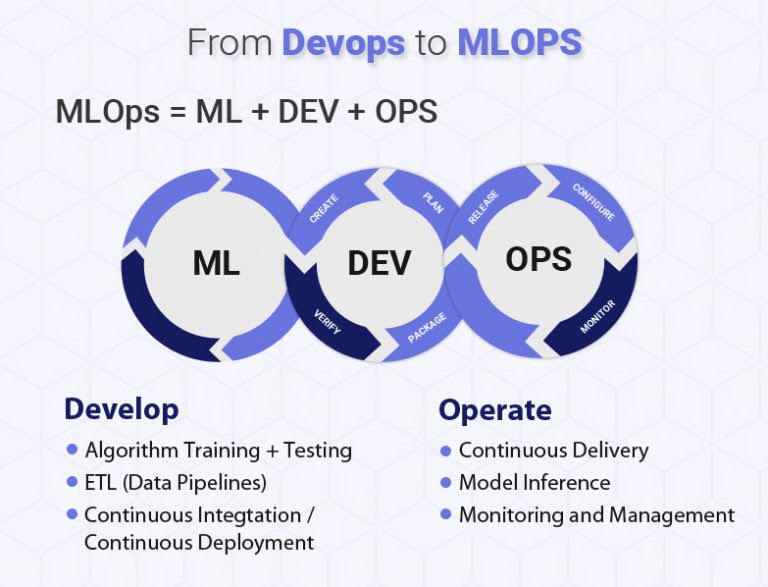
Are you confused about DevOps and MLOps? Do you think they are two sides of the same coin or completely different? Let’s dive deep into the world of DevOps and MLOps and explore their differences and similarities.
DevOps – What’s the Buzz All About?
DevOps is a set of practices that combines software development and IT operations to shorten the systems development life cycle and provide continuous delivery with high software quality. It aims to break the silos between development and operations, fostering a culture of collaboration and communication among teams.
DevOps has become an essential practice for modern software development, enabling faster delivery of features and bug fixes, better quality software, and improved customer satisfaction. DevOps practices include continuous integration and continuous delivery, infrastructure as code, monitoring, and automation.
MLOps – The New Kid on the Block
MLOps is an extension of DevOps that focuses on the machine learning life cycle, including data preparation, model training, deployment, and monitoring. MLOps aims to bring the principles of DevOps to machine learning, enabling faster and more reliable development of machine learning applications.
MLOps is crucial for organizations that want to leverage the power of machine learning to gain a competitive advantage. MLOps practices include version control for data and models, reproducibility, automation of model training and deployment, and monitoring of model performance in production.
The Differences between DevOps and MLOps
While DevOps and MLOps share many similarities, there are some significant differences between them:
Data and Model Versioning
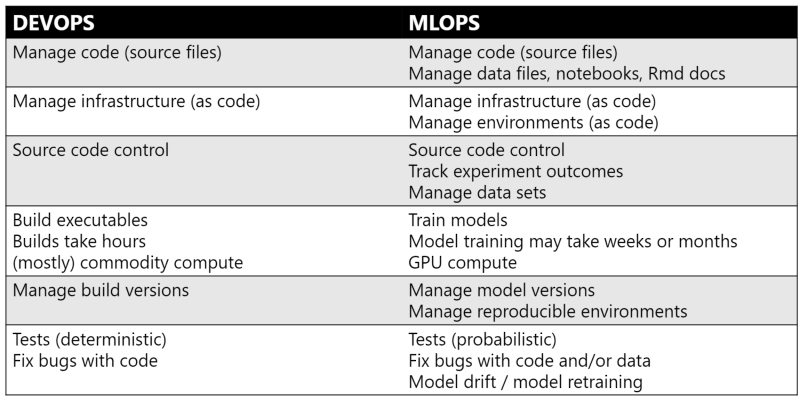
One of the key differences between DevOps and MLOps is the way they handle data and model versioning. In DevOps, version control is applied to code, configuration files, and infrastructure. In contrast, MLOps applies version control to both data and models.
Version control for data is essential in MLOps as it enables reproducibility of machine learning models. Without version control, it’s hard to keep track of changes in the training data, making it challenging to reproduce the results. Model versioning is also crucial as it enables tracking of changes in the model over time.
Model Deployment and Monitoring
Another significant difference between DevOps and MLOps is the way they handle model deployment and monitoring. In DevOps, deployment is usually straightforward, as the code is compiled into an executable and deployed to a server. In contrast, model deployment is more complex, as it involves deploying a machine learning model as a service.
MLOps also places a strong emphasis on model monitoring, as it’s essential to ensure that the model is performing as expected in production. Model monitoring involves tracking model performance metrics, such as accuracy and precision, and detecting anomalies in the input data.
Skillset and Tools
Finally, DevOps and MLOps require different skillsets and tools. DevOps practitioners need to be proficient in programming, infrastructure management, and automation tools such as Ansible, Chef, and Puppet. In contrast, MLOps practitioners need to be proficient in machine learning, data engineering, and tools such as TensorFlow, PyTorch, and Apache Spark.
Conclusion
In conclusion, DevOps and MLOps share many similarities, but they are different in many ways. DevOps focuses on software development and IT operations, while MLOps focuses on the machine learning life cycle. MLOps is crucial for organizations that want to leverage the power of machine learning to gain a competitive advantage. Understanding the differences between DevOps and MLOps can help organizations choose the right approach for their needs.
