Introduction
Your phone connects to a cell tower in seconds. You never see the hidden work behind that link. Every SIM card carries secret digital ID numbers. These numbers tell the network who you are and where you belong. They also guide calls, texts, and mobile data across borders. Billions of connections run on this quiet system every day. But most people never learn how it works. This guide opens that door in plain English. We explain country codes, carrier codes, and network routing step by step. We also show how eSIMGlobo, an evidence-led global telecom provider directory, helps researchers verify real network data. No pushy sales talk here. Just clear, practical knowledge for curious minds.
Understanding Cellular Identity: What Are MCC and MNC Codes?
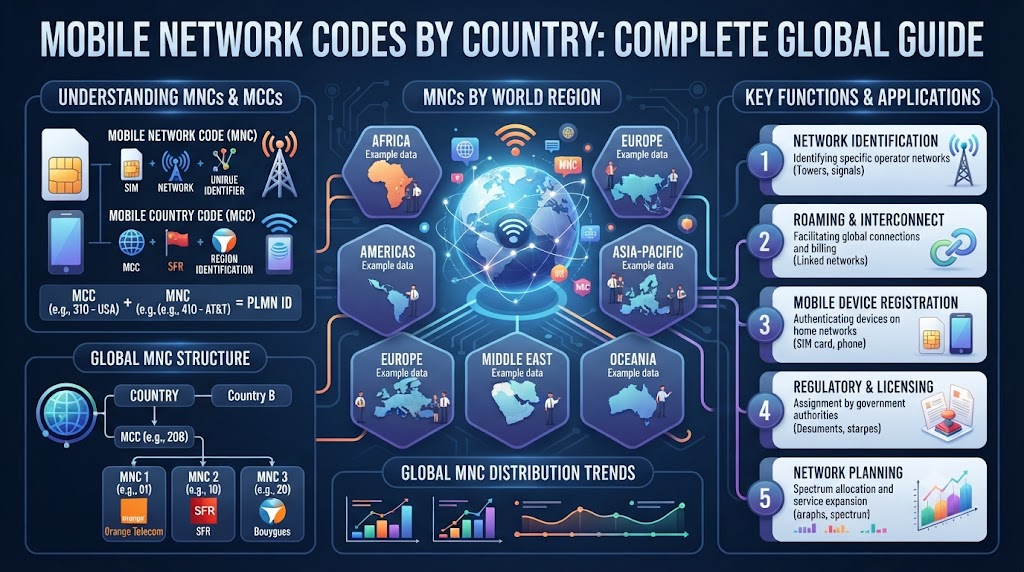
Every mobile network has a name and a number. The number matters most behind the scenes. A Mobile Country Code (MCC) is a three-digit number. It shows which country a network belongs to. For example, 310 points to the United States. Think of it as a country tag on every tower.
Next comes the Mobile Network Code (MNC). This is a two- or three-digit number. It shows the exact phone carrier inside that country. One carrier might use 260, while another uses 410. So the MCC picks the country, and the MNC picks the company.
These two numbers work as a team inside every SIM card. They guide calls and mobile data to the right place. Without them, your phone would not know which network to trust. So these small digits carry big weight in global cellular systems.
Decoding the Telecom Stack: Codes, Networks, and Operators
Cellular systems use layers of numbers. Each layer has one clear job. Some codes mark countries. Others mark carriers. A few identify each individual subscriber line. Together, they keep global mobile traffic organized and secure.
| Telecom Identifier | Number Length | Primary Purpose | Real-World Example | Managing Body |
|---|---|---|---|---|
| Mobile Country Code (MCC) | 3 Digits | Identifies geographic territory or international scope | 310 (United States) / 204 (Netherlands) | ITU-T |
| Mobile Network Code (MNC) | 2 or 3 Digits | Identifies specific mobile carrier within a country | 260 (T-Mobile) / 04 (Vodafone) | National Regulators |
| PLMN Code (MCC + MNC) | 5 or 6 Digits | Identifies unique wireless network operator | 310260 / 20404 | Cellular Industry |
| IMSI Identifier | Up to 15 Digits | Identifies the unique individual subscriber line | Stored securely on SIM card chips | Mobile Operators |
Phones read these numbers when they search for signals. The device scans nearby radio bands for available networks. Then it matches each signal to a known PLMN code. So your phone always knows which network it found. This quiet check happens many times per minute, even while you sleep.
MCC MNC Lookup and Identifying Wireless Carriers
An MCC MNC Lookup tool works like a digital phone book. You type in a five- or six-digit code. The tool shows the legal company behind that code. It also shows the country and network type. The answer appears in seconds.
Developers use these tools every day. Fraud analysts check incoming traffic against real codes. Network engineers verify which carrier owns a signal. All of them rely on official ITU-T E.212 records. This standard keeps global network IDs clean and unique.
So a lookup tool saves hours of manual research. It also catches mistakes that could cost real money. A wrong code can break SMS routing or block a payment check. So verified data protects both businesses and users. This is why lookup tools sit at the heart of modern telecom work.
PLMN Code Lookup and Cellular Network Routing
A PLMN Code Lookup starts with one simple idea. A Public Land Mobile Network (PLMN) is the full mix of country and carrier codes. So the MCC plus the MNC equals one unique network. That network belongs to one operator in one country.
Roaming depends on this match. When you travel abroad, your phone looks for local PLMN codes. Then it checks if your home carrier has a roaming deal with them. If yes, your phone connects and service continues. If no, your phone keeps searching for a partner network.
Phone radio bands also matter here. Each carrier uses specific frequency bands. Your device must support the local band to connect. So a PLMN lookup helps travelers pick devices that truly work abroad. It also helps engineers plan cross-border coverage with real data.
Mobile Network Operator Directory and Verified Network Holders
A Mobile Network Operator (MNO) owns real physical equipment. That means towers, base stations, and radio spectrum licenses. These companies build and run the actual network. Their names often differ from the brands you see on store signs.
This gap causes confusion. A retail brand may look like the network owner. But the license might belong to a parent company or a holding group. So a Mobile Network Operator Directory helps you trace the real infrastructure owner.
Verified directories link each code to legal records. They show the corporate assignee, not just the marketing name. This clarity helps researchers, investors, and regulators alike. So you always know who truly runs the towers behind your signal.
Global Telecom Provider Directory and International Coverage
The world has hundreds of mobile networks. Each one sits inside a country or territory. Some serve entire regions. Others cover tiny islands or special zones. Keeping track of all of them needs one organized source.
A Global Telecom Provider Directory solves this problem. It groups networks by country, code, and operator type. So you can search one place instead of ten websites. This saves time and reduces errors.
Some networks cross borders by design. Shared-code systems cover satellites, ships, and aircraft. These networks serve moving users across many countries at once. So a good directory marks them clearly. That way, researchers never confuse a global network with a local one.
Mobile Network Codes by Country and Regional Numbering
Each country runs its own telecom rules. National regulators assign network codes to local carriers. So Mobile Network Codes by Country differ in size and style. Europe uses many two-digit MNCs. The Americas often use three-digit codes. Asia mixes both styles across markets.
These patterns reveal market structure. A country with many codes has strong competition. A country with few codes may have a small market or a dominant player. So researchers read these lists like market maps.
Regional differences matter for device makers too. A phone built for one region may miss local bands. So checking country codes first helps avoid connection failures abroad. This simple step saves travelers and engineers real headaches.
Mobile Country Code List for Global Travelers and Researchers
A Mobile Country Code List works like a global index. It shows every assigned country block in one place. Travelers use it to identify foreign SIM cards. Researchers use it to study network growth by region.
The International Telecommunication Union (ITU) manages this list. This body assigns clean three-digit blocks to each country. So no two countries share the same MCC. That rule keeps global routing stable and clear.
The list also covers special ranges. Codes like 901 and 902 serve international networks. These include satellites and maritime systems. So the list is more than a travel aid. It is a full map of global cellular identity.
Network Data Validation and Carrier Research Checklist
Good research starts with good checks. Anyone can copy a carrier list from a random website. But copied lists often carry old or wrong data. So smart researchers verify each record against primary sources first.
| Research Step | What to Check | Why It Matters |
|---|---|---|
| ITU-T E.212 Baseline | Official Assignment Status | Confirms legal code ownership from international records |
| National Regulator Filing | Local Frequency Licenses | Shows domestic operational approval and spectrum rights |
| Commercial Role Check | MNO vs MVNO Designation | Clarifies whether the provider owns physical cell towers |
| Active Brand Matching | Retail Trade Name | Connects technical network numbers to consumer brand logos |
| International Shared Codes | 901/902 Global Allocations | Identifies satellite, maritime, and specialized IoT networks |
| Data Timestamp Review | Date of Last Assignment Audit | Ensures decommissioned or merged network codes are updated |
Outdated lists cause real damage. A merged carrier may still appear as two separate networks. A dead code may still look active. So always check the last audit date. Then cross-check with official filings. This habit keeps your data clean and trustworthy.
Telecom Operator Database and Evidence-Led Research
Facts need proof. A Telecom Operator Database becomes useful only when it links to real sources. Anyone can claim a code belongs to a certain carrier. But evidence turns that claim into fact.
So strong databases connect each record to primary documents. These include government filings and official regulatory papers. Each entry then carries a clear trail. Researchers can check the source and confirm the details.
This approach builds trust over time. Developers trust the data for routing decisions. Analysts trust it for fraud checks. Regulators trust it for market studies. So evidence-led research turns raw numbers into reliable knowledge. That shift makes the whole telecom ecosystem stronger.
MVNO Directory: Virtual Operators and Wholesale Networks
Not every carrier owns towers. Many companies sell mobile plans without building networks. These are Mobile Virtual Network Operators (MVNOs). In simple words, they rent space on someone else’s network.
An MVNO Directory lists these virtual carriers and their host networks. So you can see which real MNO supports each brand. This matters because the host network controls actual coverage and speed.
MVNOs often offer flexible plans and lower prices. They buy wholesale capacity from host MNOs. Then they package it for niche groups like travelers or students. So the MVNO model adds choice to the market. A good directory makes that market easy to understand.
eSIM Provider Directory and Modern Digital Connectivity
An eSIM is a tiny digital chip built inside modern phones. It downloads mobile plans over the internet. So you can add a new carrier without swapping plastic cards. This makes travel and device setup much easier.
An eSIM Provider Directory lists these digital plan sellers. It shows their supported countries and network partners. So users can check real coverage before buying a plan.
This data matters for travelers most. A cheap travel plan may ride on a weak local network. So checking the underlying carrier first saves trouble later. A verified directory connects digital brands to physical towers. That link turns a vague promise into a clear picture.
Developer Workflows: MCC MNC Lookup API and Data Integration
Software teams need fast, accurate answers. An MCC MNC Lookup API delivers them automatically. The app sends a code. The API returns the country, carrier, and network type. This happens in milliseconds, without human effort.
Engineers use these lookups for many tasks. They detect SIM card origins during sign-up. They route SMS codes through cheaper paths. They also block suspicious traffic from unknown networks. So each lookup adds a small layer of safety.
Fintech platforms rely on this data too. A foreign SIM can signal fraud risk. So a quick lookup helps flag odd behavior early. Telecom product teams also use APIs to tune global data routes. So automated lookups keep modern apps fast, safe, and smart.
Real-Life Telecommunications Scenarios
- A mobile app developer uses an automated network lookup to route two-factor SMS codes through the lowest-cost local carrier. This cuts delivery costs while keeping login codes fast and reliable for users worldwide.
- An international business traveler checks an online directory to identify which local network partner their roaming eSIM connects to abroad. This confirms coverage before an important meeting or flight connection.
- A telecom security analyst investigates an unfamiliar PLMN code to flag suspected SIM-swap fraud or unauthorized network spoofing. Verified records quickly separate real carriers from fake signals.
- An IoT fleet manager verifies country codes and network assignees to ensure smart tracking sensors connect reliably across foreign borders. This prevents data gaps during cross-border shipments.
Common Mistakes to Avoid in Telecom and Network Code Research
- Confusing a consumer brand name with the actual licensed infrastructure owner. Always check the legal assignee in official records, not just the logo on a store sign.
- Assuming an International Dialing Code (like +1 or +44) is the same as a Mobile Country Code (MCC). These are different systems with different jobs, so never mix them in research.
- Relying on outdated carrier lists that do not reflect recent corporate telecom mergers. Check the audit date and confirm current ownership before trusting any list.
- Overlooking whether a code belongs to an international shared range (such as 901 or 902) rather than a single country. Shared codes serve satellites and ships, not local users.
- Trusting unsourced blog lists that invent network assignments without checking ITU E.212 records. Always verify against official baseline data first.
- Forgetting that an MVNO shares the radio towers and physical PLMN codes of its host operator. So virtual brands never own separate towers, even if their name looks new.
- Assuming all mobile operators operate on the same radio frequency bands across different continents. Band support varies by region, so check device specs before travel.
- Neglecting to verify whether an assigned network code is actively operating or held as a non-commercial test license. Test codes may never serve real customers, so treat them with care.
Simple Telecom Data Research Checklist
- Verify the three-digit Mobile Country Code (MCC) against the official ITU list. This confirms the country block is real and current.
- Confirm the Mobile Network Code (MNC) length (two digits versus three digits). Length errors cause failed lookups and wrong matches.
- Check the combined five- or six-digit PLMN code in a verified operator database. This step confirms the exact network identity.
- Identify the legal corporate assignee holding the frequency license. This shows who truly owns and runs the network.
- Review official national regulator filings for recent changes or license transfers. This catches mergers and updates before they spread as errors.
Frequently Asked Questions
1. What is the difference between an MCC and an MNC?
An MCC is a three-digit Mobile Country Code. It shows which country a network belongs to. An MNC is a two- or three-digit Mobile Network Code. It shows the exact carrier inside that country. Together they form a PLMN code. So the MCC picks the country, and the MNC picks the company. Both live inside every SIM card.
2. How do mobile phones use PLMN codes to select a cellular network?
A phone scans nearby radio signals for available networks. Then it reads each signal’s PLMN code. Next it compares those codes to its home network and roaming agreements. If a match exists, the phone connects. If not, it keeps searching. So PLMN codes guide every network choice your phone makes, at home or abroad.
3. Where do official Mobile Country Code and Network Code records come from?
The International Telecommunication Union (ITU) manages the global MCC list. This body assigns clean three-digit blocks to each country. National regulators then assign MNCs to local carriers. So official records come from two layers. The ITU handles country codes, and local regulators handle carrier codes. Together they form the global baseline.
4. What is the difference between an MNO and an MVNO in a telecom directory?
An MNO owns real towers and radio spectrum. These companies build and run physical networks. An MVNO rents capacity from a host MNO. It sells plans without owning towers. So a directory must mark each type clearly. That way, users know who truly controls coverage and speed.
5. Why do some international networks use 901 or 902 country codes?
Codes 901 and 902 are special shared ranges. They serve networks that cross borders. Satellites, ships, and aircraft use them. So these codes do not belong to one country. Instead, they cover global or regional service. A good directory marks them clearly, so researchers never confuse them with local networks.
6. How does an MCC MNC lookup tool help stop financial and SMS fraud?
A lookup tool reveals the real network behind an incoming code. So analysts can spot fake or unknown carriers fast. Fraudsters often spoof numbers from odd networks. A quick check flags those signals early. This protects SMS routing, login codes, and payment checks. So verified lookups add a strong layer of safety.
7. Can two different telephone companies share the exact same MCC and MNC?
No, each PLMN code points to one network only. The ITU and national regulators keep codes unique. So two carriers cannot share the same full code. But an MVNO may use its host’s code for some services. That is why directories mark host relationships clearly. This rule keeps global routing clean and stable.
8. How does an eSIM profile connect to local physical cell towers abroad?
An eSIM downloads a digital plan from a provider. That plan carries a PLMN code and roaming deals. When you travel, your phone scans local towers. Then it matches their codes to your plan’s partners. If a deal exists, your phone connects. So the digital profile still rides on real physical towers.
9. What is an IMSI number, and how does it relate to network codes?
An IMSI is a unique number stored on your SIM card. It can hold up to 15 digits. The first digits copy the MCC and MNC. So the IMSI starts with the same codes as the network. The rest identifies your individual line. So network codes live inside every IMSI.
10. Why do some network operators hold multiple MNC assignments in the same country?
Large operators often run several brands or services. Each brand may need its own network code. So one company can hold many MNCs in one country. This helps separate consumer plans, business lines, or test networks. So multiple codes under one owner is normal, not an error.
11. How do developers integrate an MCC MNC lookup API into their applications?
Developers connect their app to the API with a secure key. The app sends a network code with each request. The API returns the country, carrier, and network type. Then the app uses that data for routing or fraud checks. Setup is simple, and responses arrive in milliseconds. So integration takes hours, not weeks.
12. How does eSIMGlobo help researchers find verified global telecom information?
eSIMGlobo links each network record to official sources. It uses ITU-T E.212 baseline data and regulator filings. So every entry carries a clear evidence trail. Researchers can check country codes, carrier roles, and MVNO links in one place. This saves time and reduces errors. So the platform turns raw numbers into trusted knowledge.
Conclusion
Global mobile networks run on small, hidden numbers. Country codes, carrier codes, and PLMN records guide every call and data link. Verified directories turn those numbers into clear, useful knowledge. Official ITU records keep the baseline clean. Regulator filings confirm real ownership. eSIM technology now adds digital plans on top of physical towers. So reliable data matters more than ever. Researchers and developers who check their sources build better systems. They avoid fraud, cut costs, and keep travelers connected. In the end, evidence-backed telecom data powers seamless global communication. So keep learning, keep verifying, and let clean data drive your work forward.
