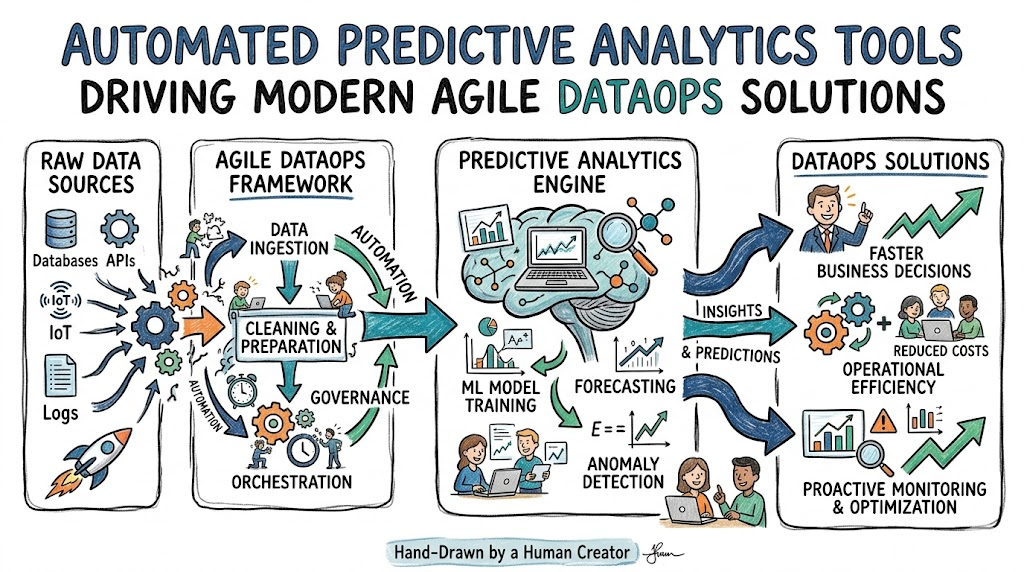
In the modern digital economy, reacting to problems after they happen is no longer enough. Businesses face an overwhelming flood of information every single day, making manual forecasting nearly impossible. To stay ahead, organizations must shift from understanding what happened to anticipating what will happen next. This is where the intersection of predictive analytics and DataOps becomes a game-changer for modern enterprises. Predictive analytics uses historical information to forecast future outcomes with incredible accuracy. Meanwhile, DataOps provides the agile framework, automated pipelines, and collaborative culture needed to deliver that information reliably. Together, they allow companies to anticipate market shifts, prevent system failures, and optimize daily workflows. When businesses combine these two forces, they transform raw data into a strategic superpower. In this comprehensive guide, you will discover how predictive analytics tools function within a DataOps framework. We will cover core components, popular tool categories, real-world use cases, and actionable deployment strategies. Whether you are a data engineer, a business analyst, or an IT leader, mastering these systems will help you build resilient data pipelines. If you want to dive deeper into these methodologies, explore the educational resources and community guides available at TheDataOps.org.
Understanding Predictive Analytics in DataOps
What is Predictive Analytics?
Predictive analytics is the branch of advanced analytics that makes predictions about unknown future events. It combines statistical modeling, data mining techniques, machine learning, and historical data to estimate the likelihood of specific outcomes.
For example, a financial institution can use predictive analytics to identify unusual transaction patterns and reduce fraud risks. Instead of just generating reports on past revenue, these systems look forward to highlight future opportunities and hidden risks.
What is DataOps?
DataOps, short for Data Operations, is an operational methodology that brings speed and accuracy to data lifecycle management. It focuses on improving collaboration, automation, and quality control across data engineers, data scientists, and business users.
Borrowing principles from Agile development and DevOps, DataOps treats data pipelines as automated manufacturing lines. It ensures that data flows smoothly, remains error-free, and reaches decision-makers without manual bottlenecks.
Relationship Between Predictive Analytics and DataOps
Predictive analytics acts as the brain, while DataOps serves as the nervous system. Without DataOps, predictive models often fail because they are fed stale, unverified, or siloed data.
DataOps automates the delivery pipelines, ensuring that machine learning models receive high-quality, real-time information. Conversely, predictive analytics provides the intelligent monitoring tools that DataOps teams need to forecast pipeline failures and optimize system performance.
Importance of Data-Driven Decision-Making
Relying on gut instinct or outdated quarterly reports is a recipe for operational failure. Data-driven decision-making helps businesses reduce uncertainty, minimize waste, and uncover new revenue streams.
By embedding predictive tools into daily operations, leaders can test hypotheses using historical evidence before investing capital. This proactive approach ensures that every business move is backed by statistical probability rather than guesswork.
Core Components of Predictive Analytics Tools
Data Collection and Integration
Every predictive analytics journey begins with gathering information from varied sources like databases, cloud storage, CRM systems, and IoT sensors. Modern analytics tools utilize connectors to pull this scattered information into a centralized repository.
This phase focuses on breaking down organizational silos so that the predictive models have a complete view of the operational landscape. Without robust integration, a predictive tool cannot access the historical trends required to build accurate forecasts.
Data Cleaning and Preparation
Raw data is rarely perfect; it is often filled with duplicate entries, missing values, and formatting inconsistencies. Predictive analytics tools feature automated preparation modules that clean and transform this raw material.
For instance, DataOps teams can automate data validation pipelines to reduce reporting errors. This step ensures that anomalies do not skew the machine learning models, which would otherwise result in flawed business predictions.
Machine Learning Algorithms
At the heart of any predictive tool lies a suite of mathematical algorithms. These algorithms analyze historical patterns to find hidden correlations and trends.
They range from simple linear regressions used for sales forecasting to complex neural networks designed for image recognition or natural language processing. The predictive tool selects and trains these algorithms, continuously refining their accuracy as new information enters the system.
Data Visualization and Reporting
Predictive insights are only useful if human teams can understand them easily. That is why core tools include interactive dashboards, charts, and automated reporting systems.
Instead of forcing business leaders to decipher complex mathematical equations, visualization features present findings visually. These dashboards display risk scores, future trend lines, and probability percentages in clear, scannable formats.
Automation and Workflow Orchestration
An enterprise-grade predictive tool cannot rely on manual steps to trigger its models. Automation components schedule data ingestion, run predictions at set intervals, and send alerts when specific thresholds are breached.
Orchestration keeps the data pipeline moving smoothly from ingestion to final reporting. If a step fails, the orchestration layer logs the issue, alerts engineers, and attempts to resolve the error automatically.
Popular Predictive Analytics Tools Used in DataOps
Machine Learning Platforms
Machine learning platforms provide the core environment where data scientists build, train, and test predictive models. These platforms offer pre-built algorithms, model registries, and testing environments that speed up development.
- Purpose: To turn raw operational data into trained mathematical models capable of forecasting future trends.
- Practical Example: A retail data team uses an ML platform to develop demand forecasting models, ensuring warehouses stock the right products ahead of major holidays.
Data Visualization Tools
Data visualization tools translate complex predictive outputs into intuitive executive dashboards. They connect directly to data warehouses and surface predictions alongside historical performance metrics.
- Purpose: To democratize data access and give non-technical stakeholders actionable insights via charts and graphs.
- Practical Example: A corporate CFO reviews a dynamic dashboard that projects company cash flow for the next three quarters based on current market indicators.
Cloud-Based Analytics Platforms
Cloud-Based analytics platforms offer massive computing power and storage capacities on demand. They allow organizations to scale their predictive initiatives without buying expensive physical server infrastructure.
- Purpose: To store petabytes of data and process complex analytical workloads quickly using cloud elasticity.
- Practical Example: A global logistics provider runs millions of route optimization simulations simultaneously in the cloud to lower delivery fuel costs.
Workflow Automation Tools
Workflow automation tools serve as the operational backbone of DataOps. They connect different data processing steps, ensuring that information moves from ingestion to the predictive model without manual intervention.
- Purpose: To orchestrate end-to-end data pipelines, manage dependencies, and eliminate manual script execution.
- Practical Example: An analytics team schedules an automation workflow that extracts customer feedback every night, cleans it, runs sentiment analysis, and updates the support dashboard by 6:00 AM.
Real-Time Monitoring and Observability Solutions
Observability tools focus on tracking the health, speed, and accuracy of both data pipelines and predictive models. They use predictive analytics internally to detect pipeline delays or model performance drops before they impact the business.
- Purpose: To maintain data quality, track data lineage, and alert engineers when a pipeline breaks or slows down.
- Practical Example: An observability tool detects that an incoming data stream has dropped by 40%, instantly alerting the DataOps team before the morning reports are generated.
Key Features of Predictive Analytics Tools
Real-Time Data Processing
Modern businesses move too fast to rely solely on batch processing that runs once a week. Top-tier analytics tools process live streams of data as they are generated.
This features allows systems to provide instant insights, such as calculating updated shipping arrival times while a delivery truck is still on the highway. Real-time processing guarantees that business decisions are based on what is happening right now, not what happened yesterday.
Automated Forecasting
Automated forecasting removes the manual effort from projecting future metrics like sales, web traffic, or supply chain demands. Users simply select a target metric, and the tool automatically reviews historical baselines to generate future projections.
These automated features adapt over time, adjusting their forecasts as new sales figures or seasonal trends enter the corporate database.
Anomaly Detection
Anomaly detection is the ability to spot unusual patterns that deviate from standard operational baselines. Predictive tools use historical data to establish what “normal” looks like for your business.
If a metric spikes or drops unexpectedly, the system flags it instantly. This helps security teams catch cyber threats, flags billing errors, and identifies manufacturing defects on a factory floor before they escalate into costly problems.
Predictive Modeling
Predictive modeling features allow data teams to build customized virtual scenarios to test business outcomes. Users can manipulate variables to see how changes might affect future performance.
For instance, an e-commerce company can use predictive analytics tools to forecast customer purchasing behavior during seasonal sales if they increase ad spend by 15%. This experimentation helps leaders optimize budgets before launching campaigns.
Data Pipeline Automation
Data pipeline automation ensures that information moves seamlessly through ingestion, cleaning, transformation, and analysis phases. Instead of requiring database administrators to manually move files, the predictive tool manages the entire lifecycle.
This automation accelerates delivery speeds and ensures that data models always operate on the freshest information available.
Reporting and Dashboarding
Advanced reporting features turn analytical findings into interactive, easily digestible business assets. Users can customize dashboards with drag-and-drop widgets, set up automated email reports, and share live tracking links across teams.
These dashboards use visual alerts, such as color-coded risk bars, to highlight areas requiring immediate executive attention.
Real-World Use Cases of Predictive Analytics in DataOps
Predictive Analytics in Healthcare
Imagine a healthcare organization analyzing patient records to predict potential disease risks before emergencies occur. By integrating hospital data pipelines with predictive tools, medical teams can review historical vital signs, lab results, and demographic details.
The system flags patients with a high statistical risk of readmission, allowing doctors to adjust care plans proactively. This saves lives, reduces hospital crowding, and optimizes medical equipment allocation across departments.
Fraud Detection in Banking
Financial institutions process millions of global transactions every single minute. Predictive analytics tools review these transactions in real time, comparing each purchase against the cardholder’s historical spending habits, geographical location, and terminal type.
If a credit card suddenly attempts a large purchase in a country the cardholder has never visited, the predictive system blocks the transaction instantly. This rapid intervention protects consumers and saves banks millions in fraud recovery costs.
Customer Behavior Prediction in E-Commerce
Online retailers use predictive frameworks to personalize the entire shopping experience. By analyzing past browsing habits, cart additions, search queries, and purchase histories, analytics engines predict what a customer is likely to buy next.
These insights power automated product recommendation grids and trigger personalized discount emails. The result is higher conversion rates, increased average order values, and improved brand loyalty.
Predictive Maintenance in Manufacturing
In heavy industrial settings, unexpected machinery breakdowns can halt entire production lines and cost thousands of dollars per hour. Manufacturers install IoT vibration, temperature, and pressure sensors directly onto factory equipment.
Predictive analytics platforms process these sensor streams continuously. When a machine begins vibrating outside of its normal threshold, the system schedules maintenance before an actual mechanical failure occurs.
IT Infrastructure Monitoring and Forecasting
Enterprise cloud environments are highly complex and prone to sudden resource bottlenecks. DataOps teams deploy predictive monitoring tools to forecast server CPU, memory, and storage utilization.
By analyzing historical traffic cycles, the predictive system can automatically provision additional virtual servers ahead of a predicted web traffic spike. This automation prevents website crashes, maintains application speeds, and optimizes cloud infrastructure costs.
Benefits of Using Predictive Analytics Tools in DataOps
Faster Decision-Making
By automating data compilation and running predictive models continuously, companies cut down decision-making times significantly. Executives no longer have to wait weeks for business analysts to assemble retrofitted spreadsheets.
Instead, they can open up a live dashboard, view predictive trends, and make strategic operational choices within minutes, keeping them ahead of slower competitors.
Improved Data Accuracy
DataOps principles emphasize automated data validation and continuous testing across every step of the pipeline. When predictive tools are embedded into this framework, they catch formatting issues and missing data fields early.
This rigorous cleaning process ensures that the information feeding your predictive models is completely accurate, resulting in highly reliable business forecasts.
Reduced Operational Risks
Operating a business without predictive insights is like driving a vehicle in heavy fog without headlights. Predictive tools serve as early warning systems that flag data pipeline failures, security breaches, and inventory shortages before they happen.
By identifying these operational bottlenecks early, teams can implement fixes and minimize business disruption.
Better Customer Experience
When businesses can anticipate customer needs, the entire service experience improves. Predictive tools help companies offer hyper-personalized product selections, resolve support issues before users complain, and keep popular items well-stocked.
This proactive care makes customers feel valued, which increases retention rates and drives long-term organic growth.
Increased Operational Efficiency
Integrating predictive analytics tools into your DataOps strategy eliminates tedious manual workflows. Data engineers no longer need to spend hours checking database entries or running manual validation tests.
Automation handles these repetitive tasks, freeing up your technical teams to focus on building new analytics features and driving innovation.
Scalability of Data Pipelines
As an organization grows, its data volume expands exponentially. DataOps-driven predictive tools are built to handle these massive surges smoothly.
They utilize cloud computing architectures to auto-scale processing resources whenever a huge wave of new data enters the ecosystem. This ensures your business forecasts remain fast and reliable, regardless of how much data you process.
Common Challenges in Predictive Analytics Projects
Poor Data Quality
The famous phrase “garbage in, garbage out” perfectly describes the biggest challenge in predictive analytics. If your data pipelines are feeding broken, duplicate, or unverified data into a predictive model, the resulting forecast will be completely inaccurate.
Organizations must invest time in automated cleaning and pipeline data validation to ensure their models are built on a dependable foundation.
Data Silos
In many companies, different departments use isolated software systems that do not talk to each other. The sales team, marketing group, and supply chain managers might all hold separate pieces of the same data puzzle.
These disconnected data silos prevent predictive tools from gaining a complete view of operations, which severely limits the accuracy of their business forecasts.
Integration Complexity
Connecting new predictive analytics tools to legacy corporate software, on-premise databases, and modern cloud platforms can be highly complex. Incompatible data formats and rigid security architectures often slow down deployments.
Without an agile DataOps integration framework, connecting these separate systems can drain valuable engineering hours and cause project delays.
Lack of Skilled Teams
Building, deploying, and maintaining enterprise-grade predictive models requires a specialized mix of technical skills. Companies need engineers who understand data pipelines, statistics, machine learning, and business strategy.
The high demand for these specialized DataOps professionals makes it difficult for many growing organizations to recruit and retain the talent needed to run projects.
Overfitting and Model Bias
Overfitting happens when a predictive model memorizes historical data too closely, making it excellent at explaining the past but terrible at predicting the future.
Additionally, if the historical data used to train the model contains human bias, the predictive tool will replicate those same biased choices. Data teams must continuously test, audit, and retrain models to ensure they remain fair and objective.
Security and Privacy Concerns
Predictive analytics tools often process highly sensitive consumer records, financial data, and proprietary business metrics. Moving this information across pipelines creates security risks if the data is not encrypted properly.
Companies must ensure their analytics practices comply with modern regional data protection laws, balancing deep insights with strict user privacy.
Best Practices for Implementing Predictive Analytics in DataOps
Build Reliable Data Pipelines
Focus on establishing resilient, error-resistant data pipelines before choosing advanced machine learning algorithms. Ensure that your ingestion pipelines can handle data traffic spikes and that automated validation steps are active at every stage.
A predictive model is only as good as the pipeline delivering its data; prioritize reliability above all else.
Focus on Data Governance
Data governance means creating clear rules regarding who owns data, who can access it, and how it must be formatted. Establish a centralized data catalog and use lineage tracking tools so everyone knows exactly where information comes from.
Strong governance keeps data clean, organized, secure, and ready for predictive modeling.
Automate Repetitive Workflows
To make your predictive analytics strategy scalable, eliminate manual interventions across your data lifecycles. Automate data extraction, cleaning schedules, model testing runs, and executive dashboard updates.
Continuous automation reduces human errors, speeds up processing, and allows your data team to focus on high-value development work.
Continuously Monitor Models
Predictive models are not “set-and-forget” software systems. Market dynamics change, customer preferences shift, and data pipelines can drift over time, causing model accuracy to degrade.
Deploy automated observability tools to track model performance continuously, and set up alerts to flag engineers when prediction accuracy drops below acceptable levels.
Improve Collaboration Between Teams
Break down the traditional barriers that separate data engineers, data scientists, and business managers. DataOps thrives on open, cross-functional collaboration.
Ensure that business stakeholders can share feedback easily with the engineering teams building the models. This collaboration ensures that your technical analytics projects directly address real-world business challenges.
Start with Small Use Cases
Do not try to overhaul your entire enterprise analytics infrastructure on day one. Instead, choose a small, clearly defined business problem with clean historical data available.
For instance, start by predicting customer churn for a single product line. Landing small, early wins helps prove value, refines your team’s DataOps workflows, and builds organizational support for larger rollouts.
Predictive Analytics vs Traditional Analytics
| Aspect | Traditional Analytics | Predictive Analytics |
| Primary Focus | Explaining past events and historical trends. | Forecasting future outcomes and probabilities. |
| Approach | Reactive (Reviewing historical summaries). | Proactive (Anticipating next shifts). |
| Core Method | Manual data gathering and basic spreadsheets. | Automated machine learning and pipelines. |
| Reporting Style | Static PDF or weekly email reports. | Live, dynamic dashboards with anomaly alerts. |
| Business Value | Helps audit past performance. | Drives immediate optimization and growth. |
Reactive vs Predictive Approaches
Traditional analytics is fundamentally reactive, focusing on compiling historical summaries to answer questions like “What were our total sales last quarter?”
Predictive analytics takes a proactive approach, using those historical baselines to answer questions like “What will our total sales likely be next month?” This forward-looking view allows businesses to adapt their strategies before market shifts occur.
Manual Reporting vs Automated Forecasting
Traditional setups rely heavily on analysts manually exporting database records, building formulas in spreadsheets, and formatting static presentations.
Predictive analytics frameworks replace these slow processes with automated data pipelines. The system ingests data, updates statistical models, and delivers refreshed future forecasts automatically without requiring manual human effort.
Static Reports vs Real-Time Insights
A traditional business report is often out-of-date the moment it is printed or emailed because it relies on static snapshots of past data.
Predictive tools within a DataOps ecosystem run on live data streams, updating executive dashboards continuously. This real-time accessibility means leaders base critical operational choices on current market realities rather than old data snapshots.
Business Decision-Making Differences
Traditional analytics tells you where your company has been, which is helpful for auditing but limits your ability to pivot quickly.
Predictive analytics gives teams the forward-looking visibility needed to run scenario simulations, mitigate operational risks, and capture emerging opportunities. It transforms analytics from an administrative bookkeeping task into a powerful strategic engine.
Essential Technologies Supporting Predictive Analytics
Artificial Intelligence and Machine Learning
AI and machine learning provide the computational intelligence required to make accurate future predictions. These technologies allow systems to learn from complex historical datasets without being explicitly programmed for every scenario.
As more data moves through your pipelines, these underlying machine learning models automatically refine their algorithms, steadily improving forecast precision over time.
Cloud Computing
Cloud computing provides the elastic storage and immense processing power needed to run modern analytics projects at scale.
Instead of investing heavily in physical server rooms that require manual maintenance, companies utilize cloud platforms to scale infrastructure resources up or down instantly. This flexibility allows organizations to process complex predictive modeling jobs affordably.
Big Data Platforms
Modern enterprises collect data in a massive variety of formats, from structured SQL databases to unstructured text files, social media streams, and media logs.
Big data platforms are designed to store and manage these massive, unformatted datasets efficiently. They ensure that predictive tools can access all historical corporate information quickly, providing a comprehensive pool of data for model training.
Observability and Monitoring
Observability technologies track the overall health, performance, and data quality running through enterprise pipelines. They act as automated watchdogs, monitoring for schema changes, processing delays, and model drift.
By ensuring your pipelines remain stable and healthy, observability systems guarantee that your predictive engines always have access to a clean stream of information.
Automation and Orchestration
Orchestration engines serve as the conductor for your entire data technology stack. They schedule data movements, manage workflow dependencies, trigger predictive scripts, and push alerts to dashboards.
By handling these background operations automatically, orchestration technologies eliminate manual workflow steps and keep the entire DataOps framework running smoothly around the clock.
Career Opportunities in Predictive Analytics and DataOps
Skills Required for DataOps Professionals
Succeeding in the growing field of DataOps requires a balanced mix of software engineering, data science, and operational strategy skills. Professionals must understand how to construct scalable data pipelines, manage cloud infrastructures, and write clean database queries.
Equally important is a strong foundational knowledge of statistics and machine learning concepts, combined with excellent communication skills to translate complex data findings into actionable business insights.
Popular Career Paths
The growth of data-driven business models has created a wide variety of rewarding career tracks across industries:
- DataOps Engineer: Focuses on building, automating, and maintaining the infrastructure pipelines that move data to predictive models.
- Data Scientist: Specializes in researching historical patterns, designing machine learning models, and optimizing prediction accuracy.
- Analytics Manager: Bridges the gap between technical data teams and corporate executives, ensuring data projects solve core business problems.
- Data Quality Analyst: Dedicated to auditing data streams, enforcing data governance rules, and ensuring information accuracy across systems.
Certifications and Learning Resources
Earning professional certifications is an excellent way to validate your skills and stand out in a competitive job market. Aspiring professionals should explore certifications focused on cloud architecture, agile data management, and machine learning platforms.
Hands-on boot camps, engineering community forums, and guided technical projects are also fantastic tools for mastering modern pipeline automation systems.
Learning Opportunities from TheDataOps.org
If you want to accelerate your professional journey in this space, leveraging structured educational material is key.
Organizations like TheDataOps.org provide curated learning resources, technical framework overviews, and industry best practices designed for both beginners and experienced data professionals. Engaging with these communities helps you stay up-to-date with evolving deployment methodologies and tools.
Future of Predictive Analytics in DataOps
AI-Driven Forecasting
The next era of analytics will feature deeper integration of advanced AI architectures into standard corporate data workflows. These intelligent systems will analyze multi-modal data streams—including text, audio, video, and traditional tables—simultaneously.
This evolution will enable automated forecasting engines to understand market contexts deeply, delivering highly accurate predictions with minimal initial human configuration.
Real-Time Business Intelligence
We are moving away from historical dashboards entirely, heading toward completely real-time business intelligence ecosystems.
Future predictive setups will analyze consumer actions, supply chain delays, and global economic indicators as they happen. This instantaneous processing will give companies the ability to adjust pricing, shift inventory, and reallocate budgets dynamically in seconds.
Autonomous Data Pipelines
Tomorrow’s DataOps environments will feature fully autonomous data pipelines that self-heal without human intervention.
If an incoming data stream changes formatting unexpectedly, embedded AI systems will recognize the variation, adjust the pipeline code automatically, and clean the data without pausing the workflow. This automation will eliminate routine maintenance tasks for engineers entirely.
Advanced Observability Platforms
As enterprise data systems grow more complex, future observability platforms will expand their capabilities significantly. They will utilize deep learning models internally to trace data lineage across global hybrid-cloud ecosystems.
These advanced watchdogs will predict pipeline bottlenecks, security vulnerabilities, and model accuracy drops days before they actually occur.
Ethical AI and Responsible Analytics
As predictive engines increasingly influence hiring choices, loan approvals, and healthcare plans, ethical considerations will become central to development. Future analytics frameworks will include automated compliance and bias-detection checks directly within the deployment pipeline.
This shift ensures that predictive models remain transparent, auditable, fair, and fully compliant with evolving global privacy mandates.
FAQ Section
- What is the main difference between predictive analytics and DataOps?
Predictive analytics focuses on using historical data and machine learning models to forecast future business trends and outcomes. DataOps is the operational methodology that automates and manages the underlying data pipelines, ensuring that the predictive tools always receive clean, accurate, and timely data.
2. How do predictive analytics tools help improve customer experience?
These tools analyze past browsing histories, purchasing patterns, and customer support interactions to anticipate what a client will want next. This allows companies to deliver hyper-personalized product recommendations, resolve service issues proactively, and ensure popular inventory remains well-stocked.
3. Can small businesses benefit from predictive analytics, or is it only for enterprises?
Small businesses can absolutely benefit by starting with targeted use cases, such as using simple cloud-based tools to forecast monthly sales or optimize marketing spends. You do not need massive physical infrastructure; scalable cloud analytics platforms allow growing teams to pay only for the processing power they actually use.
4. Why is data cleaning so important in predictive modeling projects?
Predictive models learn how to project future outcomes by analyzing historical patterns. If the historical data contains duplicate entries, formatting errors, or biased information, the model will learn those incorrect patterns, resulting in flawed business predictions that can lead to costly strategic mistakes.
5. What are the most common career paths within the DataOps and analytics fields?
Popular and rewarding career options include DataOps Engineers (who build and manage automated pipeline systems), Data Scientists (who build and train predictive machine learning models), Analytics Managers (who connect data insights to business strategy), and Data Quality Analysts (who protect data governance).
6. How do autonomous data pipelines handle errors without human intervention?
Autonomous pipelines use embedded machine learning algorithms to monitor data flows continuously. When the system detects a pipeline anomaly or formatting change, it can run automated diagnostic tests, isolate the bad data, apply pre-programmed fixes, and alert the team while keeping the rest of the pipeline moving.
Conclusion
The integration of predictive analytics tools into a DataOps framework represents a massive evolution in how modern organizations utilize information. Shifting from reactive historical reporting to proactive future forecasting allows companies to protect their pipelines, optimize daily workflows, and make critical decisions with confidence. As automated data pipelines, machine learning models, and real-time observability tools continue to advance, the business advantage will belong to teams that can turn raw data into trusted future predictions fastest. Embracing this proactive approach requires a commitment to building reliable data pipelines, establishing strong governance, and fostering open collaboration across data teams. By automating repetitive tasks and continuously monitoring your analytical models, you can create a resilient, scalable operations center.
