Introduction
Austria offers an incredible mix of high-paying jobs, public safety, world-class healthcare, and a perfect work-life balance. It is no wonder that skilled professionals from all over the world dream of settling down in this beautiful European nation. However, moving to a new country can feel overwhelming if you do not understand the legal pathways. Austria does not use a random lottery system to select its immigrants. Instead, it relies on a transparent, merit-based selection system. To navigate this system successfully, you need to understand the Austria PR Points Calculator and the Red-White-Red (RWR) Card framework. The official platform at Desinri Austria PR Points Calculator serves as an excellent starting point to run your initial score projection. This comprehensive guide will break down every single aspect of the Austrian immigration system. We will explore how points are distributed, what requirements you must fulfill, and how you can step-by-step turn your dream of European migration into reality. Whether you are an IT professional, a young university graduate, or a seasoned technician, this guide will show you exactly how to build a winning application profile.
What Is the Austria PR Points Calculator?
The Austria PR Points Calculator is an objective scoring mechanism used by the Austrian government to evaluate immigration candidates. Think of it as a transparent scorecard that grades your professional and personal profile. Instead of relying on subjective opinions, immigration officers use this structured points system to see if you possess the skills needed to boost the local economy.
The main purpose of this calculator is to fill critical labor shortages within Austria. The country has an aging population and a fast-growing digital economy, creating an urgent demand for qualified experts. By using a point-based system, the government can easily identify high-potential individuals and fast-track their entry into the workforce.
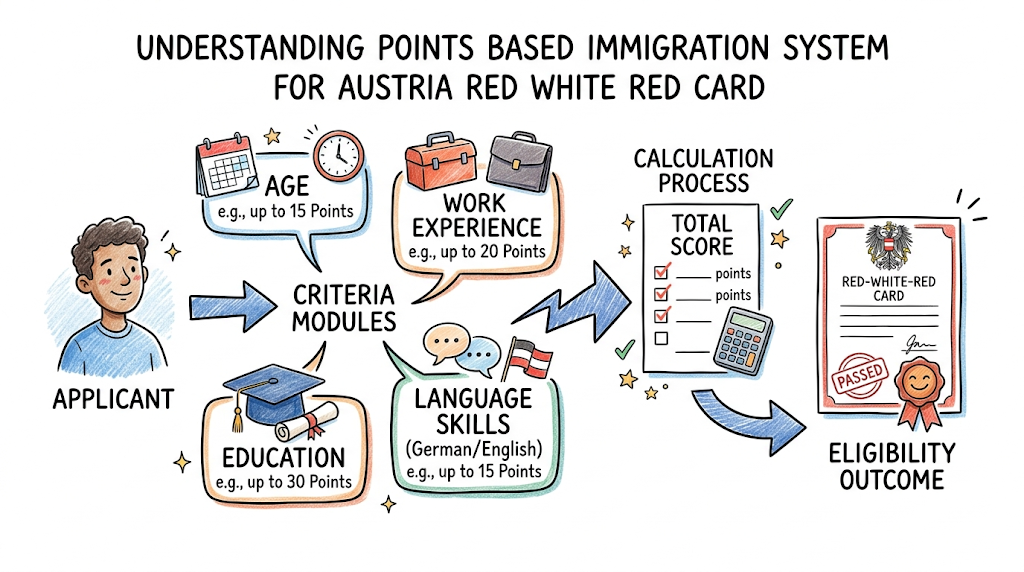
When you use the calculator, it looks at several key pillars of your life. It evaluates your formal education, your years of professional employment, your age, and your language capabilities in either German or English. Each of these categories yields a specific number of points, which are then added together to form your total immigration score.
It is vital to understand the difference between eligibility and final visa approval. Reaching the minimum score on the calculator means you are legally eligible to submit an application. However, final approval depends on the authenticity of your documents, background checks, and, in most cases, a valid job offer from an Austrian employer that complies with local labor market standards.
Austria PR Points System Explained
The Austrian immigration framework scores your profile across five main pillars. Let us look at how these points are awarded so you can maximize your potential score.
1. Education and Academic Qualifications
Your formal educational background acts as the foundation of your points calculation. Higher levels of education yield significantly higher scores.
For instance, completing a recognized university degree that took at least three years to finish will give you a strong baseline of points. If your degree is in a MINT subject (Mathematics, Informatics, Natural Sciences, or Technology), you will receive a substantial point premium because these skills are in exceptionally high demand.
2. Documented Work Experience
Austria deeply values practical hands-on experience. You earn points for every year of professional employment you have accumulated, provided it matches your field of qualification.
Importantly, the system offers extra credit for work experience gained directly inside Austria. If you have already spent six months or a year working within the Austrian market on a legal permit, those months are worth double the value of overseas experience.
3. The Age Factor
The point system is intentionally designed to attract young, dynamic professionals who can contribute to the national tax and social security systems for decades.
Applicants who are under the age of 30 receive the maximum allocation of points for this category. As you move into your 30s and 40s, the points gradually decrease. Once you cross the age of 50, this category no longer yields points, meaning you will need to make up the deficit through superior language skills or advanced educational degrees.
4. Language Skills (German and English)
Communication is the key to successful integration into Austrian society. The point system rewards proficiency in both German and English, though German is given higher priority.
Points are distributed based on the Common European Framework of Reference for Languages (CEFR), ranging from beginner levels like A1 and A2 to intermediate levels like B1 and B2. To claim these points, you must present an official test certificate from a recognized provider, such as the Goethe-Institut, ÖSD, IELTS, or TOEFL.
5. Bonus Points
Austria offers unique bonus points for specific scenarios. For instance, if you are applying as a Very Highly Qualified Worker, you can secure bonus points if you graduated from an Austrian university or if you hold registered patents or prestigious research awards.
Here is a quick illustrative example: If a 28-year-old software developer holds a Master’s degree in Computer Science, has four years of work experience, and speaks fluent English, they will score maximum points for age, education, and language. This puts them comfortably above the entry threshold.
The Red-White-Red Card System
The Red-White-Red Card is the official name of the work visa and residence permit issued by the Austrian government. It derives its name from the vibrant colors of the Austrian national flag.
This card is a combined permit, meaning it grants you both the legal right to reside in Austria and the authorization to work for a specific employer. The RWR Card is tailored to different professional backgrounds, divided into five main tracks:
Very Highly Qualified Workers
This stream is designed for top-tier scientists, senior executives, and high-level researchers. Uniquely, applicants in this category do not need an active job offer to begin the process. If they score high enough on the calculator, they can get a 6-month Job Seeker Visa to travel to Austria and look for work locally.
Skilled Workers in Shortage Occupations
If your profession is listed on Austria’s official national shortage list—such as mechanical engineers, turning technicians, certified nurses, or IT specialists—this is your pathway. You must have a concrete job offer in hand, but the points threshold to qualify is lower than the highly qualified track.
Other Key Workers
This category applies to professionals whose jobs are not on the official shortage list, but who possess specialized skills that an Austrian employer cannot find locally within the European Union. To qualify here, your prospective job must pay a minimum monthly salary set by the government each year.
Graduates of Austrian Universities
If you move to Austria as an international student and successfully graduate with a Bachelor’s, Master’s, or PhD degree from a local university, you are exempt from the standard points system. You get a 12-month residence permit extension to find a job that matches your academic degree.
Startup Founders
Austria is an emerging hub for innovation and entrepreneurship. If you have a scalable business plan, a disruptive technology idea, and a healthy pool of startup capital, you can apply under this dedicated entrepreneurial visa track.
Here is a simple structural overview of the primary pathways:
| Immigration Category | Minimum Points Required | Job Offer Needed Initially? | Primary Focus |
| Very Highly Qualified Workers | 70 out of 100 | No (Can get a Job Seeker Visa) | Academic degrees, patents, senior management |
| Skilled Workers in Shortage Occupations | 55 out of 90 | Yes | Technical diplomas, vocational trade training |
| Other Key Workers | 55 out of 90 | Yes | High-earning industry experts outside shortage lists |
| Startup Founders | 50 out of 85 | No (Requires a business plan) | Venture capital, innovative market expansion |
How Austria PR Points Are Calculated
To determine your exact standing, let us dissect the precise scoring metrics used by the authorities for the two most popular pathways: Skilled Workers in Shortage Occupations and Very Highly Qualified Workers.
Point Scale for Skilled Workers in Shortage Occupations (Max 90 Points / Target: 55)
1. Qualifications (Maximum 30 Points)
- Completed vocational training or apprenticeship in a listed shortage occupation: 30 points
- General qualification for university admission (High school diploma/Matura): 25 points
2. Work Experience (Maximum 20 Points)
- General professional experience matching your qualification: 1 point per half-year
- Professional experience explicitly gained within Austria: 2 points per half-year
3. Language Skills (Maximum 25 Points)
- German language certified at level B1: 15 points
- German language certified at level A2: 10 points
- German language certified at level A1: 5 points
- English language certified at level B1: 10 points
- English language certified at level A2: 5 points
4. Age Criteria (Maximum 15 Points)
- Up to 30 years old: 15 points
- Up to 40 years old: 10 points
- Up to 50 years old: 5 points
Point Scale for Very Highly Qualified Workers (Max 100 Points / Target: 70)
1. Special Qualifications (Maximum 40 Points)
- Graduation from a university with a MINT/STEM focus: 30 points
- PhD or Doctorate degree: 40 points
- Post-doctoral qualification or habilitation: 40 points
- Gross annual salary in a senior position last year exceeding €70,000: 30 points
- Research, innovation, patents, or awards: 10 points
2. Work Experience (Maximum 20 Points)
- Senior management or leadership experience: 4 points per year
- General professional work experience: 2 points per year
3. Language Skills (Maximum 10 Points)
- German or English language skills (A1 level): 5 points
- German or English language skills (A2 level): 10 points
4. Age Criteria (Maximum 20 Points)
- Up to 35 years old: 20 points
- Up to 40 years old: 15 points
- Up to 45 years old: 10 points
5. Austrian Studies Bonus (Maximum 10 Points)
- Completed a full program of study or at least half of a degree in Austria: 10 points
Real-Life Sample Profile Calculation
Let us look at a real-life profile calculation to see how these numbers stack up in practice.
Meet Maria, a 29-year-old mechanical engineer from Brazil. Her profession is listed on the Austrian shortage occupation list. She has a recognized engineering degree, 3 years of work experience outside Europe, a certified B1 level in English, and an A2 level in German.
Let us break down her points under the Shortage Occupations criteria:
- Education: Her engineering degree awards her 30 points.
- Work Experience: 3 years of experience translates to 6 half-years, giving her 6 points.
- Language: Her A2 German gives her 10 points, and her B1 English adds another 10 points (reaching the maximum language cap of 25 points).
- Age: Being 29 years old gives her the maximum 15 points.
Maria’s Total Score: 30 + 6 + 20 + 15 = 71 Points.
Since the minimum threshold for her category is 55 points, Maria is comfortably eligible to apply for her Red-White-Red Card once she secures a formal job offer.
Step-by-Step Application Process
Moving to Austria requires following a structured, step-by-step application sequence to avoid processing delays.
Step 1: Check Your Eligibility
Before spending money on translations and visa fees, use the points calculator to ensure your profile hits the baseline. If you fall short by a few points, take immediate steps to close the gap, such as booking a language exam.
Step 2: Collect and Legalize Documents
Gather all your diplomas, transcripts, reference letters, and identity papers. Because Austria is meticulous about paperwork, documents from outside the EU usually require an Apostille or formal legal authentication by an Austrian embassy.
Step 3: Secure a Compliant Job Offer
Unless you qualify for the independent Very Highly Qualified track, you must land a job offer from an employer registered in Austria. The employment contract must state your exact salary, working hours, and job duties, matching local labor standards.
Step 4: Submit Your Application
You can lodge your application directly at the local Austrian Embassy or Consulate in your home country. Alternatively, if you have visa-free entry to Austria, your employer can file the paperwork on your behalf directly with the immigration office (Aufenthaltsbehörde) inside Austria.
Step 5: AMS Labor Market Evaluation
Once the immigration office receives your application, they forward it to the Arbeitsmarktservice (AMS)—the Austrian Public Employment Service. The AMS reviews your credentials, checks if the local salary matches collective bargaining agreements, and confirms your point score.
Step 6: Approval and Visa Issuance
Once the AMS gives its approval, the immigration authority instructs the embassy to issue your entry visa. You can then travel to Austria, pick up your physical Red-White-Red Card, register your local address, and begin your new career.
Documents Required for Your Application
To make a strong impression on immigration officers, your paperwork must be complete, accurate, and professionally organized. Missing a single letter or certificate can stall your application for months.
Here is the essential checklist of documents you must prepare:
- Valid International Passport: Ensure your passport has at least several empty pages and does not expire within the next 6 to 12 months.
- Biometric Passport Photos: Provide recent photographs that adhere strictly to European Schengen visa standards.
- Proof of Clean Criminal Record: Secure an official police clearance certificate from your home country and any country where you have lived for more than six months over the past few years.
- Comprehensive Academic Credentials: Gather your university degrees, diplomas, vocational school records, and course transcripts.
- Detailed Work Reference Letters: Request letters from your past employers. These letters must be printed on official company letterhead, signed, and explicitly detail your job titles, start and end dates, and daily responsibilities.
- Official Language Proficiency Certificates: Present valid test score sheets from recognized institutions like ÖSD, Goethe-Institut, IELTS, or TOEFL.
- Signed Employment Contract: Provide a copy of your future Austrian job offer detailing your salary and job duties.
- Proof of Austrian Accommodation: Secure a rental agreement (Mietvertrag) or a legally binding housing declaration showing where you will reside once you arrive.
- Valid Travel Health Insurance: Secure coverage that protects you from day one until you are integrated into the public Austrian social security framework.
Processing Time and Validity
Understanding the timelines and milestones of your move helps you plan your transition smoothly.
Standard Processing Windows
On average, the formal processing time for a Red-White-Red Card takes between 6 to 8 weeks from the moment you submit a complete application. If the immigration office or the AMS needs to request additional documents, the timeline can extend to 12 weeks. It is best to apply at least three months before your intended start date.
Initial Visa Validity
Your first Red-White-Red Card is valid for exactly 24 months (two years). This card is tied to the specific employer who sponsored your application. If you want to change jobs during these two years, you must file an application to update your permit before changing roles.
Upgrading to the Red-White-Red Card Plus
After working continuously for 21 months within a 24-month window under your sponsored visa, you unlock a major milestone: the Red-White-Red Card Plus.
This upgraded permit decouples your immigration status from your employer. It gives you unrestricted access to the entire Austrian labor market, meaning you can switch companies, move cities, or even start a freelance business without needing further approvals from the AMS.
The Five-Year Path to Permanent Residency (PR)
Once you live and work continuously in Austria for five uninterrupted years and successfully complete Module 2 of the Integration Agreement (which requires proving B1 level German language skills), you can apply for long-term resident status. This is the official European Union Permanent Residency permit (Daueraufenthalt EU), which allows you to live in Austria indefinitely.
How to Increase Your Austria PR Points
If you run your initial points calculation and realize you are just below the minimum threshold, do not lose heart. There are highly effective strategic adjustments you can make to boost your score.
1. Invest in Your German Language Skills
Learning German is the most effective way to raise your score. Moving from no knowledge to a basic A1 level adds 5 points, while reaching an A2 or B1 level can add up to 15 points to your profile. Beyond the score boost, speaking German makes you far more attractive to local employers.
2. Take a Certified English Exam
Many applicants assume that since they use English daily at work, they do not need an exam. However, the Austrian immigration system requires official proof. Taking an IELTS or TOEFL exam can instantly add 5 to 10 points to your score.
3. Log Extra Months of Professional Experience
Because points are calculated per half-year, working for an extra 6 to 12 months in your home country can give you the remaining points you need to cross the qualification threshold.
4. Focus on National Shortage Occupations
If your skills cross multiple domains, look for roles that place you on Austria’s official shortage occupation list. The shortage pathway has a lower passing score (55 points) compared to the Very Highly Qualified stream (70 points).
5. Look for Jobs with International Corporate Languages
If an Austrian employer states in their official job request that the internal corporate operating language is English, you can unlock an additional 5-point corporate language bonus.
Common Mistakes Applicants Make
Even highly qualified professionals sometimes face visa denials due to minor oversights. Being aware of these pitfalls can help you avoid them.
- Choosing the Wrong Application Pathway: Applying as a Very Highly Qualified Worker when your profile fits best as a Skilled Worker in a Shortage Occupation can lead to an automatic rejection if you fail to reach the 70-point bar.
- Submitting Incomplete Proof of Experience: Providing a simple employment certificate that only lists your job title is not enough. The AMS needs to see your daily responsibilities to verify that your experience matches your degree.
- Using Expired or Unrecognized Language Certificates: Language certificates are usually only accepted if they were issued within the past two years by an accredited testing center like ÖSD, Goethe, or IELTS. Institutional letters from your university stating your courses were taught in English are not accepted.
- Ignoring the Minimum Salary Requirements: For the “Other Key Workers” track, the gross salary offered by your employer must meet strict national thresholds. If your contract falls even a few Euros short of the monthly minimum, your application will be denied.
- Applying Without a Formal Job Offer: Aside from the Very Highly Qualified track, all other Red-White-Red paths require a valid job contract signed by an Austrian employer before you can file your paperwork.
Real-Life Examples
To see how the points system applies to different professions, let us review three practical scenarios based on typical applicant profiles.
Example 1: The Tech Professional (Shortage Occupation Pathway)
- Profile: Rajesh is a 32-year-old Senior Frontend Developer from India. He has a 4-year Bachelor’s degree in Technology (STEM field) and 6 years of international experience. He speaks fluent English (B1 certified) but no German. He has a job offer from a tech startup in Vienna.
- Points Assessment:
- Education: 30 points (STEM Bachelor’s degree)
- Experience: 12 points (6 years of experience)
- Language: 10 points (B1 English certification)
- Age: 10 points (32 years old falls in the 30–40 bracket)
- Total Score: 30 + 12 + 10 + 10 = 62 Points
- Outcome: Reached the 55-point shortage occupation requirement. Approved.
Example 2: The CNC Technician (Vocational Trade Pathway)
- Profile: Luka is a 24-year-old specialized CNC Milling Machinist from Serbia. He completed a formal 3-year vocational training program matching a listed shortage occupation. He has 2 years of work experience, speaks basic conversational German (A2 certified), and basic English. He secured a job offer with an industrial firm in Linz.
- Points Assessment:
- Education: 30 points (Vocational training in a shortage field)
- Experience: 4 points (2 years of experience)
- Language: 10 points (A2 German certification)
- Age: 15 points (Under 30 years old)
- Total Score: 30 + 4 + 10 + 15 = 59 Points
- Outcome: Reached the 55-point shortage occupation requirement. Approved.
Example 3: The International Business Student (Graduates Pathway)
- Profile: Chloe is a 26-year-old from Canada who just completed her Master’s degree in International Business at a university in Vienna. She has zero professional experience and speaks conversational German (A2 level). She recently received a job offer as a junior marketing analyst at a Viennese firm with a salary meeting local standards.
- Points Assessment: Because Chloe graduated from an accredited Austrian university, she is exempt from the standard points-based calculator entirely.
- Outcome: Her application is evaluated based on her Austrian degree and a valid job contract that pays according to local union agreements. Approved.
FAQs
1. What is the Austria PR Points Calculator?
The Austria PR Points Calculator is an objective point-based scoring mechanism used by the Austrian immigration authorities to evaluate international applicants based on their education, age, work experience, and language skills.
2. Is German language proficiency mandatory for an Austria PR visa?
No, German is not mandatory for every category, as some pathways allow you to qualify using English skills alone. However, learning German boosts your point total significantly and is required later if you wish to upgrade to permanent residency.
3. How many points do I need to get the Red-White-Red Card?
The passing score depends on your visa track. Skilled Workers in Shortage Occupations need a minimum of 55 points out of 90, while Very Highly Qualified Workers require at least 70 points out of 100.
4. Can I move to Austria without a job offer in hand?
Yes, you can move without a job offer, but only if you qualify under the Very Highly Qualified Workers category. This path allows you to obtain a 6-month Job Seeker Visa to live in Austria while searching for employment locally.
5. How long does it take for the government to process an RWR Card?
The standard processing time ranges from 6 to 8 weeks once you submit a complete application file to the immigration office or embassy.
6. Can I bring my family members with me to Austria?
Yes, holders of the Red-White-Red Card can bring their immediate family members, including spouses and dependent minor children. Family members receive a Red-White-Red Card Plus, which gives them the immediate right to work anywhere in Austria.
7. What is the difference between an RWR Card and an RWR Card Plus?
The standard RWR Card binds you to one specific employer for 24 months. The RWR Card Plus grants you full, unrestricted access to the entire Austrian labor market, allowing you to change jobs freely.
8. How long does it take to get Permanent Residency (PR) in Austria?
You can apply for full EU Permanent Residency (Daueraufenthalt EU) after living and working continuously in Austria for five uninterrupted years, provided you pass a B1 German integration exam.
9. What happens if I lose my job while on a Red-White-Red Card?
If you lose your job during the initial two years, you must notify the immigration authority immediately. You are typically given a grace period of up to several weeks to find a new employer and submit an update for your permit.
10. Are IT professionals considered shortage workers in Austria?
Yes, software developers, system analysts, data engineers, and UI/UX designers are consistently featured on Austria’s official national shortage occupations list.
11. Can I calculate my immigration score online for free?
Yes, you can use online tools like the Desinri calculator to estimate your point breakdown and see if you meet the requirements before starting your paperwork.
12. Do I need to translate my documents into German?
Yes, any document that is not originally written in German or English must be translated by a certified, sworn translator and officially legalized before submission.
Conclusion
Navigating a move abroad can feel complex, but Austria’s Red-White-Red Card system offers a clear, reliable pathway. By using a transparent points-based calculator, the country removes the guesswork from immigration. If you have the education, experience, and language skills the country needs, the system is designed to welcome you. Succeeding in this process comes down to thorough preparation. Take the time to evaluate your profile, gather and legalize your documents, and work on your language skills to maximize your score. Even a small increase in your points can be what sets your application up for success.
