SQL | GROUP BY
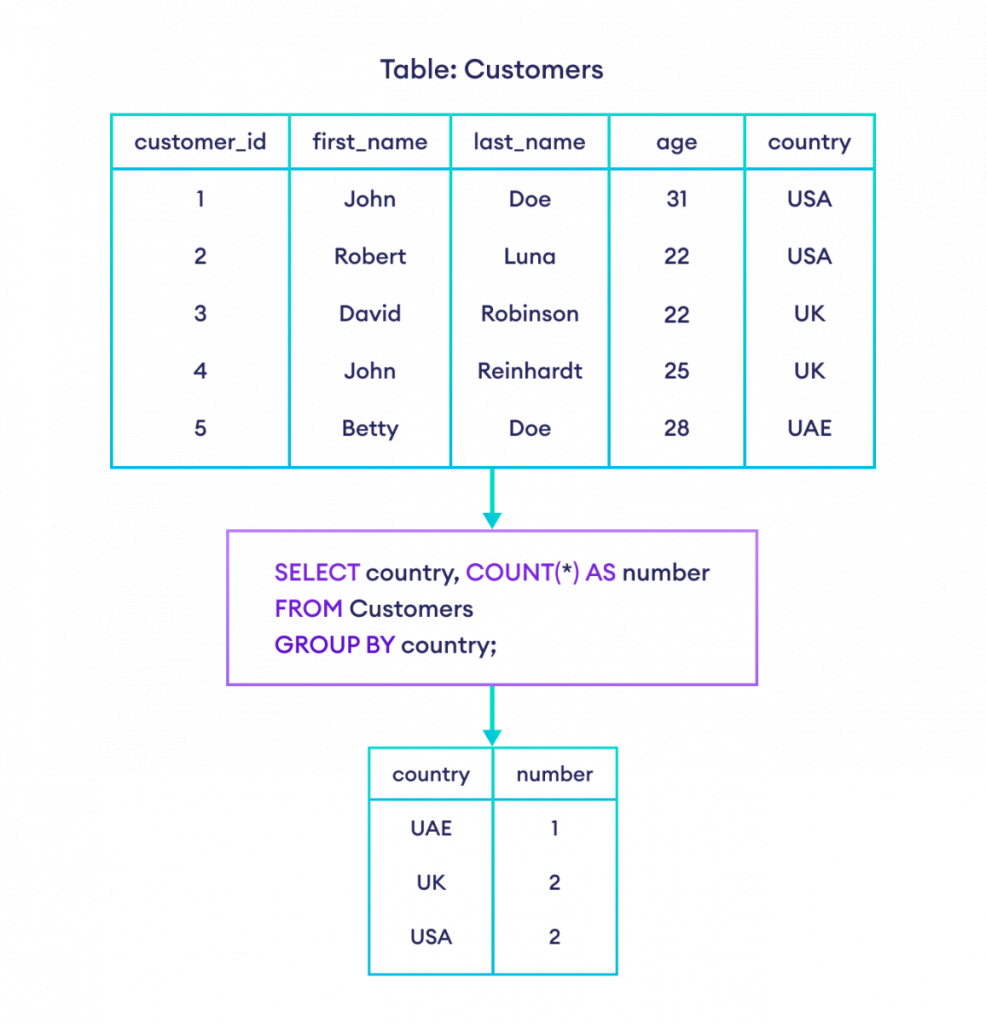
The GROUP BY Statement in SQL is used to arrange identical data into groups with the help of some functions. i.e. if a particular column has the same values in different rows then it will arrange these rows in a group.
Feature:
The GROUP BY clause in SQL is used to group rows based on one or more columns and perform aggregate functions on each group. It allows you to generate summary reports and analyze data at a higher level of granularity.
Syntax:
The basic syntax of the GROUP BY clause in SQL is as follows:
SELECT column1, column2, ..., aggregate_function(column)
FROM table
GROUP BY column1, column2,SELECT: Specifies the columns to be included in the result set.FROM: Specifies the table from which to retrieve data.GROUP BY: Specifies the columns used for grouping the data.aggregate_function: Performs calculations on each group, such as SUM, AVG, COUNT, MAX, MIN, etc.
Function:
The GROUP BY clause serves several functions in SQL:
- Grouping Data: It allows you to group rows based on one or more columns. Rows with the same values in the specified columns are combined into groups.
- Aggregating Data: The GROUP BY clause works in conjunction with aggregate functions like SUM, AVG, COUNT, MAX, MIN, etc. These functions perform calculations on each group separately and return a single value for each group.
- Generating Summary Reports: By using GROUP BY with appropriate columns and aggregate functions, you can generate summary reports that provide insights into the data. For example, you can calculate the total sales per region or the average salary per department.
- Data Analysis: GROUP BY helps in analyzing data at a higher level of granularity. It allows you to identify patterns, trends, or anomalies in the data by aggregating and summarizing it based on specific criteria.
By combining the GROUP BY clause with other SQL clauses like WHERE, HAVING, and JOIN, you can further refine your data analysis and generate meaningful results.
It’s important to note that when using GROUP BY, any column in the SELECT clause that is not part of the GROUP BY clause should be an aggregate function or included within an aggregate function. This is to ensure that the result set is consistent and meaningful.
