Introduction
The digital landscape is shifting rapidly. As companies across the globe transition to cloud-native infrastructures, the demand for professionals who can bridge the gap between development and operations has never been higher. The “Best DevOps Salary” is not just a figure; it is a reflection of how effectively an engineer can automate complex systems, ensure reliability, and accelerate software delivery.
DevOps is no longer just a role; it is a critical business strategy. Organizations are investing heavily in talent that understands Kubernetes, CI/CD pipelines, and Infrastructure as Code (IaC). Because the complexity of maintaining modern cloud environments is significant, companies are willing to pay a premium for engineers who can reduce downtime and improve deployment frequency.
However, a high salary is rarely the result of a single certification. It is the outcome of a combination of technical depth, strategic problem-solving, and the ability to adapt to new technologies. In this guide, we will break down the salary landscape, providing a realistic look at how your skills, experience, and specialization influence your earning potential.
Whether you are a newcomer to the tech industry or a seasoned professional looking to pivot into a more specialized role, understanding the dynamics of DevOps compensation is your first step toward long-term career growth.
Why DevOps Salaries Are Growing
The upward trend in DevOps compensation is driven by the sheer necessity of cloud-native engineering. As businesses scale, the manual management of servers becomes a bottleneck. Automated, scalable, and secure infrastructures are now the standard, leading to several key drivers:
- Cloud Adoption: Companies are migrating legacy applications to the cloud to achieve agility.
- Kubernetes Growth: As the de facto container orchestrator, Kubernetes skills are currently among the most sought-after in the industry.
- DevSecOps Demand: Security can no longer be an afterthought. Integrating security into the CI/CD pipeline has created a high-value niche for professionals.
- SRE and Platform Engineering: Moving from firefighting mode to building robust platforms that developers can self-serve is the ultimate goal for mature tech organizations.
- Skill Shortage: There is a persistent gap between the supply of skilled, hands-on engineers and the demand from enterprises.
Factors Affecting DevOps Salary
Your salary is influenced by a combination of tangible and intangible factors. It is essential to understand that while a certification might get you an interview, your project experience closes the deal.
- Depth of Cloud Expertise: Knowing how to launch a virtual machine is entry-level; knowing how to optimize cloud costs and manage multi-region architecture commands a much higher salary.
- Automation Proficiency: The ability to write clean, reusable code for IaC (Terraform, Pulumi) or configuration management (Ansible) is highly valued.
- Linux and Networking Knowledge: These are the bedrock of all cloud systems. Engineers who truly understand how packets flow and how Linux kernels operate are rare and highly rewarded.
- Location and Industry: Geography plays a massive role in compensation, though remote work is slowly balancing global salary standards.
- Strategic Thinking: The ability to align technical decisions with business goals—such as reducing time-to-market—is a trait of high-earning senior engineers.
DevOps Salary by Experience Level
Fresher DevOps Engineer
Entry-level positions focus on learning the ecosystem. At this stage, your salary growth is limited by your foundational knowledge. You are expected to learn CI/CD tools, understand container basics, and master the command line.
Mid-Level DevOps Engineer
This is where the salary jump becomes significant. A mid-level engineer is expected to manage production Kubernetes clusters, write complex Terraform modules, and manage the full lifecycle of an application. They can solve problems independently without constant supervision.
Senior DevOps Engineer
Senior roles transition from hands-on implementation to architectural design. You are expected to design for reliability, scale systems to millions of users, and mentor junior team members. Compensation here is often tied to your impact on the company’s uptime and developer productivity.
DevOps Salary by Role
The specialization you choose often dictates your salary ceiling:
- DevOps Engineer: The generalist who manages pipelines and infrastructure.
- Cloud DevOps Engineer: Focuses heavily on platform-specific services (AWS/Azure/GCP).
- Kubernetes Engineer: A specialist role solely focused on container orchestration and cluster management.
- Site Reliability Engineer (SRE): Focuses on availability, latency, and performance. Often one of the highest-paying roles.
- DevSecOps Engineer: Combines security practices with DevOps workflows; highly specialized and compensated accordingly.
- Platform Engineer: Builds internal tools and developer experiences.
- Infrastructure Automation Engineer: Focuses purely on scripting and IaC.
- Cloud Architect: The highest level of design, responsible for overall cloud strategy and cost optimization.
DevOps Salary by Country
While salary ranges vary by the cost of living, the demand for DevOps talent is universal. Tech hubs like the United States, Germany, Australia, and Singapore typically report higher nominal salaries, while India and other emerging markets have seen explosive growth in demand for cloud talent, narrowing the gap through remote and multinational company opportunities.
DevOps Salary by Cloud Platform
Whether you choose AWS, Azure, or Google Cloud, the key is depth.
- AWS: Still the market leader with the highest number of job openings.
- Azure: Seeing massive growth in enterprise environments, especially where there is a heavy reliance on the Microsoft ecosystem.
- Google Cloud: Often preferred by data-intensive and Kubernetes-heavy organizations, leading to high-value, specialized roles.
Highest-Paying DevOps Skills
To command the best DevOps salary, focus on these high-demand technical areas:
- Kubernetes: Orchestration at scale.
- Terraform: The gold standard for Infrastructure as Code.
- Cloud Providers (AWS/Azure/GCP): Deep, architectural-level knowledge.
- Observability: Prometheus, Grafana, and ELK stack skills.
- GitOps: Tools like ArgoCD or Flux that automate deployment.
- Security Automation: Integrating tools like Snyk or Aqua into pipelines.
Certifications That Increase Salary
Certifications provide a structured learning path and validate your expertise to recruiters. However, they should be paired with hands-on projects:
- Certified Kubernetes Administrator (CKA): Highly respected for its hands-on exam format.
- AWS Certified DevOps Engineer – Professional: Shows you can design complex, secure environments.
- Terraform Associate: Validates your ability to manage infrastructure programmatically.
- SRE Certifications: Increasingly important for reliability-focused roles.
DevOps Salary Comparison Table
| Role | Experience | Main Skills | Salary Growth Potential |
| DevOps Engineer | Mid | CI/CD, Docker | High |
| Kubernetes Engineer | Mid/Senior | K8s, Helm | Very High |
| SRE | Senior | Observability, Go/Python | Excellent |
| Cloud Architect | Senior/Expert | Cloud Design, Strategy | Top Tier |
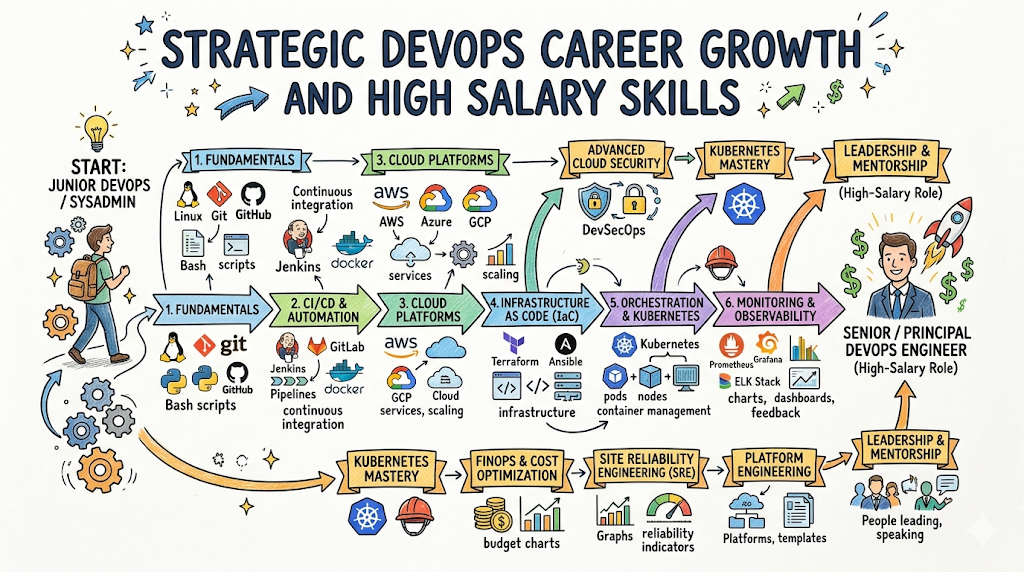
Career Roadmap for Higher Salary
- Beginner Path: Focus on Linux fundamentals, networking, shell scripting, and basic CI/CD concepts.
- Intermediate Path: Master containerization (Docker) and learn Kubernetes. Start using Terraform for all your infrastructure.
- Advanced Path: Transition into SRE or Platform Engineering. Focus on multi-cloud architecture and incident management.
- Specialized Path: Dive into MLOps, FinOps, or advanced DevSecOps security automation.
Real-World Career Scenarios
- Sysadmin to DevOps: By learning Python/Go and Terraform, a traditional Sysadmin can increase their salary by transitioning to a Cloud Engineer role.
- Developer to DevOps: A developer who learns Kubernetes and infrastructure automation often becomes a highly effective, well-compensated Platform Engineer.
Common Mistakes Affecting Salary Growth
- Ignoring Fundamentals: Skipping Linux or networking and jumping straight to advanced tools will limit your problem-solving capability.
- Collecting Certifications Only: You need a portfolio of projects to prove you can do the work.
- Stagnating on One Tool: Always be willing to learn new cloud services or orchestration tools as the market evolves.
- Avoiding Soft Skills: Communication is vital for senior roles. You must be able to explain technical decisions to non-technical stakeholders.
Hands-On Skills Employers Want
Employers look for engineers who can:
- Build a complete CI/CD pipeline from scratch.
- Deploy and manage a production-grade Kubernetes cluster.
- Automate environment provisioning using Terraform.
- Configure monitoring and alerting for a distributed system.
- Troubleshoot production outages under pressure.
FAQs
What is the average DevOps engineer salary?
Salaries vary widely based on location and experience. It is best to research local market data on platforms like Glassdoor or LinkedIn for your specific city.
Which DevOps role pays the highest salary?
Site Reliability Engineer (SRE) and Cloud Architect roles generally command the highest compensation due to the architectural and high-stakes nature of the work.
Is Kubernetes good for salary growth?
Yes. Kubernetes is currently one of the most in-demand skills in the industry, and expertise here significantly boosts your market value.
Which cloud platform pays the highest salary?
No single platform is inherently “better,” but specializing in one and mastering its advanced features is more profitable than having surface-level knowledge of all three.
Do DevOps certifications increase salary?
They can act as a catalyst for salary growth by helping you land interviews and validating your expertise, especially when paired with practical experience.
Is AWS or Azure better for DevOps careers?
Both are excellent choices. AWS has a larger market share, but Azure is rapidly expanding in enterprise environments. Choose based on the industry demand in your region.
Which DevOps skill is most in demand?
Currently, Kubernetes and Infrastructure as Code (Terraform) are at the top of the list for most enterprises.
Is DevOps a high-paying career?
Yes, it is consistently ranked as one of the most lucrative and rewarding career paths in the technology sector.
Can beginners get high DevOps salaries?
Beginners start at a lower range, but with continuous learning and a focus on practical skills, the career trajectory for rapid salary growth is very steep.
How long does it take to become a high-paid DevOps engineer?
It depends on your dedication. With intense, hands-on learning, many professionals reach mid-level salaries within two to three years.
Is Terraform important for salary growth?
Extremely. Automation is the core of DevOps, and Terraform is the industry standard for managing infrastructure as code.
Which certification is best for DevOps salary growth?
The Certified Kubernetes Administrator (CKA) is widely regarded as one of the most valuable credentials due to its rigorous practical requirements.
Final Recommendation
The path to the best DevOps salary is built on a foundation of continuous learning and practical application. Do not rely on theory alone. Build projects, break them, and fix them. Master the fundamentals of Linux and networking, embrace Infrastructure as Code, and keep your cloud skills sharp. Focus on becoming an engineer who solves real business problems, and the compensation will follow. Start by mastering one skill at a time, build a portfolio, and remain curious. Your career growth is in your hands.
