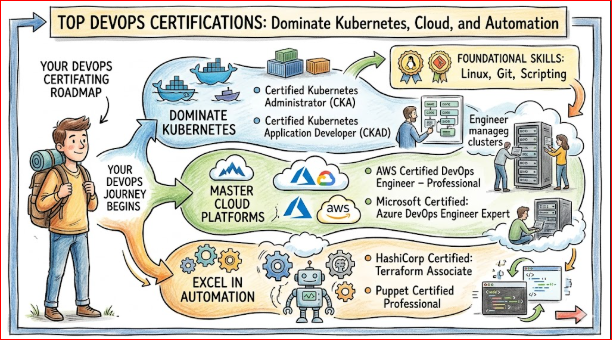
Introduction
The cloud infrastructure world is moving faster than ever, and the demand for production-ready engineering talent is breaking records. Teams everywhere are desperately trying to bridge the gap between fast software development and rock-solid system stability. But if you are trying to break into this space or level up your current role, you are likely facing an overwhelming wall of certification logos. It is incredibly easy to fall into the certification trap. Thousands of eager learners spend months collecting advanced cloud certificates, only to discover they can’t debug a basic network routing issue or write a clean automation script during a live technical interview. They focused on memorizing answers instead of building real engineering muscles. A Best DevOps Certification has exactly zero value if it doesn’t represent real-world capabilities. Hiring managers don’t care about a digital badge; they care about what you can build, break, and fix when production systems go offline. To win in this industry, your educational journey must be active, hands-on, and grounded in core systems reality. This guide shatters the confusion. We break down the top industry certifications, evaluate how they match up with actual engineering jobs, and show you how to design a roadmap that gets you noticed for your practical skill rather than just a list of acronyms on a LinkedIn profile.
Why DevOps Certifications Matter
When you approach them with the right mindset, certifications are powerful tools that accelerate your professional growth:
- Forcing Structured Upskilling: A great exam curriculum forces you out of your comfort zone. It fills in the blind spots you miss when you only learn bits and pieces on the job, making sure you know the exact structural reasons behind complex system designs.
- Objective Skill Verification: For a recruiter scanning through massive stacks of applications, a rigorous, performance-based certification serves as absolute proof that you can handle a live terminal environment under pressure.
- Accelerated Interview Confidence: Preparing deeply for real-world engineering tracks gives you the precise technical vocabulary and systems insight needed to confidently clear tough system design rounds.
- Aligning with Industry Standards: Leading certification paths track directly with modern engineering shifts—including declarative GitOps execution loops, automated DevSecOps security checks, and scalable, immutable infrastructure setups.
Who Should Read This Guide
This career blueprint is built for anyone ready to take control of their cloud journey:
- Freshers & Academic Graduates: Ambitious newcomers who want a clear, no-nonsense roadmap to land their very first operational systems role.
- Software Engineers & Developers: Programmers who want to break down walls, master infrastructure automation, and deploy their own applications flawlessly.
- Linux Admins & Traditional Ops Personnel: Classic infrastructure professionals moving away from manual configurations toward state-driven Infrastructure as Code automation.
- Cloud & Security Architects: Engineers looking to embed automated security policies straight into continuous delivery pipelines without blocking development speed.
Types of DevOps Certifications
To win, you need to understand how different certifications fit into the modern technology stack:
Foundation Certifications
These entry-level tracks introduce basic terminology, cultural ideas, and agile framework principles. They focus on vocabulary and concepts rather than technical implementation or terminal commands.
Tool-Based Certifications
These are heavy, performance-based exams that test your ability to run specific tools inside a live environment. Passing means writing real configurations under a time limit. Key tracks include Docker Certified Associate (DCA), HashiCorp Certified: Terraform Associate, and the Linux Foundation’s gold-standard Kubernetes family (CKA/CKAD/CKS).
Cloud DevOps Certifications
Platform-specific paths created by major cloud providers that focus on tying their proprietary managed systems into your automation code. These center around Amazon Web Services (AWS), Microsoft Azure, and Google Cloud Platform (GCP) platforms.
DevSecOps Certifications
Specialized training tracks aimed at shifting security left. You learn to build automated container vulnerability scanning, secret management systems, and compliance guardrails straight into software pipelines.
SRE and Platform Engineering Certifications
Advanced engineering disciplines that prioritize high availability, automated incident response, systems visibility, and creating internal developer platforms (IDPs) so teams can self-service their infrastructure needs.
Advanced Tech Ecosystems
Cutting-edge fields driving enterprise operations forward, including automated GitOps delivery, machine learning workflows (MLOps), smart efficiency automation (AIOps), and continuous cloud cost optimization (FinOps).
Best DevOps Certifications at a Glance
| Certification | Best For | Level | Main Focus | Difficulty | Recommended Role | Link |
| DevOps Certified Professional (DCP) | Core Lifecycle Automation | Foundational | CI/CD, Git, Jenkins, Core Workflows | Low | Junior DevOps Engineer | View Course |
| DevSecOps Certified Professional (DSOCP) | Pipeline Vulnerability Scanning | Advanced | Shift-Left Security, SAST/DAST, Compliance | High | DevSecOps Engineer | View Course |
| Site Reliability Engineering (SRE) | System Resiliency & Observability | Advanced | SLOs, Error Budgets, Chaos Engineering | High | Site Reliability Engineer | View Course |
| Master in DevOps Engineering (MDE) | End-to-End Enterprise Strategy | Expert | Architecture Design & Production Release | High | Senior DevOps Architect | View Course |
| Master in Azure DevOps | Microsoft Ecosystem Specialists | Advanced | Azure Pipelines, Boards, Repos Setup | Medium | Azure Cloud Engineer | View Course |
| AWS Certified DevOps Professional | Amazon Web Services Architecture | Advanced | AWS Developer Tools, CloudFormation, Auto Scaling | High | AWS Infrastructure Engineer | View Course |
| Master in Python Programming | Infrastructure Automation Scripting | Intermediate | Scripting, Custom CLI Tools, API Automation | Medium | Automation Engineer / Developer | View Course |
| Certified Kubernetes Administrator (CKA) | Production Container Orchestration | Advanced | Cluster Architecture, Networking, Troubleshooting | High | Kubernetes Specialist | View Course |
| Docker Certified Associate (DCA) | Application Containerization | Intermediate | Image Optimization, Container Runtimes, Volumes | Medium | Systems Administrator | View Course |
| Google Cloud DevOps Engineer | Google Cloud Native Platforms | Advanced | GKE Administration, GCP Operations Suite | High | GCP Cloud Engineer | View Course |
| Master in Data Science | Enterprise Data Engineering | Advanced | Statistical Analytics, Scalable Data Pipelines | High | Data Infrastructure Engineer | View Course |
| Hashicorp Certified Terraform Associate | Multi-Cloud Infrastructure as Code | Intermediate | Declarative State Files, Module Management | Medium | Cloud Automation Specialist | View Course |
| Master in Artificial Intelligence | Intelligent System Automation | Advanced | Neural Networks, Automated Model Training | High | AI Operations Specialist | View Course |
| Master in Deep Learning | Advanced Model Topologies | Advanced | Complex Layer Compute, Topology Deployments | High | Deep Learning Engineer | View Course |
| GitOps Certified Professional (GOCP) | Declarative Continuous Delivery | Intermediate | ArgoCD, Flux, Git-Driven Cluster State | Medium | Platform Engineer | View Course |
| Envoy ISTIO Certification Training | Microservices Service Mesh | Advanced | Traffic Splitting, mTLS Encryption, Sidecars | High | Network Infrastructure Architect | View Course |
| Prometheus with Grafana | Cloud-Native Systems Monitoring | Intermediate | Time-Series Metrics, Dashboard Visuals, Alerting | Medium | Monitoring & Operations Engineer | View Course |
| MLOps Certification Training Course | Machine Learning Pipeline Scale | Advanced | Model Lifecycle Automation, Data Versioning | High | MLOps Engineer | View Course |
| Master in Machine Learning | Predictive Operational Algorithms | Advanced | Supervised/Unsupervised Modeling Deployments | High | ML Infrastructure Engineer | View Course |
| Master in AppDynamics | Enterprise Performance Tracking | Intermediate | APM Dashboards, JVM/CLR Code Diagnostics | Medium | Application Support Engineer | View Course |
Detailed Certification Analysis
1. Certified Kubernetes Administrator (CKA)
What It Is
The CKA is a 100% practical, hands-on exam delivered by the Cloud Native Computing Foundation (CNCF) and The Linux Foundation. There are no multiple-choice questions here—you are given a live terminal and a set of broken or unconfigured Kubernetes clusters that you must fix in real time.
Who Should Take It
Systems engineers, cloud developers, and operations pros who want to prove they can manage production-grade cloud-native infrastructure.
Best Career Fit
- Kubernetes Platform Engineer
- Site Reliability Engineer (SRE)
- Cloud Infrastructure Specialist
Difficulty Level
Advanced
Career Scope
Kubernetes is the absolute standard for enterprise container management. Holding a CKA tells companies that you are a highly capable engineer who can navigate real system failures under immense time pressure.
Skills You Will Learn
- Building highly available Kubernetes clusters completely from scratch.
- Configuring secure application pods, network tracking, and services.
- Setting up persistent storage volumes and cluster network access rules.
- Troubleshooting system component failures and dead worker nodes.
- Executing safe cluster version upgrades and managing control plane backups.
Tools Covered
- Kubernetes (kubectl, kubeadm, kubelet)
- Container Runtimes (containerd)
- Network Interfaces (CNI)
- Etcd databases
Exam Details
- Format: Performance-based command-line lab challenges.
- Duration: 2 Hours.
- Passing Score: 66% or higher.
- Validity: 3 Years.
- Cost: $395 USD (includes one free retake).
Study Roadmap
- Build an airtight understanding of Linux system management and network sockets.
- Spin up multi-node testing clusters using local virtual machines or lightweight tools like Kind.
- Master imperative
kubectlcommands to move at lightning speed during the exam window. - Practice intentionally breaking clusters—drop control plane configurations, expire security certificates—and learn to fix them fast.
Real-World Use Cases
An engineer steps in during a major production incident to diagnose why internal web traffic cannot reach newly deployed application pods, quickly tracing the issue to an unapplied container network policy.
Pros
- Highly respected worldwide because it cannot be passed by simple memorization.
- Skills apply anywhere, completely free from proprietary cloud vendor lock-in.
- Forces you to develop elite command-line speed and structural understanding.
Cons
- Very intimidating learning curve if your base Linux terminal skills are rusty.
- Requires intense time management practice to finish all lab challenges on time.
Best Recommendation
An absolute must-have for intermediate or senior engineers aiming for elite cloud roles. If you are brand new to tech, set this as a milestone goal—learn Docker container runtimes first.
2. HashiCorp Certified: Terraform Associate
What It Is
A fast-paced, highly targeted exam that validates your core knowledge of Infrastructure as Code (IaC) principles using HashiCorp’s widely adopted tool, Terraform.
Who Should Take It
Cloud engineers, developers, and administrators who want to stop building infrastructure manually and start defining everything programmatically.
Best Career Fit
- Cloud Automation Engineer
- DevOps Systems Specialist
- Infrastructure Developer
Difficulty Level
Intermediate
Career Scope
Terraform dominates the multi-cloud provisioning space. This certification proves you know how to build, version, and manage massive infrastructure setups cleanly across completely different cloud ecosystems.
Skills You Will Learn
- Writing clean, modular infrastructure configurations using HashiCorp Language (HCL).
- Managing infrastructure state files securely without causing conflicts or data loss.
- Building highly reusable code modules to enforce company infrastructure standards.
- Manipulating variables, outputs, and conditional resource loops cleanly.
- Plugging local code bases safely into collaborative Terraform Cloud platforms.
Tools Covered
- Terraform CLI
- HashiCorp Configuration Language (HCL)
- Terraform Cloud / Enterprise ecosystems
Exam Details
- Format: Multiple-choice, multiple-selection, and syntax fill-in-the-blank questions.
- Duration: 1 Hour.
- Passing Score: Scaled score (around 70% correct answers).
- Validity: 2 Years.
- Cost: $150 USD.
Study Roadmap
- Understand how cloud platforms use API calls to provision virtual resources.
- Fire up a free cloud tier account and connect your local Terraform CLI terminal.
- Write infrastructure configurations from scratch—build out private networks, firewalls, and storage units.
- Dive deep into how state files handle infrastructure tracking, resource locking, and remote storage backends.
Real-World Use Cases
An engineering team uses a single repository of Terraform modules to deploy identical, secure staging and production networks across global cloud zones in under five minutes, eliminating configuration drift.
Pros
- Extremely accessible exam fee with direct, straightforward test goals.
- Skills transfer immediately across AWS, Azure, GCP, and private data centers.
- High market demand as companies embrace automated, code-driven deployments.
Cons
- The exam format uses multiple-choice questions instead of a live terminal lab.
- Focuses heavily on specific tool syntax rather than teaching wider architecture design.
Best Recommendation
A brilliant asset for any cloud professional. It pairs perfectly with platform architecture certificates to prove you know how to actually implement designs through clean automation code.
3. AWS Certified DevOps Engineer – Professional
What It Is
An intensive, scenario-heavy professional track engineered to test your absolute ability to automate, secure, scale, and maintain complex systems on the AWS platform.
Who Should Take It
Experienced AWS practitioners responsible for engineering high-scale delivery pipelines, corporate governance, and complex cloud operations.
Best Career Fit
- AWS DevOps Enterprise Architect
- Senior Automation Engineer
- Cloud Operations Lead
Difficulty Level
Advanced / Expert
Career Scope
This stands as one of the most elite, high-value tracks in cloud computing. Holding it signals that you can build enterprise-level automated deployment ecosystems that run flawlessly at scale.
Skills You Will Learn
- Architecting secure, fully automated multi-stage continuous delivery engines on AWS.
- Configuring auto-scaling groups and dynamic application routing rules.
- Enforcing automated compliance scanning, cloud guardrails, and audit logging.
- Building centralized monitoring networks to catch and alert on production errors.
- Implementing rolling, blue/green, and canary application deployment strategies.
Tools Covered
- AWS CodePipeline, CodeBuild, CodeDeploy
- AWS CloudFormation, Systems Manager (SSM)
- Amazon CloudWatch, AWS CloudTrail, X-Ray
- AWS Control Tower, Organizations, IAM Management
Exam Details
- Format: Long, scenario-based multiple-choice and multi-select questions.
- Duration: 180 Minutes.
- Passing Score: 750 / 1000 scaled points.
- Validity: 3 Years.
- Cost: $300 USD.
Study Roadmap
- Clear the AWS SysOps or Developer Associate exam first to lock down your baseline platform knowledge.
- Spend significant time building advanced deployment models using AWS developer utilities.
- Master multi-account infrastructure setup, centralized identity access, and enterprise log collection.
- Practice with full-length mock exams to train your ability to break down massive word problems quickly.
Real-World Use Cases
An engineer designs an automated system that detects whenever an app update introduces performance issues, triggering an automated rollback to the previous safe deployment version without affecting active users.
Pros
- Carries heavy authority for premium cloud consulting and enterprise architect roles.
- Teaches comprehensive system management, governance, and scaling strategies.
- Provides clear, practical paths for handling high-volume production setups.
Cons
- The exam questions are long and demanding, requiring incredible reading stamina.
- The technical skills learned are locked tightly inside proprietary AWS ecosystems.
Best Recommendation
Highly recommended if you are operating inside a dedicated AWS company. Make sure you back this up with massive amounts of hands-on platform experience before trying the exam.
DevOps Certification Comparison Table
| Certification | Primary Focus | Testing Environment Style | Core Testing Areas | Main Target Role |
| CKA | Container Systems | Live Terminal Lab | Cluster setup, Component Fixing, & Resource Troubleshooting | Platform / SRE Infrastructure |
| Terraform Associate | Code-Driven Provisioning | Multiple Choice Format | Syntax Execution, State Safety, & Module Logic | Multi-Cloud Automation |
| AWS DevOps Professional | AWS Automation Platforms | Complex Scenario Analysis | Pipeline Design, Automated Scaling, & Cloud Auditing | Enterprise AWS Management |
| Azure DevOps Expert | Enterprise Microsoft Clouds | Scenario Architecture | Git Management, Boards, & Hybrid Workflows | Corporate Azure Operations |
DevOps Certification Roadmap
True mastery is built step-by-step. Use this strategic, phase-by-phase framework to build a bulletproof cloud career:
[Phase 1: Foundations Layer] ➔ [Phase 2: Automation Layer] ➔ [Phase 3: Production Layer] ➔ [Phase 4: Advanced Layer]
  - Linux Systems Mastery          - Container Packaging Basics     - Orchestration Scales (CKA)    - Security Compliance Audits
  - Git Version Control Loops      - Infrastructure as Code (IaC)   - Platform-Wide Automation      - System Reliability Models
  - Networking Core Fundamentals   - Continuous Testing Pipelines   - Central Visibility Systems     - Developer Platform Design
Phase 1: Foundational Systems Mastery (The Base Layer)
Before touching high-level deployment tools, lock down the essential computing fundamentals that everything else runs on.
- Linux Systems Engineering: Live in the terminal. Learn user permissions, system processes, shell scripting, and tracking logs.
- Git Version Workflows: Master branching strategies, merge conflict resolution, and securing your repositories.
- Networking Core Fundamentals: Understand DNS lookups, subnets, firewall rules, and essential protocols like HTTP/HTTPS and SSH.
Phase 2: Core Automation Execution (The Delivery Layer)
Shift your focus toward packaging software cleanly and building infrastructure using automated code scripts.
- Container Packaging Basics: Learn to isolate and wrap applications into lightweight, reliable Docker containers.
- Infrastructure as Code (IaC): Use Terraform to replace manual configuration steps with clean, repeatable, code-driven deployments.
- Continuous Integration Engines: Build automation pipelines that automatically test, check, and prepare code updates the moment they are pushed.
Phase 3: Production Scale Architecture (The Management Layer)
Learn how to manage large-scale systems across real production-grade cloud platforms.
- Container Orchestration: Master Kubernetes to keep complex, multi-container systems running reliably across clustered server nodes.
- Platform Automation: Deeply integrate your delivery code with the automated scaling, security systems, and resource managers of your chosen cloud platform.
- Central Visibility Systems: Set up monitoring dashboards and smart alert networks to spot and solve performance drops before users notice.
Phase 4: Advanced Specialization Tracks (The Elite Layer)
Branch out into highly technical specializations based on your target career goals and team needs.
- DevSecOps Pipeline Integration: Inject security vulnerability scanning directly into your automated pipelines to stop threats early.
- Site Reliability Engineering (SRE): Design self-healing infrastructure patterns backed by clear system availability target models (SLAs/SLOs).
- Internal Developer Platforms (IDP): Build internal self-service developer portals that empower software teams to ship code independently and safely.
Recommended Certification Path by Role
The Beginner Starting Out Track
Build rock-solid baseline computing habits before attempting advanced automation tracks.
- Linux Professional Institute (LPI) Linux Essentials or CompTIA Linux+
- HashiCorp Certified: Terraform Associate
- Associate Cloud Practitioner / Administrator (AWS or Azure track)
The Container Platform Expert Track
Focus entirely on cloud-native orchestration systems, container runtimes, and platform infrastructure.
- Docker Certified Associate (DCA) basics
- Certified Kubernetes Administrator (CKA)
- Certified Kubernetes Security Specialist (CKS)
The Enterprise Cloud Architect Track
Focus on scaling multi-account operations, automated infrastructure, and governance models across corporations.
- Cloud Associate Track (AWS Developer or Azure Administrator)
- HashiCorp Certified: Terraform Associate
- Professional DevOps Tier (AWS DevOps Professional or Azure DevOps Expert)
Real-World Career Scenarios
Scenario A: Transitioning from Classic IT/SysAdmin to Cloud Automation
- The Problem: A system admin spent years managing local hardware and VMs manually and needs to adapt to modern cloud-native standards.
- The Action Plan: Don’t chase high-level cloud architecture badges yet. Start by clearing Terraform Associate to shift your existing systems knowledge into code, then back it up with an AWS Associate track to learn cloud resource behaviors.
Scenario B: Software Developer Wanting to Own the Delivery Cycle
- The Problem: A backend developer wants to stop tossing code over the wall to operations and start building their own automated deployment pipelines.
- The Action Plan: Focus heavily on container systems. Pursue the Certified Kubernetes Application Developer (CKAD) track to learn how to structure, scale, and manage containerized application workloads efficiently.
Common Mistakes to Avoid
- Rushing straight into Kubernetes: Attempting to learn Kubernetes orchestration before understanding basic container concepts, network ports, or storage targets leads straight to frustration.
- Collecting credentials over coding practice: Memorizing answers to pass multiple-choice tests won’t help you on the job. If you can’t build or debug a system under pressure, a digital badge won’t pass a technical interview.
- Neglecting the Linux command line: Modern automation engines, container setups, and cloud systems are built on Linux. If your terminal skills are weak, your progress will stall out completely.
- Getting trapped by a single cloud vendor: Focusing exclusively on proprietary cloud tools while ignoring open-source standards like Git and Terraform can limit your career agility.
Hands-On Projects Portfolio
To stand out to engineering teams, build real projects that prove your certifications are backed by solid capability:
Project 1: Automated & Secured Container Pipeline
Build a continuous integration pipeline that triggers automatically on code commits. It must build a custom Docker container, run automated test suites, scan the code for security flaws, and push the verified image to a private container registry.
- Why it works: This proves you can design automated, secure workflows from a developer’s code branch straight to a clean deployment package.
Project 2: Multi-Cloud Network Deployment via Code
Write modular, clean Terraform configuration scripts that spin up a highly secure cloud network (complete with private subnets, internet gateways, and security groups) using a secure remote state file to track your infrastructure safely.
- Why it works: This demonstrates you know how to build and maintain cloud environments using reproducible code instead of manual console work.
Project 3: Self-Healing GitOps Kubernetes Cluster
Deploy a multi-node Kubernetes cluster and set up a continuous GitOps engine like ArgoCD. Configure it to watch a source repository and automatically update your application deployments whenever changes drop into your production branch.
- Why it works: This proves you can run modern, declarative, self-healing application deployments at scale.
Tools and Free Learning Resources
- Linux Command Line Mastery: Head over to linuxjourney.com to build an airtight understanding of terminal navigation and shell automation scripting.
- Interactive Container Testing: Use free browser-based environments like Play with Docker or Play with Kubernetes to practice cluster operations without spending money on cloud resources.
- Official Documentation Guides: Get comfortable navigating the official documentation sites for Kubernetes and Terraform. Learning to read these docs efficiently is a superpower, especially during open-book exams like the CKA.
- Local Infrastructure Sandboxes: Install lightweight utilities like Minikube, Kind, or VirtualBox to run, break, and fix live infrastructure right on your laptop.
How to Choose the Right DevOps Certification
Before booking an exam slot, ask yourself these direct, strategic questions:
- What does my daily hands-on practice look like? If you are a total beginner, prioritize Linux and basic container setups. If you are already running servers, jump directly into code-driven orchestration and automation engines.
- What does my target market actually build with? Review active job listings in your region or target industry. If your dream companies are heavily invested in AWS infrastructure, target the AWS track. If they run complex hybrid networks, focus on agnostic tools like Terraform and the CKA.
- How do I want to specialize? If you love diving deep into live systems troubleshooting, performance-based tracks like the CKA will be incredibly rewarding. If you prefer design, focus on platform architecture paths.
Frequently Asked Questions (FAQ)
1.Which DevOps certification is best for beginners?
Beginners should stay away from advanced cloud architecture tracks at first and focus on the foundations. Start by mastering Linux systems administration and Git repository workflows. Once you can comfortably navigate systems through the terminal, take the Terraform Associate exam to build a practical, code-driven approach to infrastructure.
2. Is Kubernetes certification worth it?
Yes, the Certified Kubernetes Administrator (CKA) is highly respected across the entire tech sector. Because it is a 100% practical lab exam rather than a multiple-choice test, holding this certification proves to employers that you have genuine, hands-on troubleshooting experience under pressure.
3. Which cloud certification is best for DevOps?
The answer comes down to what platforms your target companies run. The AWS Certified DevOps Engineer Professional track holds incredible market weight among companies running on AWS. If you are working in an enterprise environment that depends heavily on Microsoft ecosystems, the Azure DevOps Engineer Expert path is an ideal choice.
4. Is Terraform certification useful?
Yes, the Terraform Associate exam is highly valuable because it focuses on a platform-neutral approach to infrastructure automation. It proves you know how to define and manage cloud resources programmatically across AWS, Azure, GCP, or private data centers, making your skills highly adaptable.
5. Do DevOps engineers need coding?
You do not need to be an expert software developer, but you must understand system logic patterns and how to interact with APIs. You should feel comfortable writing clean automation scripts in Bash or Python, and configuring automation tools using clean YAML or JSON structures.
6. How long does DevOps certification preparation take?
Preparation time depends completely on your active technical background. If you already work in tech, an intermediate exam like Terraform Associate might take 4 to 6 weeks of study. A heavy, hands-on exam like the CKA typically requires 3 to 6 months of daily practice to truly master.
7. Is Docker certification worth it?
While learning Docker fundamentals is absolutely critical for your career, the market has shifted its focus to larger container orchestration systems. Focus on mastering container basics through hands-on practice, but save your exam budget and energy for the CKA, which carries much higher industry value.
8. Which certification is best for SRE roles?
SRE tracks require a deep focus on system stability, troubleshooting, and platform operations over standard feature deployment pipelines. The CKA is a fantastic match here because it forces you to spend hours diving directly into cluster mechanics and live systems recovery.
9. Which DevOps certification has highest salary value?
Advanced tracks like the AWS Certified DevOps Engineer Professional and the CKA consistently command top-tier compensation. However, your actual market value is driven by your practical ability to solve expensive production outages and build reliable automation, not the certificate itself.
10. Should beginners start with Kubernetes?
No, diving straight into Kubernetes is a massive mistake that causes unnecessary confusion. You should first learn how an individual application runs inside a single local Docker container and understand basic networking rules. Once those pieces clicks, step up to Kubernetes orchestration.
11. Is DevOps certification enough to get a job?
A certification alone will rarely secure a job offer. Think of your certifications as a way to get past initial resume screening filters, while your hands-on projects, code repositories, and real technical communication are what actually land you the job.
12. Which DevOps certification roadmap is best?
The most effective approach is a skills-first progression. Begin with Linux terminal commands and Git workflows, move on to container packaging and Infrastructure as Code automation, and then transition into high-scale orchestration and platform design once your foundations are rock-solid.
Final Recommendation & Call to Action
Certifications are fantastic tools when you use them as structured milestones along an active learning path—not as trophies to collect. When a production environment drops offline, a piece of paper won’t save the cluster; your real, hands-on engineering capabilities will. If you are building your foundations: Focus completely on mastering the Linux command line, Git workflows, and basic container isolation. If you are automating systems: Pick up multi-cloud infrastructure tools like Terraform to turn manual infrastructure configurations into clean, reusable code. If you are managing scale: Target the CKA to learn how to keep distributed, production-grade cloud environments running flawlessly. Choose one path that perfectly matches your immediate career goals, spin up a local lab environment, and start building. True engineering confidence is built by breaking things, fixing them, and writing code every single day.
