Introduction
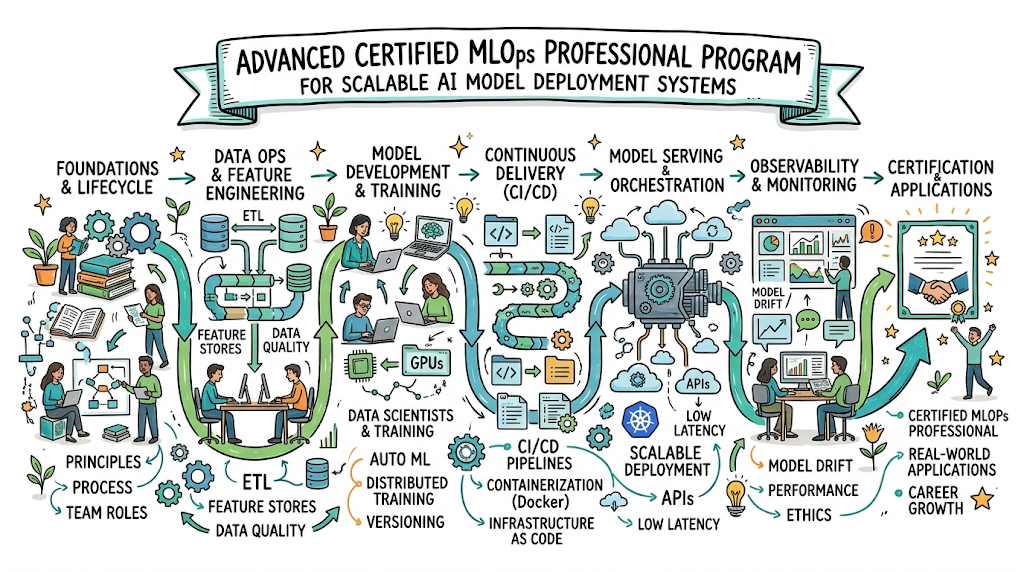
The Certified MLOps Professional program from AIOpsSchool has emerged as a vital benchmark for engineers looking to bridge the gap between data science and production engineering. This guide is designed for professionals who need to move beyond experimental notebooks and into the world of scalable, automated machine learning pipelines. As organizations struggle to move AI models into production, the role of an MLOps expert has become central to DevOps, cloud-native, and platform engineering strategies.
By following this comprehensive guide, you will understand the technical depth required to master machine learning operations and how to navigate the complex ecosystem of tools and practices. We will explore how this certification validates your ability to manage the entire lifecycle of a model, from data ingestion to continuous monitoring. This resource helps engineering leaders and individual contributors make informed decisions about their professional development and long-term career trajectory.
What is the Certified MLOps Professional?
The Certified MLOps Professional designation represents a rigorous validation of an engineer’s ability to apply DevOps principles specifically to machine learning workflows. It exists to solve the “production gap,” where high-quality models fail to provide value because they cannot be deployed, scaled, or monitored effectively. Unlike theoretical courses, this certification focuses on the technical mechanics of building reproducible pipelines and managing the operational overhead of AI.
This program aligns perfectly with modern engineering workflows by emphasizing automation, versioning for both code and data, and the implementation of CI/CD for ML models. It treats machine learning as a first-class citizen in the enterprise software stack, ensuring that models are subject to the same reliability and security standards as any other microservice. For practitioners, it provides a structured framework to master the intersection of data engineering, software development, and infrastructure management.
Who Should Pursue Certified MLOps Professional?
This certification is primarily built for software engineers, SREs, and cloud architects who are increasingly tasked with supporting data science teams. It is also highly beneficial for Data Engineers who want to move into more operational roles and for Machine Learning Engineers who need to understand the infrastructure side of their work. Security professionals will find it valuable for understanding the unique vulnerabilities present in ML pipelines, while managers can use it to gain a technical overview of how to structure their departments.
In the global market, the demand for these skills is skyrocketing as traditional enterprises shift toward AI-driven products. Beginners with a strong foundation in Linux and Python can use this as a roadmap to enter a high-growth field, while senior engineers can use it to pivot their careers toward emerging “Ops” disciplines. It provides a common language for cross-functional teams, making it a vital asset for anyone involved in the modern delivery of intelligent software.
Why Certified MLOps Professional is Valuable and Beyond
The longevity of the Certified MLOps Professional certification is rooted in the permanent shift toward data-driven decision-making in the enterprise. As AI adoption matures, the focus is moving away from just building models toward maintaining systems, ensuring that MLOps skills will remain relevant for decades. This program helps professionals stay ahead of the curve by teaching principles that apply regardless of whether you are using Jenkins, GitLab CI, or specialized ML tools.
Investing time in this certification offers a high return because it addresses the most significant bottleneck in the tech industry today: the operationalization of AI. Companies are actively seeking professionals who can reduce the time-to-market for models while ensuring they remain accurate and cost-effective. By mastering these competencies, you differentiate yourself from standard DevOps engineers, positioning yourself for leadership roles in high-stakes, data-centric environments.
Certified MLOps Professional Certification Overview
The program is delivered via the official training portal and hosted on the specialized learning platform. It is designed to be a practitioner-led experience, focusing on hands-on labs and real-world scenarios rather than just multiple-choice questions. The assessment approach is built to test your ability to troubleshoot failing pipelines and optimize model performance in a simulated production environment.
The certification structure is divided into logical modules that cover everything from infrastructure as code for ML to advanced monitoring and drift detection. It is owned and maintained by industry veterans who ensure the curriculum is updated to reflect changes in the cloud-native landscape. This ensures that the skills you learn are immediately applicable to enterprise environments running on major cloud platforms.
Certified MLOps Professional Certification Tracks & Levels
The curriculum is organized into levels that match the natural progression of an engineer’s career, beginning with the foundation of ML automation. At the introductory level, the focus is on understanding the vocabulary and the basic components of an ML pipeline, including data versioning and model registries. This provides the necessary groundwork for anyone coming from a traditional software background who needs to understand how ML differs from standard applications.
As you move into the professional and advanced levels, the certification branches out into specialized tracks that align with specific roles like SRE or FinOps. For instance, an SRE-focused track might emphasize model monitoring and high availability, while a FinOps track would focus on optimizing the high costs associated with GPU clusters. This layered approach allows professionals to build a deep, T-shaped skill set that combines broad MLOps knowledge with deep technical expertise.
Complete Certified MLOps Professional Certification Table
| Track | Level | Who it’s for | Prerequisites | Skills Covered | Recommended Order |
| Core Operations | Foundation | New ML Engineers | Basic Python | Data Versioning, Pipelines | 1 |
| Infrastructure | Professional | Cloud Architects | Foundation Level | Kubernetes, GPU Scaling | 2 |
| Security | Advanced | Security Engineers | Professional Level | Governance, Secure ML | 3 |
| Reliability | Specialist | SREs | Professional Level | Monitoring, Drift Detection | 3 |
| Optimization | Specialist | FinOps Practitioners | Foundation Level | Cost Management, Resources | 3 |
Detailed Guide for Each Certified MLOps Professional Certification
Certified MLOps Professional – Associate
What it is
This certification validates a candidate’s understanding of the fundamental MLOps lifecycle and the ability to set up basic automation for data science teams. It serves as the entry point for those transitioning from standard DevOps into machine learning operations.
Who should take it
It is ideal for Junior DevOps engineers, Data Scientists wanting to understand deployment, and System Administrators looking to enter the AI space.
Skills you’ll gain
- Mastery of Git-based workflows for Machine Learning projects.
- Ability to implement basic Data Version Control.
- Understanding of model packaging and containerization using Docker.
- Setup of basic CI/CD pipelines for model training.
Real-world projects you should be able to do
- Create a reproducible environment for a data science team.
- Automate the movement of raw data into a training environment.
- Build a Docker image that serves a pre-trained model as an API.
Preparation plan
- 7-14 Days: Focus on Python basics and the fundamental differences between code and data versioning.
- 30 Days: Complete hands-on labs involving Docker and basic CI tools.
- 60 Days: Build an end-to-end pipeline from scratch using a sample dataset.
Common mistakes
- Treating ML models exactly like standard binary files.
- Neglecting the importance of data quality checks in the pipeline.
- Over-complicating the initial infrastructure setup.
Best next certification after this
- Same-track option: Certified MLOps Professional – Professional Level.
- Cross-track option: Certified SRE Professional.
- Leadership option: Technical Team Lead Roadmap.
Certified MLOps Professional – Professional
What it is
This level focuses on the scaling and management of ML workloads in production environments, specifically focusing on orchestration and resource management. It proves you can handle the complexities of distributed training and large-scale model deployment.
Who should take it
Experienced DevOps engineers, Cloud Architects, and Machine Learning Engineers with significant production experience.
Skills you’ll gain
- Advanced Kubernetes orchestration for machine learning workloads.
- Implementation of feature stores for large-scale data management.
- Setting up automated model monitoring and alerting systems.
- Managing distributed training across multiple GPU nodes.
Real-world projects you should be able to do
- Deploy a multi-node Kubernetes cluster optimized for ML.
- Implement a centralized feature store for an organization.
- Create a dashboard that tracks model performance and data drift.
Preparation plan
- 7-14 Days: Deep dive into Kubernetes and container orchestration concepts.
- 30 Days: Study distributed systems and specialized ML frameworks like Kubeflow.
- 60 Days: Execute a project that involves deploying and monitoring multiple models simultaneously.
Common mistakes
- Failing to account for the high costs of cloud resources during training.
- Ignoring model decay and lack of automated retraining triggers.
- Poor integration between the data engineering team and the ops team.
Best next certification after this
- Same-track option: Certified MLOps Professional – Expert Level.
- Cross-track option: Certified DevSecOps Professional.
- Leadership option: Engineering Manager Track.
Choose Your Learning Path
DevOps Path
Engineers on the DevOps path should focus on the integration of ML into existing CI/CD pipelines. This involves treating the model as a software artifact that requires automated testing, staging, and deployment. The goal for this path is to ensure that the release of a new model is as boring and predictable as the release of a new web service.
DevSecOps Path
The security path focuses on the vulnerability of the model itself and the data used to train it. Professionals here must learn how to protect against adversarial attacks, data poisoning, and unauthorized model extraction. You will be responsible for integrating security scans into the ML pipeline and ensuring that the data used for training complies with privacy laws.
SRE Path
SREs focusing on MLOps are responsible for the availability, latency, and performance of ML services. This involves building robust monitoring systems that can detect when a model’s predictions are no longer accurate due to changes in real-world data. You will work on implementing error budgets for models and ensuring that the infrastructure can handle spikes in inference requests.
AIOps Path
The AIOps path is distinct as it focuses on using AI and ML to improve traditional IT operations and infrastructure management. Professionals in this track learn how to implement anomaly detection, automated root cause analysis, and predictive maintenance within the IT stack. It is less about building models for business users and more about building models that keep servers running.
MLOps Path
The pure MLOps path is dedicated to the lifecycle of machine learning models from a holistic perspective. This includes the orchestration of training jobs, managing model registries, and ensuring smooth handoffs between data scientists and engineers. It is the core path for those who want to be the architect of the entire ML ecosystem within a company.
DataOps Path
DataOps professionals focus on the fuel of the ML engine: the data. This path involves building automated, high-quality data pipelines that feed into the ML training process. You will learn about data orchestration, quality testing, and the management of data lakes. Without a strong DataOps foundation, even the best MLOps practices will fail because models will be trained on poor data.
FinOps Path
The FinOps path for MLOps is becoming increasingly important due to the extreme costs associated with training large models. Professionals in this track focus on cloud cost transparency, resource optimization, and the economic impact of ML infrastructure. You will learn how to balance the need for high-performance GPUs with the company’s budget, implementing automated scaling to prevent waste.
Role → Recommended Certified MLOps Professional Certifications
| Role | Recommended Certifications |
| DevOps Engineer | Associate + Professional (Core) |
| SRE | Professional + Reliability Specialist |
| Platform Engineer | Professional + Infrastructure Track |
| Cloud Engineer | Associate + Cloud Architecture |
| Security Engineer | Professional + Security Specialist |
| Data Engineer | Associate + DataOps Specialist |
| FinOps Practitioner | Associate + FinOps Optimization |
| Engineering Manager | Associate + Strategic Leadership |
Next Certifications to Take After Certified MLOps Professional
Same Track Progression
Once you have achieved the Professional level, the natural progression is to move toward specialized expert tracks that focus on specific infrastructure like Kubernetes or cloud-specific ML certifications. Deepening your knowledge in the same track involves mastering the niche nuances of hyper-scale environments and multi-cloud strategies.
Cross-Track Expansion
If you want to broaden your impact, moving into the DevSecOps or SRE domains is a powerful strategy. A professional who understands both how to deploy a model and how to secure and keep it reliable is incredibly rare and highly compensated. Cross-track expansion allows you to act as a bridge between different departments.
Leadership & Management Track
For those looking to move away from individual contribution, the certification serves as a technical foundation for moving into management. Understanding the complexities of MLOps allows you to better estimate project timelines, advocate for the right tools, and hire the right talent. This track leads toward positions like Director of AI Engineering.
Training & Certification Support Providers for Certified MLOps Professional
DevOpsSchool
DevOpsSchool is a leading global platform for mastering the art of automation and modern software delivery practices. They provide a robust learning environment that caters to both individual professionals and large enterprise teams looking to upgrade their technical stack. With a vast library of video tutorials and a community of industry experts, they focus on delivering practical skills that are immediately applicable in a production environment. Their training modules are updated regularly to reflect the latest shifts in the cloud-native ecosystem, ensuring that learners remain competitive. By fostering a culture of continuous learning, DevOpsSchool has become a cornerstone for engineers aiming to master the complexities of modern IT systems globally.
Cotocus
Cotocus has built a reputation for providing high-end technical training and consulting services that focus on modern cloud-native technologies. Their approach to MLOps training is highly structured, emphasizing the architectural side of building scalable systems. They often work with corporate teams to provide customized training programs that align with specific enterprise requirements. By focusing on the reason behind the technology as much as the implementation, Cotocus ensures that their students develop a deep, fundamental understanding of the systems they are managing. This makes them an excellent choice for engineers who want to reach the professional and advanced levels of certification while working in complex, high-stakes enterprise environments.
Scmgalaxy
Scmgalaxy serves as a comprehensive knowledge hub for engineers involved in configuration management, CI/CD, and advanced machine learning operations. They provide a massive repository of technical articles, scripts, and community forums that are invaluable for troubleshooting complex pipeline issues. Their focus is on the practical engineer, providing the small details and edge cases that are often missing from high-level courses. For those pursuing the Certified MLOps Professional title, Scmgalaxy is an essential secondary resource for finding community-contributed solutions and staying up to date with the rapidly evolving tool ecosystem. Their dedication to documentation and community support helps bridge the gap between academic learning and real-world infrastructure challenges.
BestDevOps
BestDevOps focuses on delivering high-quality content and structured learning paths for the most in-demand certifications in the engineering world. Their training materials are designed to be concise and impactful, making them ideal for busy professionals who need to gain skills quickly. They put a strong emphasis on curriculum excellence, ensuring that every lesson is aligned with the current requirements of the job market. By offering a blend of self-paced learning and expert guidance, BestDevOps helps candidates navigate the complexities of MLOps without feeling overwhelmed. Their goal is to provide a clear, direct path to certification success, making them a popular choice for those looking for efficiency.
devsecopsschool.com
This provider is the primary resource for engineers who want to specialize in the security side of the pipeline. Their curriculum for MLOps is infused with security-first principles, teaching candidates how to integrate automated security testing and governance directly into their machine learning workflows. They cover critical topics like data privacy, model integrity, and secure deployment strategies that are essential for high-trust environments. For those looking to take the Security Specialist track within the MLOps certification framework, this school provides the deep technical dive required to master the protection of AI systems. Their specialized focus ensures that security is never an afterthought in the production environment.
sreschool.com
SRESchool focuses exclusively on the reliability and stability of production systems, making them a key partner for MLOps practitioners. Their training covers the essential concepts of Service Level Objectives and Error Budgets as they apply specifically to machine learning models. Students learn how to build self-healing infrastructures and sophisticated monitoring systems that can detect data drift and model performance degradation in real-time. By bridging the gap between traditional reliability practices and the unique challenges of AI, SRESchool prepares engineers to maintain high-availability ML platforms at enterprise scale. This ensures that AI services remain as reliable and stable as any other core component of the software stack.
As the primary host for the Certified MLOps Professional program, AIOpsSchool is the definitive source for this certification. They specialize in the next generation of operations, where AI and ML are used both as the product and the management tool. Their training environment is built around hands-on labs that simulate real enterprise challenges, providing students with a safe space to experiment with complex automation. Because they are the owners of the curriculum, learners are guaranteed to receive the most accurate and up-to-date information regarding the certification exams. Their focus on the future of operations makes them a central pillar for any career in modern, data-driven engineering.
dataopsschool.com
DataOpsSchool provides the foundational training required to manage the data pipelines that fuel modern machine learning. They recognize that MLOps cannot exist without a robust data strategy, so their courses focus on data orchestration, quality, and lifecycle management. Candidates learn how to use tools for data versioning and how to build automated checks to ensure that poor data never makes it into the training set. For those who want to specialize in the DataOps track or simply strengthen their MLOps foundation, this school offers the specialized knowledge needed to manage data-heavy workloads. Their curriculum ensures that the data fueling the AI models is always reliable and accurate.
finopsschool.com
With the rising costs of cloud-based AI, FinOpsSchool has become an essential provider for those who need to manage the financial health of their MLOps initiatives. Their training focuses on the intersection of engineering, finance, and business, teaching practitioners how to optimize GPU spending and manage cloud budgets effectively. Students learn how to implement cost-allocation strategies and how to use data-driven insights to make informed infrastructure decisions. This specialized focus ensures that ML projects remain economically viable, making FinOps-certified professionals some of the most valued members of any technical leadership team. They provide the tools needed to balance high-performance computing with sustainable business growth and financial responsibility.
Frequently Asked Questions (General)
- How difficult is the certification exam?
The exam is designed to be challenging and focuses on practical application. It requires a solid understanding of both DevOps principles and the machine learning lifecycle. If you have hands-on experience building pipelines, the difficulty is manageable.
- How much time should I dedicate to preparation?
For a professional with some background in DevOps, a period of 4 to 8 weeks is usually sufficient. This allows enough time to go through the modules and, more importantly, spend significant time in the hands-on labs.
- Are there any specific prerequisites for the Associate level?
While there are no strict formal requirements, having a working knowledge of Python and basic Linux command-line skills is highly recommended to succeed in the hands-on portions of the exam.
- What is the expected ROI of this certification?
The ROI is high because it places you in a specialized niche where demand significantly outstrips supply. Professionals with MLOps certifications often see faster career progression and higher salary ceilings compared to generalists.
- Can I take the certification exam online?
Yes, the certification is designed to be accessible globally and is delivered through a secure online proctoring system. This allows you to take the exam from your home or office at your convenience.
- Does this certification expire after a certain period?
Like most high-end technical certifications, there is a renewal period typically every two to three years. This ensures that certified professionals keep their skills up to date as the tool ecosystem evolves.
- How does this differ from a Data Science certification?
Data science certifications focus on building models and statistical analysis. MLOps focuses on the engineering required to deploy, scale, and monitor those models. It is about the operations rather than the science.
- Will this certification help me move into a leadership role?
Absolutely. Managers who understand the technical bottlenecks of MLOps are in high demand to lead transformation projects. It provides the technical credibility needed to lead high-performing engineering teams.
- Is there a community for certified professionals?
Yes, once you are certified, you gain access to an exclusive network of practitioners. This community is a great resource for job opportunities, technical troubleshooting, and staying informed about industry changes.
- What specific tools will I learn to use during the course?
The program is designed to be tool-agnostic but uses industry standards like Docker, Kubernetes, and various cloud-native services for the labs. The goal is to teach principles that apply across the entire tool landscape.
- Is this relevant for small startups or only large enterprises?
While large enterprises have complex problems, startups benefit significantly from MLOps by building right from the start. It prevents technical debt and allows small teams to manage complex systems efficiently.
- Can I skip the Associate level and go to Professional?
It is generally recommended to follow the order to ensure no gaps in foundational knowledge. However, if you have several years of documented experience, you may be able to challenge the Professional level directly.
FAQs on Certified MLOps Professional
- How does this certification handle the high costs of GPU infrastructure?
The program includes a strong focus on resource optimization. You will learn strategies for using spot instances and implementing automated scaling to ensure that your ML infrastructure is both powerful and cost-efficient.
- What is the focus on data drift and model monitoring in the exam?
One of the core modules is dedicated to Production Reliability. You will learn how to set up automated alerts that trigger when a model’s performance drops or when the underlying data distribution changes significantly.
- Does the certification cover both cloud and on-premise deployments?
Yes, the principles taught are applicable to both environments. The focus on Kubernetes and containerization ensures that you can apply these skills in private data centers or hybrid cloud setups as well.
- How is the Certified MLOps Professional program curriculum updated?
The curriculum is reviewed regularly by a board of industry experts. This ensures that new tools, security vulnerabilities, and operational practices are integrated into the training to keep it relevant.
- Is there a focus on automated retraining within the pipelines?
Yes, the Professional level covers the architectural patterns required to trigger automated retraining based on performance metrics. This is a critical skill for maintaining model accuracy over long periods in production.
- Does the course cover governance and compliance for AI?
The advanced specialist track focuses heavily on governance. You will learn how to build audit trails for models and ensure that your ML pipelines meet the regulatory requirements of different industries.
- How much Python knowledge is required to pass?
You should be comfortable reading and writing Python scripts to automate tasks. You do not need to be a senior software developer, but you should understand how to interact with APIs and libraries.
- What is the primary format of the certification assessment?
The assessment is a mix of scenario-based questions and hands-on lab challenges. You will be required to solve actual engineering problems in a live environment to demonstrate your technical competency.
Final Thoughts
From the perspective of a mentor who has seen the industry transition through multiple waves of technology, the answer is a practical yes. The value of a certification is not just in the credential but in the structured rigor it forces upon your learning process. MLOps is a messy, complicated field where it is easy to get lost in the hype; this program provides the necessary guardrails to focus on what actually works in a production environment.
If you are an engineer who enjoys solving complex orchestration problems and wants to be at the center of the next major wave of enterprise technology, this path is for you. It requires a commitment to continuous learning and a willingness to operate at the intersection of several difficult disciplines. For those who put in the work, the career impact is significant, providing both job security and the opportunity to work on the most innovative projects in the world.
