Introduction
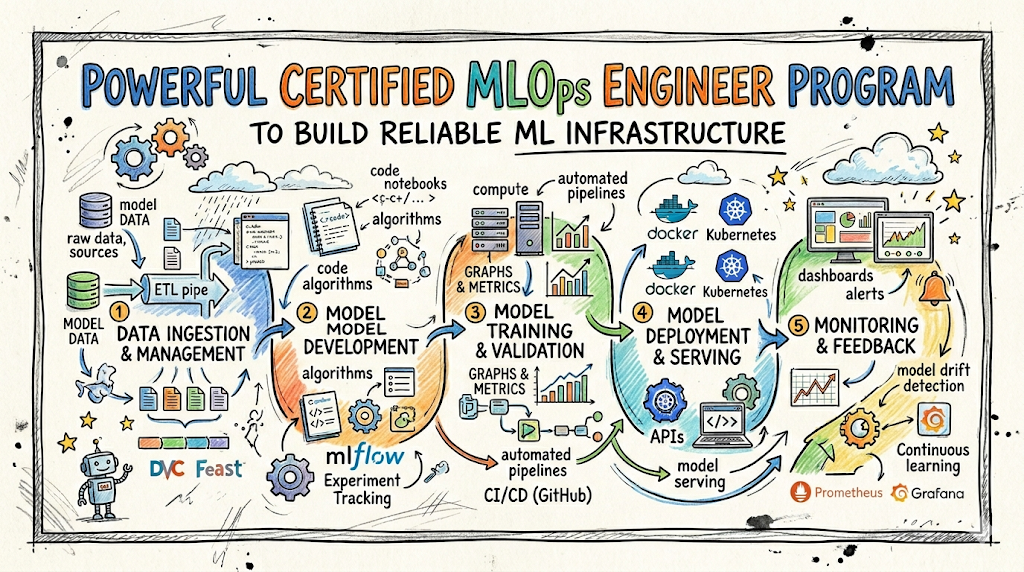
The integration of Machine Learning into production environments has created a significant gap between data science and traditional software engineering. The Certified MLOps Engineer program is designed to bridge this divide by applying DevOps principles to the machine learning lifecycle. This guide is crafted for professionals who want to move beyond building models and focus on the architecture, deployment, and monitoring of scalable AI systems.
As organizations scale their AI initiatives, the demand for engineers who understand both the rigors of platform engineering and the nuances of data pipelines has reached an all-time high. This program, hosted on aiopsschool, provides a structured roadmap for engineers to transition from standard continuous integration workflows to complex machine learning automation. By following this guide, you will gain clarity on how to navigate the evolving landscape of cloud-native AI and make informed decisions for your career progression.
Positioning yourself as a specialist in this domain requires more than just knowing how to code; it requires a deep understanding of operational excellence in a data-centric world. Whether you are a DevOps professional looking to expand into artificial intelligence or a Data Engineer seeking to operationalize models, this certification serves as a professional benchmark. It ensures you are equipped to handle the unique challenges of model decay, data drift, and hardware acceleration in production.
What is the Certified MLOps Engineer?
The Certified MLOps Engineer designation represents a professional standard for practitioners who manage the intersection of data, code, and infrastructure. It exists to formalize the skills required to take a machine learning model from a researcher’s notebook into a resilient, scalable, and high-availability production environment. Unlike academic courses that focus on algorithm design, this certification emphasizes the operational aspect of machine learning—focusing on reliability, scalability, and repeatability.
The program is built around real-world application, ensuring that candidates understand how to architect systems that can handle massive datasets while maintaining low-latency inference. It aligns with modern enterprise practices by incorporating cloud-native tools, containerization, and automated testing tailored specifically for non-deterministic systems. This shift from theory to production-focused learning is what distinguishes the certification in a crowded market of technical educational resources.
By pursuing this certification, engineers learn to treat machine learning models as software artifacts that require the same level of versioning, testing, and deployment rigor as any other microservice. It addresses the practical realities of enterprise workflows, such as regulatory compliance, security in data pipelines, and cost management in high-compute environments. This holistic approach ensures that certified professionals can lead cross-functional teams and drive real business value through automation and intelligence.
Who Should Pursue Certified MLOps Engineer?
This certification is highly beneficial for DevOps and Site Reliability Engineers who are increasingly being tasked with supporting data science teams. Cloud architects and platform engineers who design the underlying infrastructure for AI workloads will find the curriculum essential for building cost-effective and scalable environments. It provides the necessary bridge for these professionals to understand the unique requirements of GPU scheduling and distributed training.
Data professionals, including Data Engineers and Machine Learning Engineers, should pursue this to master the deployment side of their craft. Often, models fail to reach production due to a lack of operational knowledge; this program solves that problem by teaching data specialists how to build robust pipelines. Security engineers will also find value in learning how to secure the machine learning supply chain, protecting models from adversarial attacks and ensuring data privacy.
From a managerial perspective, technical leaders and engineering managers can use this certification to better understand the team structures and tooling required for successful AI initiatives. In the Indian market and globally, there is a massive shift toward AI-first product development, making this skill set relevant across industries like finance, healthcare, and e-commerce. It is designed to be accessible for those with a baseline in software engineering while providing deep technical growth for veterans.
Why Certified MLOps Engineer is Valuable and Beyond
The demand for operationalized machine learning is not a passing trend but a fundamental shift in how software is built and maintained. Organizations are moving away from siloed data science experiments toward integrated production systems, creating a long-term need for engineers who can maintain these assets. By mastering this domain, professionals ensure their longevity in the market, as they become the vital link between high-level business logic and low-level infrastructure execution.
Enterprise adoption of machine learning requires more than just technical skill; it requires a mindset of continuous improvement and monitoring. This certification helps you stay relevant even as specific tools and frameworks change, as it focuses on the core principles of automation, observability, and governance. The return on investment is measured not just in salary increases, but in the ability to lead high-impact projects that define the future of an organization.
In an era where automated tools are beginning to handle routine coding tasks, the complex orchestration of data and model lifecycles remains a highly skilled human endeavor. Mastering these workflows protects your career against the commoditization of basic software development. It positions you at the forefront of the next wave of technological innovation, where data-driven systems are the standard rather than the exception.
Certified MLOps Engineer Certification Overview
The program is delivered via the official course portal and hosted on the aiopsschool platform. It is structured to provide a comprehensive learning path that covers the entire spectrum of machine learning operations, from initial data ingestion to final model retirement. The certification uses a multi-level assessment approach that combines theoretical knowledge with practical, project-based evaluations to ensure real-world readiness for any engineering environment.
The certification is owned and maintained by industry practitioners who understand the challenges of modern engineering teams. It is divided into logical levels that allow learners to progress from foundational concepts to advanced architectural design. This structure ensures that regardless of your starting point, there is a clear trajectory for skill acquisition and professional validation within the machine learning operations domain.
Assessment focuses on the ability to solve production problems rather than memorizing definitions or formulas. Candidates are required to demonstrate proficiency in building automated pipelines, implementing monitoring solutions, and managing infrastructure as code for specialized workloads. This practical orientation makes the certification highly respected by hiring managers who need engineers who can contribute to production systems from their first day on the job.
Certified MLOps Engineer Certification Tracks & Levels
The certification is organized into three primary levels: Foundation, Professional, and Advanced. The Foundation level focuses on the basic principles of the machine learning lifecycle and the role of operations in AI. It is an ideal entry point for beginners or managers who need a high-level understanding of the field without diving deep into complex infrastructure management or backend code.
The Professional level is where the core engineering work resides, focusing on the implementation of automation and cloud-native services. This track covers the development of continuous deployment for models, containerization with Kubernetes, and the setup of feature stores and registries. It is designed for practitioners who will be responsible for building and maintaining the actual pipelines that drive enterprise-level machine learning models.
The Advanced level is targeted at architects and technical leads who must design complex, distributed systems. This track focuses on topics like multi-cloud deployments, high-scale data governance, and advanced security for artificial intelligence. These levels align with typical career progression, moving from individual contributor roles to senior engineering and finally to architectural leadership positions within a modern technology organization.
Complete Certified MLOps Engineer Certification Table
| Track | Level | Who it’s for | Prerequisites | Skills Covered | Recommended Order |
| Core Operations | Foundation | Beginners, Managers | Basic IT Knowledge | ML Lifecycle, Pipeline Basics | 1st |
| Engineering | Professional | DevOps/Data Engineers | Python, Linux, CI/CD | Model Deployment, K8s, CI/CD | 2nd |
| Architecture | Advanced | Senior Architects | Pro-level MLOps, Cloud | Distributed Training, SecML | 3rd |
| Reliability | SRE Focus | SRE Professionals | Incident Management | Model Monitoring, Observability | 4th |
| Optimization | FinOps Focus | Cloud Economists | Cloud Billing Basics | Cost Management, GPU ROI | 5th |
Detailed Guide for Each Certified MLOps Engineer Certification
Certified MLOps Engineer – Foundation
What it is
This certification validates a candidate’s understanding of the basic principles of machine learning operations and the integration of automation into the data science process. It confirms the ability to speak the language of both data scientists and operations teams effectively within a business context.
Who should take it
This is suitable for junior engineers, product managers, and engineering leaders who are new to the world of AI operations. It is intended for those who need to understand the strategic value of the field before committing to deep technical implementation or architectural design.
Skills you’ll gain
- Understanding the standard machine learning lifecycle stages.
- Identifying the differences between traditional software and ML-based software.
- Basic knowledge of version control for both code and data assets.
- Familiarity with the tools and platforms used in the modern ecosystem.
Real-world projects you should be able to do
- Create a high-level architectural diagram for a standard machine learning pipeline.
- Draft a standard operating procedure for model handoffs between development and operations.
Preparation plan
Explain 7–14 days, 30 days, and 60 days preparation strategies.
- 7–14 Days: Focus on learning the core vocabulary and the standard stages of the machine learning pipeline through official guides.
- 30 Days: Read industry whitepapers on common operational challenges and watch introductory technical overview videos.
- 60 Days: Participate in community forums and complete a comprehensive review of the foundational exam guide and sample questions.
Common mistakes
- Treating machine learning models exactly like static code files without considering the state of the data.
- Underestimating the importance of data versioning in the successful reproduction of research results.
Best next certification after this
- Same-track option: Certified MLOps Engineer – Professional
- Cross-track option: Cloud Practitioner Certification
- Leadership option: Technical Product Management Certification
Certified MLOps Engineer – Professional
What it is
This certification validates the technical ability to design, build, and maintain automated machine learning pipelines in a production environment. It proves that an engineer can handle the infrastructure requirements and automation logic needed for scalable and reliable AI systems.
Who should take it
Experienced DevOps engineers, Data Engineers, and machine learning practitioners with several years of experience should take this. It is for those who are actively responsible for deploying and monitoring models in a cloud or on-premise production setting.
Skills you’ll gain
- Implementing continuous deployment pipelines specifically tailored for non-deterministic models.
- Managing containerized workloads using Kubernetes and related orchestration tools.
- Configuring automated monitoring for data drift and model performance degradation.
- Setting up and managing feature stores to ensure consistent data across training and inference.
Real-world projects you should be able to do
- Deploy a multi-stage pipeline that includes automated data validation and model testing.
- Configure a monitoring dashboard that alerts on statistical shifts in production data streams.
Preparation plan
Explain 7–14 days, 30 days, and 60 days preparation strategies.
- 7–14 Days: Review core Kubernetes concepts and standard automation tooling such as Jenkins or GitLab CI.
- 30 Days: Build a local lab environment using open-source tools to practice pipeline automation and container management.
- 60 Days: Study advanced topics like model quantization, inference optimization, and large-scale data storage strategies.
Common mistakes
- Failing to automate the data validation step, leading to silent failures in production environments.
- Hardcoding environment variables instead of using dynamic configuration management for different stages.
Best next certification after this
- Same-track option: Certified MLOps Engineer – Advanced
- Cross-track option: Certified Kubernetes Administrator
- Leadership option: Engineering Lead Certification
Certified MLOps Engineer – Advanced
What it is
This certification validates the ability to architect enterprise-grade platforms that support multiple teams and hundreds of models. It focuses on the governance, security, and high-level optimization of the entire artificial intelligence ecosystem within a large organization.
Who should take it
Senior Architects, Principal Engineers, and Technical Leads with extensive experience in both cloud-native systems and machine learning lifecycles. It is for the visionaries who define the technology stack and standards for an entire enterprise.
Skills you’ll gain
- Designing multi-cloud and hybrid-cloud architectures for distributed training.
- Implementing strict security protocols for data privacy and adversarial robustness.
- Establishing governance frameworks for model explainability and regulatory compliance.
- Optimizing large-scale hardware clusters for maximum cost-efficiency and performance.
Real-world projects you should be able to do
- Architect a global model serving infrastructure with low-latency requirements across multiple regions.
- Design a secure data governance platform that complies with international privacy and security standards.
Preparation plan
Explain 7–14 days, 30 days, and 60 days preparation strategies.
- 7–14 Days: Deep dive into cloud-provider specific AI services and global networking architectures.
- 30 Days: Analyze case studies of failed large-scale AI projects to understand architectural pitfalls and security risks.
- 60 Days: Focus on the economics of operations and advanced security frameworks for artificial intelligence systems.
Common mistakes
- Over-engineering the platform for small-scale teams where simpler tools would be more effective.
- Ignoring the legal and compliance aspects of data residency and inherent model bias.
Best next certification after this
- Same-track option: Post-Graduate Diploma in AI Leadership
- Cross-track option: Certified Solutions Architect Professional
- Leadership option: Chief Technology Officer Program
Choose Your Learning Path
DevOps Path
This path focuses on applying traditional rigors—such as infrastructure as code, automated testing, and continuous deployment—to the machine learning world. Engineers starting here will learn how to treat model code as a first-class citizen in their existing pipelines while managing specialized hardware. The goal is to create a seamless flow from the development environment to the final production service with high reliability and speed.
DevSecOps Path
The security path emphasizes the protection of the entire machine learning supply chain, ensuring that data pipelines and models are safe from unauthorized access. Candidates will focus on automated security scanning for libraries, securing container images, and implementing robust access controls for sensitive datasets. It is designed for engineers who want to specialize in the intersection of artificial intelligence and cybersecurity to protect corporate assets.
SRE Path
In this path, the focus is on the reliability and observability of machine learning models in production environments. This includes setting up performance objectives for inference latency and model accuracy, as well as building automated recovery systems for when models fail. Engineers on this path become experts in incident management for complex systems and ensuring the uptime of high-demand AI services for global users.
MLOps Path
The MLOps path is the core journey for those specifically focused on the unique challenges of machine learning lifecycles, such as data versioning and model retraining. It bridges the gap between data engineering and deployment, ensuring that models are effectively operationalized at scale. This path is ideal for practitioners who want to be the central architects of an organization’s internal machine learning platform and strategy.
AIOps Path
The AIOps path focuses on using artificial intelligence and machine learning to improve IT operations and infrastructure management. Instead of operationalizing models for business use, this path teaches how to use intelligence to detect anomalies in system logs and predict outages. It is a specialized track for operations professionals who want to use advanced tools to enhance system reliability and automate root cause analysis.
DataOps Path
DataOps focuses on the quality, speed, and reliability of the data pipelines that feed machine learning models. Engineers on this path learn how to implement automated data testing, manage large-scale data lakes, and ensure that high-quality data is always available for training. This is a critical foundation for any successful AI initiative, as a model is only as good as the data it receives.
FinOps Path
The cost optimization path addresses the significant expenses associated with running large-scale machine learning workloads in the cloud. It teaches engineers how to optimize hardware utilization, manage cloud instances for training, and create cost-allocation models for different projects. This is essential for ensuring that machine learning initiatives remain economically viable and provide a clear and measurable return on investment for the business.
Role → Recommended Certified MLOps Engineer Certifications
| Role | Recommended Certifications |
| DevOps Engineer | Certified MLOps Foundation + Professional |
| SRE | Certified MLOps Professional + SRE Path |
| Platform Engineer | Certified MLOps Professional + Advanced |
| Cloud Engineer | Certified MLOps Foundation + Professional |
| Security Engineer | Certified MLOps Professional + DevSecOps Path |
| Data Engineer | Certified MLOps Foundation + DataOps Path |
| FinOps Practitioner | Certified MLOps Foundation + FinOps Path |
| Engineering Manager | Certified MLOps Foundation |
Next Certifications to Take After Certified MLOps Engineer
Same Track Progression
Once you have achieved the professional level, the logical next step is to move toward the advanced architectural certifications. This allows you to deepen your expertise in specific domains like distributed training or high-scale model serving for global applications. Continued learning in this track ensures you remain a subject matter expert in the ever-evolving world of operations, keeping pace with new methodologies as they emerge in the technology sector.
Cross-Track Expansion
To become a more versatile engineer, consider expanding your knowledge into adjacent fields such as cloud security or large-scale data engineering. Gaining certifications in specific cloud platforms for their specialized AI services can complement your MLOps credentials and broaden your perspective. This expansion of skills makes you more valuable in cross-functional environments where you need to understand the entire technology stack from top to bottom.
Leadership & Management Track
For those looking to move into management, certifications in technical leadership or project management are excellent follow-up options. These programs help you transition from being a technical contributor to someone who can lead teams, manage budgets, and define the strategic direction of major projects. Understanding the human and organizational side of engineering is just as important as the technical side for long-term career growth in the enterprise.
Training & Certification Support Providers for Certified MLOps Engineer
DevOpsSchool
DevOpsSchool is a leading provider of technical training that focuses on the practical application of operations and automation tools. They offer a range of courses designed to take students from absolute beginners to industry-ready professionals through intensive hands-on labs. Their curriculum is known for being highly practical, ensuring that every theoretical concept is backed by a laboratory exercise that mirrors real-world production environments. With a strong presence in the global market, they provide the resources and mentorship needed to pass technical exams with confidence. The platform is highly regarded for its community-driven approach and its commitment to keeping course materials updated with the latest industry standards and tool versions.
Cotocus
Cotocus specializes in high-end technical consulting and training for modern engineering workflows, including cloud-native technologies and specialized automation. They provide deep-dive workshops that are tailored for corporate teams and individual practitioners who need to master complex architectures. Their trainers are industry veterans who bring years of real-world experience to the classroom, offering insights that go beyond standard technical documentation. Cotocus is an excellent choice for those who want to understand the architectural nuances of scaling systems in enterprise environments. Their focus on the intersection of business value and technical excellence makes them a standout provider for professional development and advanced certification support in the technology space.
Scmgalaxy
Scmgalaxy is a comprehensive knowledge portal and training provider that has been a cornerstone of the automation community for many years. They offer extensive resources for aspirants, including detailed tutorials, practice exams, and comprehensive guides on industry-standard tools. Their training programs are structured to help professionals navigate the complexities of source code management and continuous integration in the context of data-driven systems. By focusing on the foundational tools that power the modern software supply chain, Scmgalaxy ensures that its students have the baseline skills required for advanced certifications. It is a trusted destination for engineers who value deep technical documentation and structured learning paths.
BestDevOps
BestDevOps focuses on providing the highest quality of training materials for engineers who want to excel in the field of operations and automation. Their courses are designed to be concise yet thorough, focusing on the most relevant skills needed in today’s competitive job market. They emphasize the importance of observability and reliability, making their training particularly useful for those moving into production-focused roles. BestDevOps offers a variety of learning formats, including self-paced videos and live instructor-led sessions, catering to different learning styles and schedules. Their commitment to excellence ensures that candidates are well-prepared for the rigors of professional-level assessment processes and technical interviews.
devsecopsschool.com
DevSecOpsSchool is the primary destination for engineers who want to integrate security into the heart of their engineering and automation workflows. They provide specialized training on securing data pipelines, protecting digital assets, and ensuring compliance in automated systems. Their curriculum is essential for any professional working in highly regulated industries like finance, insurance, or healthcare where security is paramount. By focusing on the security aspect of the lifecycle, they fill a critical gap in the technical education landscape. The instructors at DevSecOpsSchool are experts in both cybersecurity and modern automation, providing a unique perspective that is highly valued by enterprises looking to build resilient and secure systems.
sreschool.com
SRESchool focuses on the principles of site reliability engineering as applied to the complex and often unpredictable world of modern production systems. They teach students how to manage system decay, monitor for performance issues, and build automated systems that can handle major incidents with minimal downtime. Their training is geared toward engineers who are responsible for the uptime and performance of critical services. By focusing on reliability objectives and error budgets, SRESchool provides a framework for managing systems with the same rigor as traditional high-availability services. It is an ideal training partner for those who want to specialize in the operational stability of high-scale technology platforms.
aiopsschool.com
AIOpsSchool is a primary training provider that offers a direct and comprehensive path to professional certification. They offer course materials that are specifically aligned with exam objectives, ensuring that students are focused on the most relevant information. The platform provides an integrated learning environment where students can access video lectures, interactive labs, and community support in a single location. Their focus is entirely on the operational side of modern technology, making them a direct resource for anyone looking to master the field. The curriculum is designed by experts who understand the current market demands, ensuring the highest level of relevance and accuracy for all candidates.
dataopsschool.com
DataOpsSchool provides the essential training needed to manage the complex data lifecycles that fuel modern automated systems. They focus on data quality, automated testing, and the management of large-scale engineering pipelines that deliver data to various endpoints. Since modern operations are fundamentally dependent on high-quality data, the skills taught here are a vital prerequisite for any serious practitioner in the field. Their courses cover a wide range of tools and methodologies for ensuring that data is reliable, accessible, and secure throughout its entire lifecycle. DataOpsSchool is the perfect choice for professionals looking to transition into more operations-focused roles within the data domain.
finopsschool.com
FinOpsSchool addresses the critical need for cost management and optimization in modern cloud-based operations. As technology workloads can quickly become prohibitively expensive, the skills taught here are essential for ensuring the long-term sustainability of major projects. They provide training on how to track, manage, and optimize the costs associated with hardware, cloud storage, and large-scale compute clusters. Their curriculum is designed for both engineers and management professionals who need to work together to maximize the business value of technology investments. FinOpsSchool provides the tools and frameworks needed to bring financial accountability and transparency to the world of high-performance computing.
Frequently Asked Questions (General)
- How difficult is the certification for someone with no machine learning experience?
The Foundation level is designed to be accessible to those without a deep background, focusing on concepts rather than complex coding. However, the Professional and Advanced levels require a solid understanding of software engineering and cloud infrastructure to be successful.
- What is the average time required to complete the Professional level?
Most professionals with a background in engineering or data can expect to spend thirty to sixty days preparing, depending on their familiarity with the specific tools and workflows covered in the curriculum.
- Are there any prerequisites for taking the Foundation exam?
There are no formal prerequisites for the Foundation level, though a basic understanding of software development lifecycles and general information technology concepts will be highly beneficial for any candidate.
- What is the return on investment for becoming a Certified MLOps Engineer?
The return on investment is significant, as this is one of the highest-paying and most in-demand roles in the current technology market. It opens doors to leadership roles in major firms and innovative startups.
- How often do I need to renew the certification?
To ensure that practitioners stay current with the rapidly changing landscape of the industry, the certification typically requires renewal every two to three years through continued learning or updated examinations.
- Does the certification focus on a specific cloud provider?
While the principles are cloud-agnostic, the training often uses popular platforms to demonstrate real-world applications and practical implementations of the core concepts.
- Is there a practical lab component to the examination?
Yes, the Professional and Advanced levels include practical assessments where candidates must demonstrate their ability to build and troubleshoot actual pipelines in a controlled environment.
- Can a Data Scientist benefit from this certification?
Absolutely. Data scientists who understand the operational side of their models are far more effective at ensuring their work reaches production and delivers actual business value to the organization.
- What is the difference between MLOps and AIOps?
One is about the operational lifecycle of machine learning models, whereas the other is about using intelligence and automation to improve and manage traditional IT operations and infrastructure.
- Is knowledge of Python required for this certification?
For the Professional and Advanced levels, a working knowledge of Python is essential, as it is the primary language used for development and many of the associated automation scripts.
- How does this certification compare to general DevOps certifications?
This is a specialized certification that builds upon core principles but adds layers of complexity unique to machine learning, such as data versioning and non-linear lifecycles.
- Are there group discounts for corporate training?
Many training providers offer customized group packages and corporate training rates for organizations looking to upskill their entire engineering teams at once.
FAQs on Certified MLOps Engineer
- What core tools are covered in the curriculum?
The program covers a wide range of industry-standard tools including Kubernetes for orchestration and various automation platforms. It also delves into specialized tools for model versioning and data tracking.
- How does the certification address the issue of model drift?
The curriculum places a heavy emphasis on observability. You will learn how to set up automated systems that detect statistical shifts in production data and trigger appropriate responses.
- Does the program cover the security aspects of artificial intelligence?
Yes, particularly at the Professional and Advanced levels. You will learn about securing pipelines, managing secrets, and protecting assets from various forms of unauthorized access or manipulation.
- Is distributed training included in the Advanced track?
Yes, the Advanced track covers the architectural requirements for distributed training across large hardware clusters. This includes managing parallelism and optimizing throughput for high-performance tasks.
- What role does Data Governance play in the certification?
Data governance is a key component, focusing on lineage, privacy compliance, and ensuring that the data used is high-quality and meets all regulatory requirements.
- How are real-world projects evaluated during the course?
Projects are evaluated based on their functionality, scalability, and adherence to established best practices. You must demonstrate that your solutions are automated, observable, and resilient.
- Can I skip the Foundation level if I have significant experience?
While it is possible to move directly to the Professional level with sufficient experience, the Foundation level is recommended to ensure a complete grasp of the specific terminology used.
- What support is available for students during their preparation?
Students have access to comprehensive study guides, practice exams, and community support forums. Many providers also offer mentorship and live sessions to help clarify complex technical topics.
Final Thoughts: Is Certified MLOps Engineer Worth It?
From the perspective of a mentor with decades in the industry, the transition to specialized operations is not just a career move; it is a necessary evolution. The days of siloed engineering roles are fading, and the future belongs to those who can operate at the intersection of multiple complex domains. This program provides the structured, high-quality training needed to thrive in this new reality by moving beyond the hype and focusing on the hard technical work of building reliable systems.
If you are looking for a way to distinguish yourself in a competitive global market, this certification is a solid investment. It signals to employers that you have the practical skills to handle the complexities of production-grade systems. However, remember that the certification is just the beginning of the journey. The real value comes from the continuous application of these principles to solve complex problems and drive innovation within your organization over time.
Ultimately, the worth of this certification is determined by your commitment to mastering the craft of operational excellence. It provides the roadmap, the tools, and the professional validation, but the journey of becoming a principal-level engineer requires consistent effort and a passion for learning. For those willing to put in the work, this path is one of the most rewarding and future-proof trajectories in the modern technology landscape.
